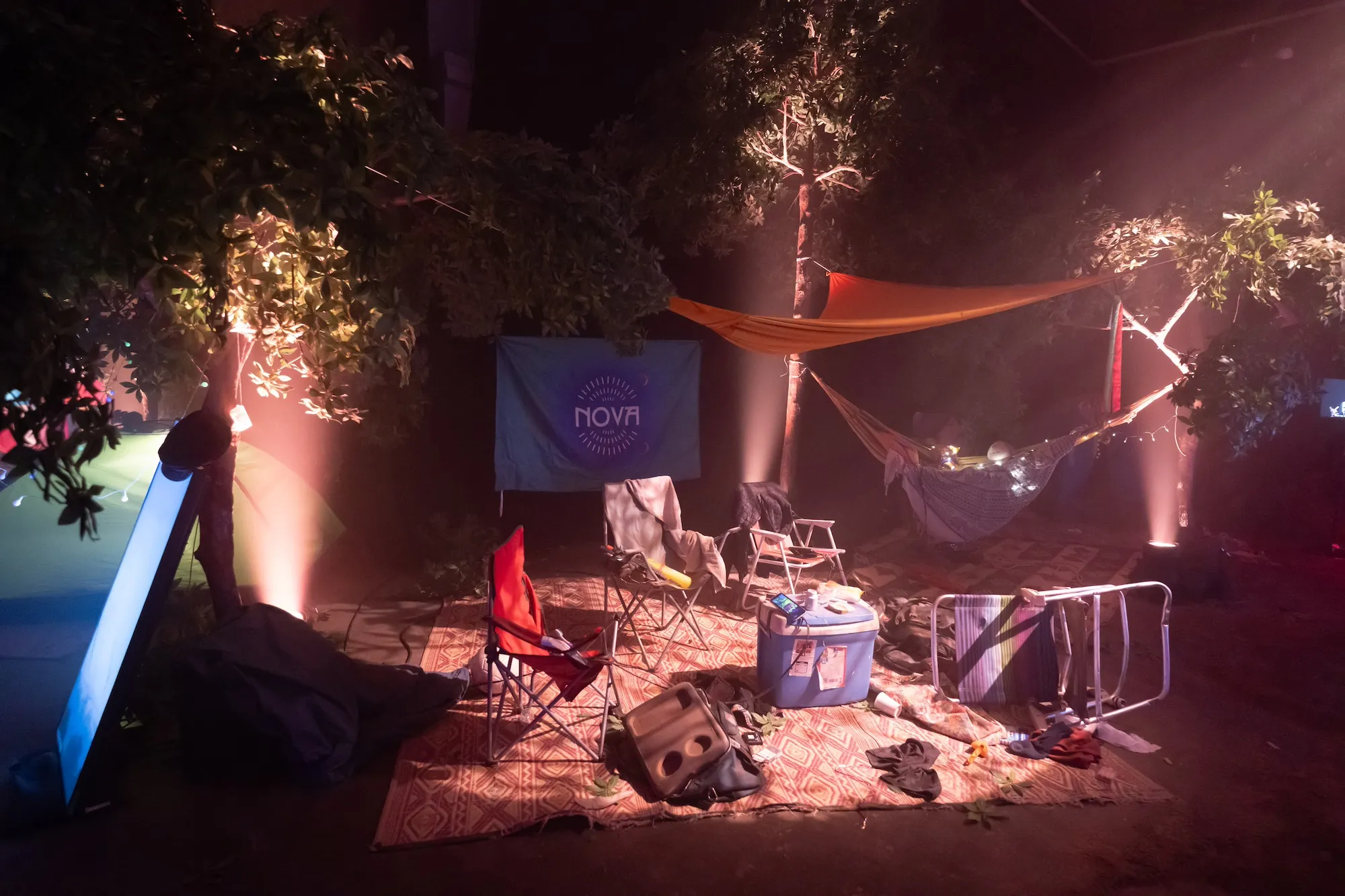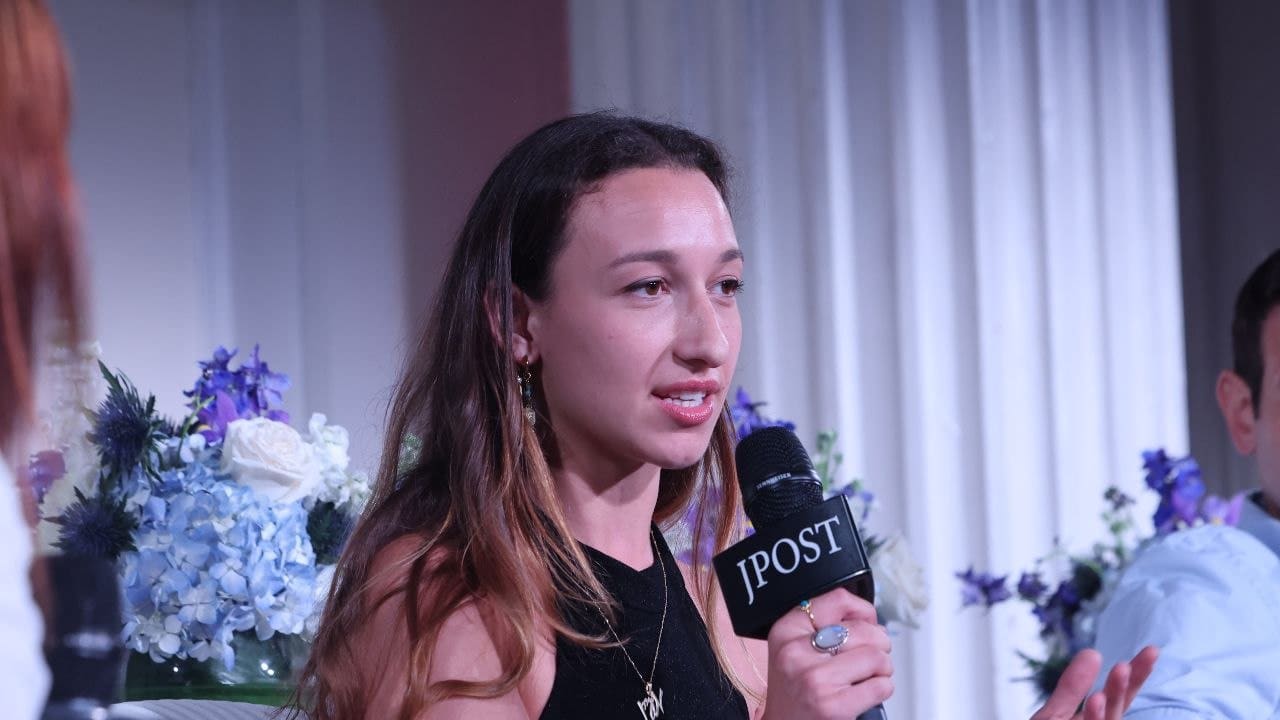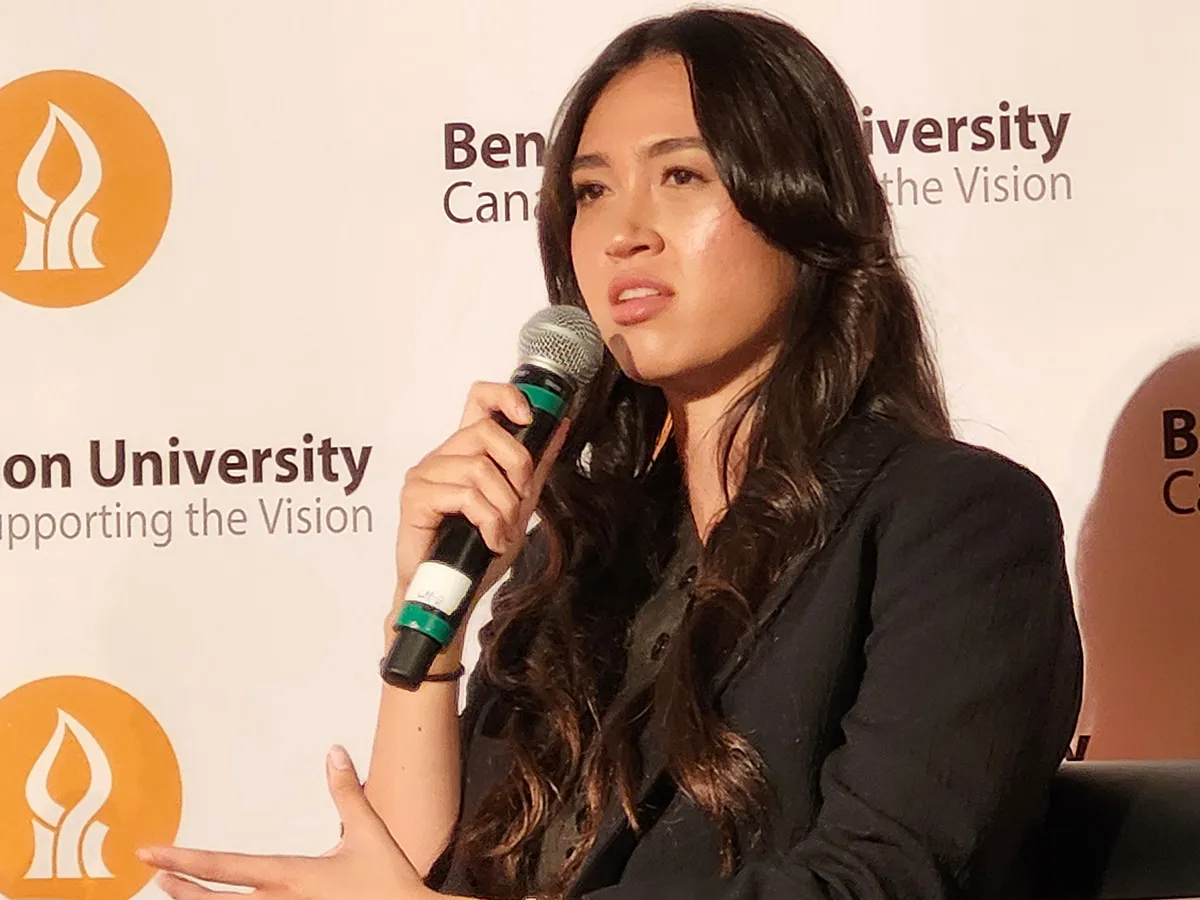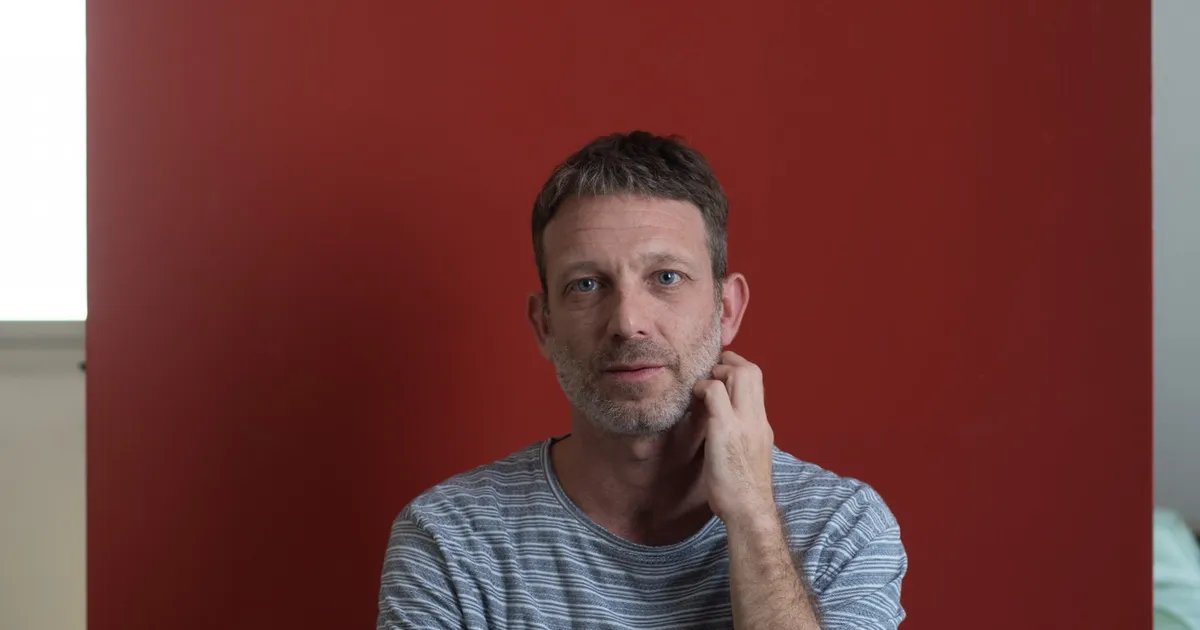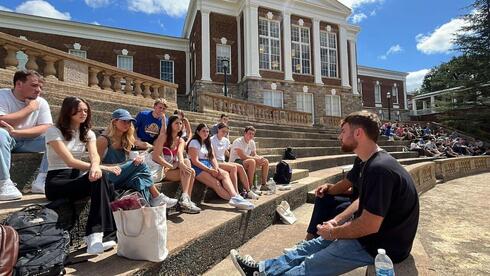
In her Tel Aviv apartment overlooking a construction site, on the third floor without an elevator, Sapir Golan returns to the massacre scene.Not a single feature of this young woman gives away what she saw that morning or the journey she has been on since. Her scars are hidden from view. But the words she speaks are sharp, fluent and painful, telling an almost unimaginable story.12 View gallery Sapir Golan, Nova survivor and volunteer at 'Israel-is' (Photo: Moti Kimchi)Over coffee and banana cake she baked, she describes the eight hours that felt to her like eternity, breaking them down into heart-stopping moments, images, sounds, smells and sensations that she will carry for the rest of her life alongside the title “Nova survivor.”One of those moments came when she fled for her life with dozens of other young people as thick smoke rose behind them from an ambulance that had turned into a death trap for 18 festival participants. She was there with Shahar (pseudonym), her commander in the artillery corps who became her closest friend.“We heard the ambulance explode and understood the situation was messed up,” Sapir recalls. “After things got a bit quiet, we started running. Suddenly one of the girls running with us, someone I didn’t know, decided to stop. I turned to her and said, ‘Why are you stopping?’ She said, ‘Look at me, I’m not an athlete. I can’t run.’ I said, ‘Who cares? Run! Our lives depend on it.’ She said, ‘I have no air, I’m done.’ I picked up a bottle of water and said, ‘Drink.’ The moment I handed her the bottle, she was shot in the head and died right in my hands.”“I laid her on the ground and I understood what was happening but I couldn’t move. And Shahar was shouting at me, ‘Sapir, run!’ We kept running until we reached a tank (the tank of the Shay Levinson unit, may his memory be a blessing). When we were hiding there I told Shahar, ‘Damn, I left her the water bottle. She died, what is she going to do with it? We need water.’”You were half a meter away. The bullet could just as easily have hit you. Do you think about that?“Of course. It’s the most insane thing. But once we got to the tank, I understood I was going home alive. Two days later that girl started appearing in my nightmares. I called Shahar and asked her to tell me if it really happened or if it was just in my dreams. And she said, ‘Yes, of course it happened.’”Sapir Golan hiding from the terrorists who invaded Nova on October 7thTo this day she does not know the identity of the young woman killed in front of her and she has not tried to find out. “I’m not sure her parents would want to hear this,” Sapir says.Sapir, 26, grew up in Ramat Gan and is the eldest of three siblings. She has never been interviewed by the media, but has shared what she went through on October 7 in dozens of lectures and meetings with American audiences through the organization “Israel-is”, ranging from warm and supportive Jews and Christians to students filled with hostility and ignorance.During a 21-day speaking tour across the United States in September 2024 with her younger sister Shir, who was also at Nova and lost six close friends, and another mission about two months later, she encountered both types of audiences.“At the University of Michigan we met two guys handing out flyers against Israel,” she recalls. “I said, let’s take one and see what they want. And you read it and you’re shocked.”She shows the flyer, which features a Palestinian flag. “Muslims, Christians, Jews and atheists must unite for the liberation of Palestine, which is a moral imperative,” it read. “We will not rest until the killing of Palestinian children stops.”12 View gallery Sapir's sister, also a Nova survivor, with pro-Palestinian protestersSapir says, “We told them, ‘You know we are from Israel?’ One of them freaked out and started screaming that we are child killers and committing genocide against Palestinians. But his friend was actually willing to listen to our story. We told him what happened to us on October 7, showed him photos and videos from Nova, and he was somewhat shocked. But it wasn’t enough for him and he said, ‘I need to look into this again.’”“In the meantime his friend kept shouting that we kill children. I was at my limit and started shouting back until Aviv Koren, who accompanied my sister and me on behalf of ‘Israel-is,’ stopped me and said: ‘Sapir, don’t go down to their level. If you want to get the message across, this is not the way. You need to create empathy, otherwise you become what they claim we are.’”In another case, after an event at a campus, she was told, “You can’t leave now because there is a protest against Israel at the entrance and they will throw eggs at you.” I said, “Eggs? Just let me go back to the hotel, I’m exhausted.”12 View gallery Flyers distributed by anti-Israel protestersA very different experience came at a Jewish National Fund women’s conference in Arizona, also through “Israel-is.” “The audience listened to me for 45 minutes, and when I finished speaking 450 people stood up and applauded,” Sapir recalls. “I was in shock.”Afterward, one woman approached her and said she lights a candle every day for Omer Shem Tov and would appreciate it if Sapir could pass that message to his mother. At the time he was still held hostage in Gaza. She managed to reach his sister and pass on the message.“Another woman told me that after hearing me, she and her husband would stop donating to general causes and would only donate to Jewish and Israeli organizations.”In both cases, the woman who opened her heart and wallet and the pro-Palestinian student who agreed to listen, it was a success.Sapir Golan during the outreach in the United States“People connect first to people and only afterward to ideas,” says Yotam Ivry, CEO of “Israel-is.” “You first have to open the heart and only then can you change an opinion. And that is not simple. When you are attacked and accused of war crimes, the last thing you want is dialogue. But through personal stories and lived experience, you can create change.”Ivry emphasizes that “Israel-is” is not a traditional hasbara (public diplomacy of Israel) organization. “Our goal is not to explain or preach morality, but to show all the good things Israelis have to offer the world. At the end of the day there is a people here that has chosen life and creation and is dealing with enormous threats.”To achieve this, the organization built what Ivry calls “an army of young people with the tools to do it.” “We say: Israel’s greatest strength is its people, so let’s train every Israeli traveling abroad to be an ambassador for us.”12 View gallery Yotam Ivry, CEO of the 'Israel-is' organization, which engages in outreach abroad (Photo: Ryan Preuss)“To date, about 110,000 Israelis have gone through our training, from a one-day session before a big trip, to a month-long program for students going abroad to study, to a five-month course for social media influencers. The next stage is training tech professionals who travel frequently.”One of “Israel-is” key target audiences is Generation Z in the United States. “We have a team in the U.S. and we bring delegations with the most diverse and inspiring Israeli stories to campuses,” he explains. Sapir and her sister participated in two such delegations.“In the past two years we have met more than 40,000 American students on campuses,” Ivry says. The organization equips its delegates with VR headsets that show immersive reality experiences, including the story of Nova survivor Mazal Tazazo, who also participates in delegations.“There is something called event tabling, it is very popular in U.S. campuses,” Ivry says. “You set up a table without an Israeli flag or the Israel-is logo and invite people to a VR experience. Almost no one stops watching halfway. Sometimes someone asks, ‘Why didn’t you say you are from Israel?’ We answer, ‘Does it matter?’ And they keep watching to the end.”12 View gallery 'Israel-is'' outreach activities on campuses in the US (Photo: Courtesy of the 'Israel-is')“I don’t expect to change someone completely in a 20-minute encounter. But if I get them to ask questions, if I expose them to good people who do not fit the lies they heard about Israel, if after the meeting they say to themselves, ‘Maybe what I was told is not entirely true,’ and go and check the facts, that is a success.”One of Israel-is guiding principles is to expose audiences abroad to the full diversity of Israeli society. “When they meet someone like Mazal, an Ethiopian Israeli, or a Bedouin police officer who saved dozens at Nova, or a Druze family from the Golan whose daughter was killed in Majdal Shams, they understand that the claim of an ‘apartheid state’ is far from reality,” Ivry says.Ivry’s own family story is closely tied to Jewish and Israeli history. His great-grandfather, Benjamin Ivry, immigrated from Poland during the Second Aliyah and headed the political department of the Haganah intelligence service, the predecessor of Israeli intelligence agencies.After the state was founded, that department was absorbed into what became the Mossad, and he continued serving for years as an emissary in Europe. Ivry was eight when his great-grandfather died and still heard stories from him about his global work.12 View gallery Yotam Ivry's grandfather, Tzur Ivry, in Tehran (Photo: Dina Frankel)His paternal grandfather, Tzur Ivry, was born in Israel and married Yehudit, a Holocaust survivor from Poland. His maternal grandmother Gila is also a Holocaust survivor, and his grandfather Sami grew up in Egypt and was loosely connected to the Lavon Affair spy case.“They took teenagers from the Maccabi youth movement in Cairo, including my grandfather Sami, and asked them to pass notes with intelligence. He was 15 and probably not important enough, so when the network was exposed and its members executed, they did not reach him.”Tzur, a water engineer, later served as an adviser to the Shah of Iran on agriculture in the late 1970s. Ivry’s father, Moti, lived in Tehran as a teenager and was a competitive fencer who represented Iran internationally and was expected to compete in the 1980 Moscow Olympics.The Islamic Revolution changed those plans.12 View gallery Tzur Ivry, grandfather of Yotam Ivry, in Tehran with his two daughters (Photo: Dina Frankel)“My father, my grandmother Yehudit and her two sisters were on vacation in Israel when the revolution happened,” Ivry says. “My grandfather was on the last El Al flight out of Tehran on December 8, 1978, along with animals that were being smuggled to Israel.”His father later died of a heart attack during a hike in Bulgaria at age 54, when Ivry was with him in his final moments.Ivry also served in the IDF, initially accepted into pilot training before transferring to naval officers’ course. He later served as a naval officer and visited Germany during his service.12 View gallery Yotam Ivry with his father, Moti (Photo: Family album)“What did it feel like to stand on German soil as an Israeli officer and grandson of Holocaust survivors?”“Both of my grandmothers are Holocaust survivors. From one I heard many stories. She told me how, as a child, she was taken to execution pits and saw Nazis shooting hundreds of people. At one point the Germans stopped for lunch and the Jews waiting to die stood there, hoping the killing would resume after the break.”“Her mother grabbed her hand and they escaped into the forest, barefoot in the snow in Poland, until they were caught by a German soldier. My great-grandmother begged for their lives and, for some reason, he let them go. Just before they left, she asked his name and said, ‘One day, if there is a better world, I want to thank you.’”“My grandmother never forgot the face of that soldier laughing and saying, ‘Do you really think after Hitler there will be a single Jew left in the world?’ He pointed at her and said, ‘Do you think that dirty little Jewish girl will be alive in a year?’ And she believed him. In her wildest dreams she could not imagine she would one day live in a Jewish state with a strong army, with children and grandchildren who would become officers and soldiers. That was her victory.”12 View gallery Yotam Ivry with his grandmother, a Holocaust survivor, Yehudit Ivry (Photo: Family album)“So when you ask me what it was like to return to Germany as an Israeli officer and sing ‘Hatikvah’ on German soil, it was a great privilege,” Ivry says, tearfully. “In those moments you understand that the State of Israel is the greatest achievement of the Jewish people. In a 2,000-year perspective, it is an incredible miracle.”His grandmother Yehudit passed away about three years ago.And while she could not have imagined a Jewish state, she also could not have imagined that in that same state, young Israelis like Sapir Golan would one day find themselves fleeing through forests from Nukhba terrorists.12 View gallery Israel-is activities on campuses in the US (Photo: Courtesy of the 'Israel-is')Sapir never imagined it either. In fact, she was not supposed to be there.Shahar, who had been her commander in the artillery corps and became like an older sister, repeatedly insisted she join her at a desert rave. They had planned to go to one event but Sapir could not make it due to work. The next event was Nova.At 2 a.m. they arrived and Sapir saw the sign for Re’im. “We had served there for about a month,” she says. “I did not remember it as dangerous.”At 6:29 a.m., everything changed.They saw flashes in the sky. “One of the guys said, ‘Wow, looks like fireworks.’ Then a girl said, ‘It is rocket fire, we need to get out of here.’”Explosions began. Sapir lay on the ground covering her head. Her sister Shir, who arrived separately, saw her and panicked. “I told her, ‘Don’t worry about me, the party is over, take the other girls and go home.’ And that is what they did. They got stuck in traffic. Twelve girls went to Nova, only six came back alive.”Later she saw her sister again at the police station in Ofakim after hours of terror.Sapir’s survival story continued through running, hiding and repeated gunfire. At one point she hid with Shahar in a production caravan near the ambulance that had been hit by an rocket-propelled grenade and set on fire.12 View gallery Sapir, hiding from the terrorists in Nova (Photo: Sapir Golan)About 60 festival-goers eventually took shelter around a tank. Sapir and Shahar were among them. Hours later, a police vehicle arrived to evacuate them.“I looked out and saw the road full of bodies,” she recalls. “People who tried to escape and did not make it, people lying in pools of blood, burned cars. For a moment I felt like I was inside my brother’s GTA game. My body went into shock. I stopped breathing.”She was treated on site and evacuated to a gas station at the Ofakim junction that had become a makeshift medical center, then to the police station where she reunited with her sister. Only days later did she learn that her friends Daniel and Yarden had been murdered.Since then, life has not returned to normal. “Before October 7 I worked as an event manager, weddings, bar mitzvahs, corporate events of up to 300 people. It was my dream job. I made a lot of money. After October 7 I tried to go back, but you cannot manage a wedding with hundreds of guests if you might have a panic attack in the middle.”She tried social media management, yoga therapy training, youth work with the Scouts and eventually returned again to social media work.Sapir is recognized by Israel’s National Insurance Institute as a victim of terror attacks suffering from post-traumatic stress disorder. She now lives with her partner near Tel Aviv’s Rabin Square.12 View gallery Sapir Golan, Nova survivor (Photo: Moti Kimchi)Her involvement with “Israel-is” began almost by chance after her trip to India was canceled due to the Iranian missile attack in April 2024. Her sister told her about the organization and a planned delegation to the United States.“I said, let’s go for fun,” she recalls. “I did not know what we were about to experience. I was at a point where I had nothing to lose.”After two delegations to the U.S. and additional activities in Israel, Sapir is thinking about the future. “After October 7 I felt a strong urge to create, especially living things. I sprouted everything I could at home, green onions, potatoes, avocados. I had about 20 sprouting avocados in my apartment.”“And suddenly I felt a strong urge to build a family and have children. After seeing death so vividly, what is left other than to create life?”
Nova survivor on US campus tour: 'I told my Nova story - a student screamed ‘you are child killers’'
Through Israel-is, Nova survivor Sapir Golan shares her Oct. 7 testimony on US campuses, where the organization trains Israelis to engage students abroad using personal stories, VR tools and delegation programs amid both support and hostility
2,845 words~13 min read