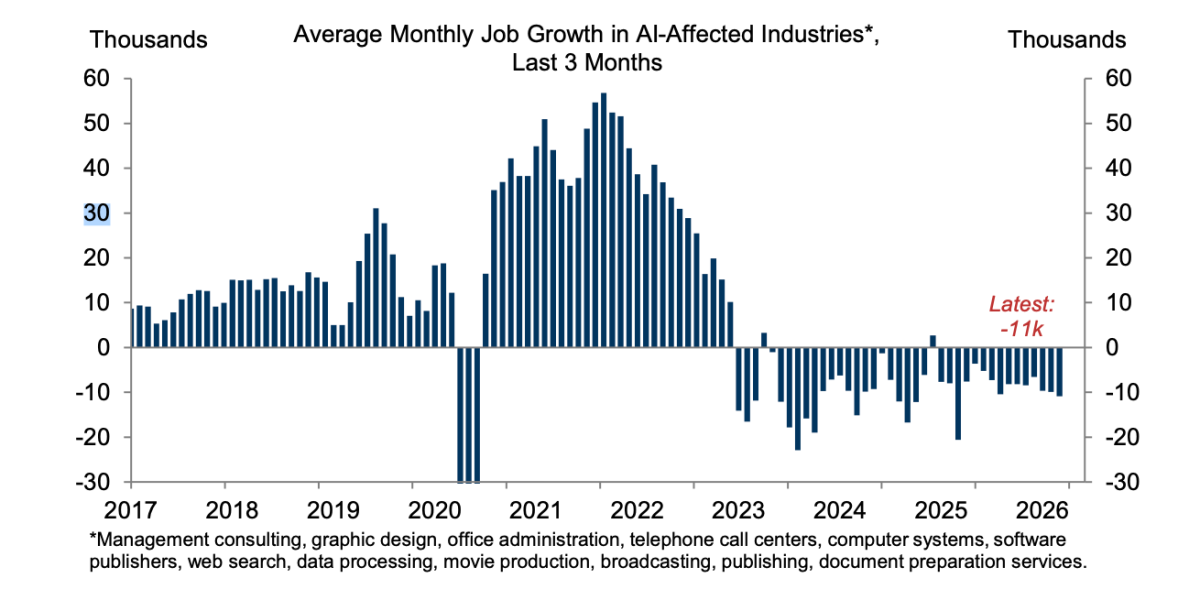
Especially alarming to many has been AI’s effect on entry-level jobs. A blockbuster Stanford study in August was especially rattling, as it claimed to find a “significant and disproportionate impact” on entry-level jobs most exposed to AI automation—like software development and customer service—which have seen steep relative declines in employment. This came out close to the MIT study that said 95% of generative AI pilots were failing and the somewhat sudden realization that AI could be building toward a bubble. Even Federal Reserve Chair Jerome Powell sees something going on, commenting that “kids coming out of college and younger people, minorities, are having a hard time finding jobs.”But according to a new study from Yale and Brookings researchers, these instances are “lightning strikes,” as opposed to “house fires.” The U.S. labor market just isn’t showing any signs of broad, AI-driven disruption, at least not yet.
Martha Gimbel, a Yale economist and the paper’s lead author, hopes that understanding this data helps people relax. “Take a step back. Take a deep breath,” Gimbel told Fortune. “Try to respond to AI with data, not emotion.”
No apocalypse yet
The new study examined multiple measures of labor market disruption, drawing on Bureau of Labor Statistics data on job losses, spells of unemployment, and shifts in broader occupational composition. The conclusion: There’s movement, but nothing out of the ordinary.