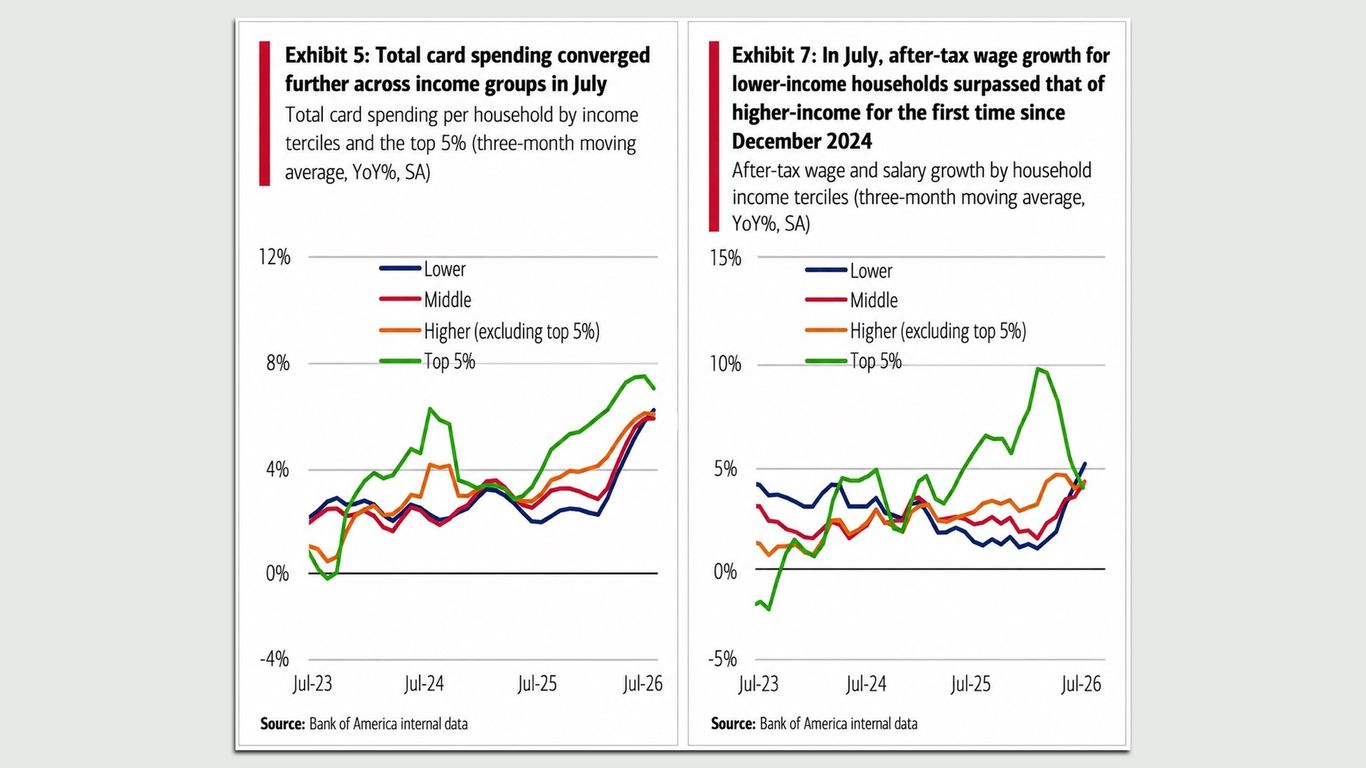
If you’re struggling to find a job, get a promotion, or shop the way you used to, you’re not an anomaly. In fact, you’re on one side of a “bifurcated” economy where wealthier, older people are fairing markedly better than their younger counterparts.
That’s according to Oxford Economics, who wrote that overall the outlook for consumers is “optimistic” but that the divide between those thriving and those surviving is deepening—and is expected to diverge even further.
“Consumer bifurcation took hold with the post-pandemic inflation surge, disproportionately impacting discretionary spending for low-income and younger households,” Michael Pearce, deputy chief U.S. economist wrote in a note seen by Fortune. Pearce adds that while tariffs present a smaller shock across the board, they nonetheless will have the largest impact on low-income households.
Using data from Haver Analytics and the Congressional Budget Office (CBO), Oxford Economics found that tariffs and changes to the fiscal landscape will have a negative net impact on real income for the lowest 0% to 20% of earners, of approximately 2.5% over the next 10 years.
Conversely, the packages outlined by the Trump administration increasingly benefit those higher up the income ladder. Those in the 40% to 60% income segment will see a negative impact on their spending power (a little over -0.5%) while fiscal packages will boost them approximately 1%. Meanwhile in the top percentile—80% to 100%—fiscal packages will boost real post-tax incomes by more than 2% while being offset by a modest 0.5% drop due to tariffs.