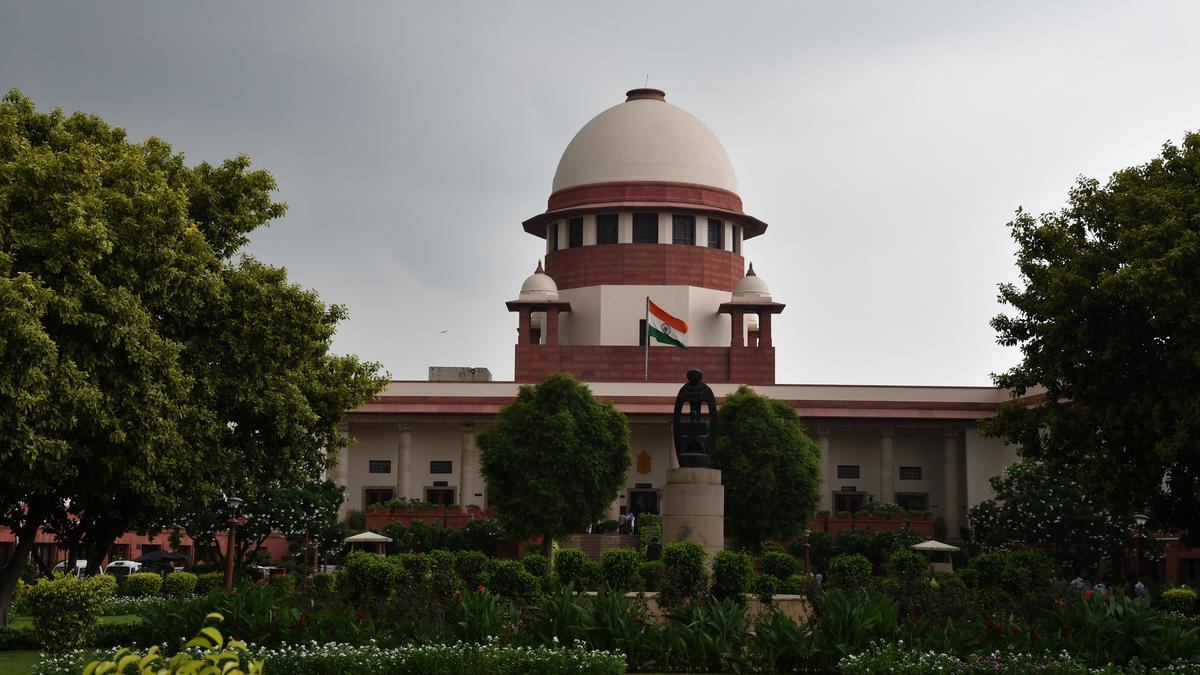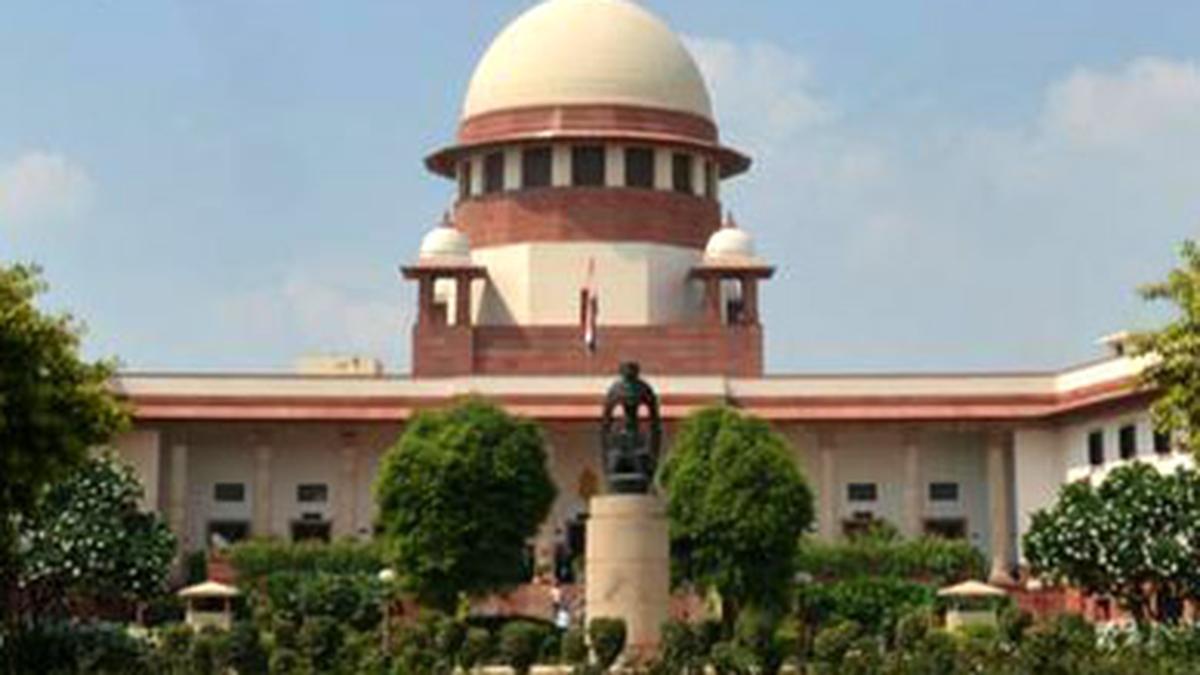
A view of the Supreme Court of India in New Delhi. File
| Photo Credit: R.V. Moorthy
The Supreme Court on Wednesday (September 24, 2025) agreed to hear urgently a challenge to an Allahabad High Court order staying Ramlila celebrations at a school ground in Uttar Pradesh, bringing sharply into focus the question of whether “secular” school playgrounds can host religious or ceremonial activities.A three-Judge Bench headed by Justice Surya Kant listed the case for September 25 after a lawyer made an oral mentioning against the ex parte stay order passed by the High Court.The High Court, according to the counsel, appearing for the petitioner, who is the coordinator of the Shree Nagar Ram Lila Mahotsav, had concluded in a September 22 order that the Ramlila festivities would “interfere” with school activities. The stay was based on a public interest petition, and affected the ongoing preparations for the festivities.The High Court order recorded that a “huge stage” had been constructed on the school ground and interlocking tiles put in. The order records an instance when the High Court Bench asked the State authorities “whether any sports activities can take place now at the playground”, and the answer obviously was “no”. The court had found the diversion of the school ground to a festival spot “ex-facie illegal”.On the other hand, the counsel for the event’s organisers submitted in the Supreme Court that the High Court’s freeze order had been passed without even affording the Ramlila organisers an opportunity for a hearing.The hearing comes nearly seven years after a Division Bench of the Supreme Court headed by Justice Rohinton F. Nariman (now retired), in July 2018, referred a similar question of law to a Constitution Bench for an authoritative pronouncement in Jyoti Jagran Mandal versus NDMC. This was regarding an appeal against a National Green Tribunal (NGT) order refusing permission to conduct a religious event, Mata-ki-Chowki, in a public park in the national capital. The appellant had argued that policy allowed Ramlila and Durga Puja to be held in public parks.The Bench had found that the appeal raised a question of “great Constitutional importance as to whether such activities can be allowed in State-owned premises in view of our Constitution being secular in nature”. The issue requires a balance to be struck between the right to education of children, a fundamental right established under Article 21A of the Constitution, and the freedom to observe religious practices under Article 25.The Supreme Court has in the past reminded State authorities that right to education is also part of the Directive Principles of State Policy and “compulsory and primary education is treated as a part of Article 21 [right to life] of the Constitution, which has consequently led to the enactment of the Right of Children to Free and Compulsory Education Act, 2010”.Various High Courts have dealt with the question whether available spaces, including playgrounds and public spaces like parks, could be used for religious events or not.A 2023 decision of the Calcutta High Court had concluded that a school playground, even of a government institution, could by “no stretch of imagination” be used to hold festivals.In Sudarsan Mandal versus The State Of West Bengal, the High Court had held that a school premises cannot be designated as a “public ground” for the purpose of holding festivals.“Even if a school playground belongs to a government-aided school, the same ipso facto does not convert the playground of the school, which is an educational institution, to a public, free-for-all area where any and everybody can seek to organise any festival whatsoever,” the Calcutta High Court had observed.The Allahabad High Court itself had, in Bajrangpuri Ram Leela Committee vs State Of Uttar Pradesh of 2019, frowned upon the use of “public spaces”, including parks and playgrounds, for performing religious activities.“No person or group or class of persons having faith in any religion or religious denomination, whether belong to majority community or minority community, can claim a right to block public place so as to prevent its utilisation to public at large, even for a shorter period, as it amounts to temporary encroachment which is illegal and cannot be permitted to any community, whether belongs to majority community or minority community. It is the responsibility of the competent authority to ensure that no such activity is undertaken and public places are maintained unobstructed, un-encroached, unoccupied and free from such activities, which restricts common persons from exercising his/her general right of use of public places, without any hindrance,” the Allahabad High Court had ordered. Published - September 24, 2025 03:05 pm IST