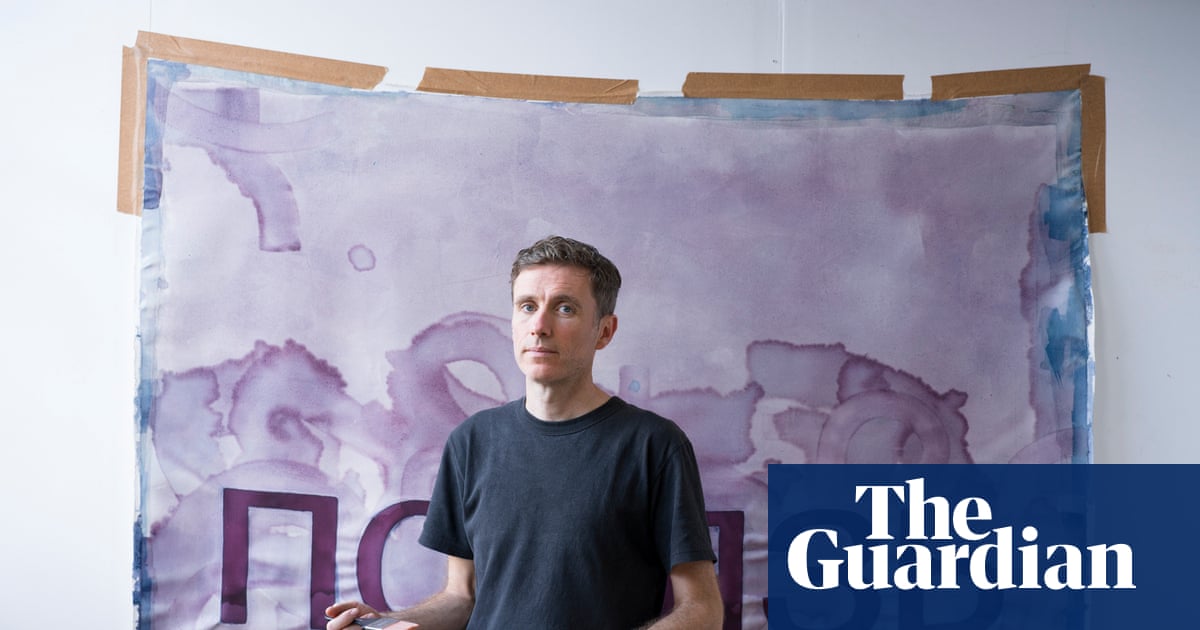
Every two weeks, a language is lost – and by the end of the century, half of the world’s 7,000 tongues could have vanished. We meet the artist using eyeliner and chokeberries to rescue everything from Ogham to Arablish
I
n his studio, Sam Winston appears less artist, more linguistic alchemist. He is experimenting with manufacturing inks out of tobacco from Marlboro cigarettes, the juice of Belarusian chokeberries imported in a 100g packet small enough to make it past customs and a strange brew of kohl eyeliner from the Middle East and galena – the mineral form of lead sulfide – from Wales.
The coloured substances are used to conjure words on to giant canvas flags that will soon hang from the ceiling of London’s Barbican Centre – connecting a group of poets’ native languages with materials from their native landscapes. The quintet speak marginal or at-risk languages covering five continents, and their newly commissioned poems all speak to their sense of home.
The kohl concoction will spell out شلونچ؟ or “How are you?” in Arablish, a melding of Arabic and English, taken from a poem by Hanan Issa, the half-Iraqi National Poet of Wales. Quebec-born writer Norma Dunning’s flag will bear the word ᑕᖃ, or “veins” in Canadian syllabics, made out of wild blueberries foraged from her home terrain. The piece, Seed Syllable, will welcome visitors to Voiced, Britain’s first arts festival celebrating minority and endangered languages, or what the Barbican calls an “explosion of creative multilingualism”. In February, the extravaganza will travel on to Manchester, one of the world’s 53 Unesco Cities of Literature “dedicated to promoting cultural diversity and literary richness”.