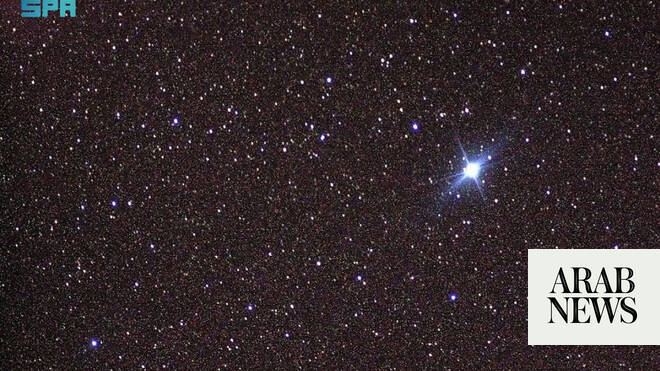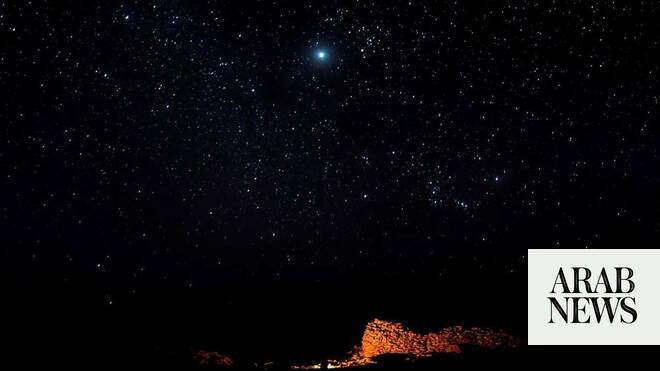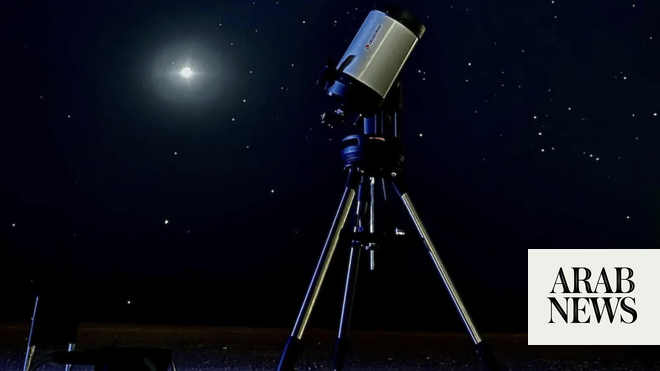
RAFHA: The heavens sparkle with countless stars every night, but none commands the attention quite like Sirius, also known as the Dog Star.
This celestial giant has puzzled astronomers and inspired civilizations around the world for millennia, its brilliance outshone only by the sun.
Berjis Al-Fulaih, an Afaq Society for Astronomy member, said: “Sirius operates as a binary star system, featuring a colossal primary star paired with a smaller stellar companion in orbital dance. Positioned just eight light-years from Earth, it stands among our closest stellar neighbors. Yet despite this vast cosmic distance, Sirius boasts nearly double the sun’s mass and burns at extraordinarily high surface temperatures, generating its characteristic dazzling radiance.”
Throughout history, this stellar powerhouse has accumulated over 50 distinct names across cultures. Western astronomy adopted “Sirius” — meaning scorching or glowing — from ancient Greek, while Arab astronomers dubbed it “Al-Shi’ra Al-Yamaniya.” Its significance extends into religious texts; the Qur’an references it in Surat An-Najm: “And that it is He who is the Lord of Sirius.”
As the dominant star in the Canis Major constellation, Sirius earned the moniker Dog Star. Observers sometimes call it the Rainbow Star due to the way atmospheric refraction creates spectacular multicolored flashing — a natural light show that occasionally triggers UFO reports from witnesses.