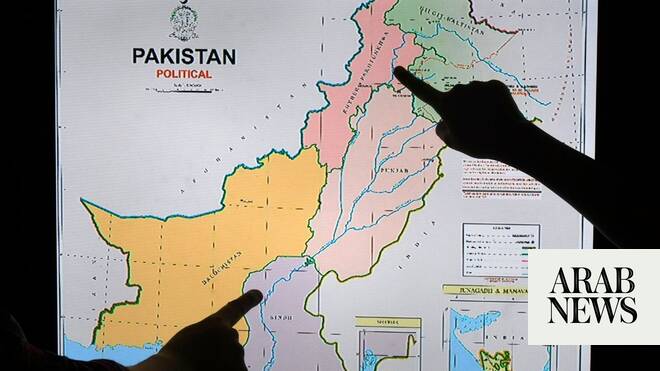
ISLAMABAD: A fresh debate has broken out in Pakistan over whether the country should be carved into more provinces, after a widely-quoted report by a new think tank suggested restructuring the federation into as many as 12 to 38 units to improve governance and reduce inequality.
The idea, long raised in Pakistani political circles, gained traction this week when the Economic Policy and Business Development think tank, set up by former caretaker prime minister Anwar-ul-Haq Kakar and ex-federal minister Gohar Ijaz, proposed multiple models for redrawing the map in a report released over the weekend. Pakistani media and politicians have since widely speculated on the plan, which would mark the most sweeping change in Pakistan’s administrative structure since independence.
Currently, Pakistan’s population of more than 240 million is divided into just four provinces — Punjab, Sindh, Khyber Pakhtunkhwa and Balochistan — each serving on average over 60 million people. The think tank argued this was one of the highest ratios globally and had contributed to sharp disparities in poverty, education and access to services.
The institute’s report outlined scenarios for 12 provinces with about 20 million people each, or up to 38 provinces with around 6.3 million people per unit. It cited poverty rates of 30 percent in Punjab, 45 percent in Sindh, 48 percent in Khyber Pakhtunkhwa and 70 percent in Balochistan despite large budget allocations. Smaller provinces, the report said, could use resources more efficiently, raise new revenues through tax reforms and reduce deprivation.