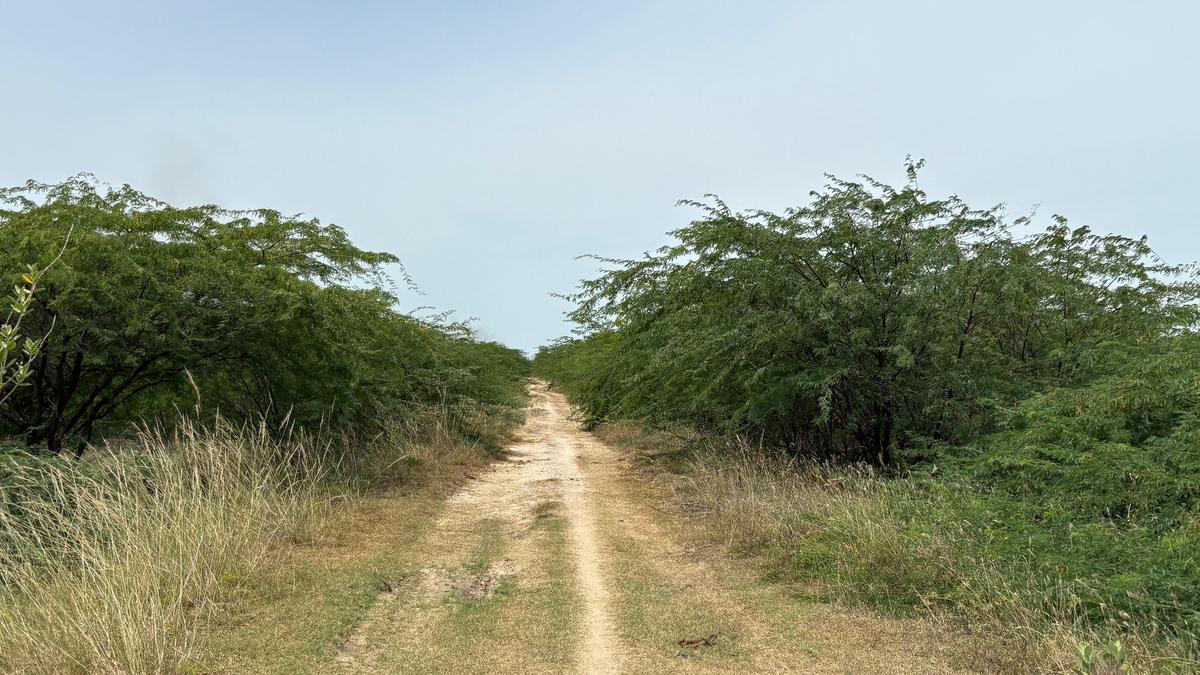
The 46.5-hectare land identified for the textile park is overrun by Seemai Karuvelam trees at Ayakkaranpulam village in Vedaranyam.
| Photo Credit: Special Arrangement
Five years after it was announced, the proposed Veda Textile Park at Ayakkaranpulam in Vedaranyam block remains a non-starter.The 46.5-hectare site—now under the State Handlooms and Textiles Department—lies unattended and overrun by Seemai karuvelam (Prosopis juliflora). Industry representatives and local leaders have renewed calls for a clear timeline and basic infrastructure to put the project back on track.Announced in December 2020, the park was conceived under the Scheme for Integrated Textile Parks (SITP) with a project outlay of ₹98.86 crore for 36 units (34 readymade garment and two knitwear). Subsidies of ₹37.8 crore from the Union government and ₹23.62 crore from the State were envisaged, alongside a Tamil Nadu Skill Development Corporation plan to train 20,000 workers in stitching and allied garment skills.While the designated land has been transferred to the department, on-ground progress has been minimal. After the announcement, in the past three years four garment companies are currently operating outside the park area—in Vaimedu, Kathiripulam, and Vedaranyam town—together employing about 700 women.Framing the sectoral context, M. P. Muthurathinam, President of Tiruppur Export and Manufacture Association(TEMA) said Tamil Nadu remains India’s leading textile State, with the Kongu belt producing the entire spectrum of textiles. “For the past decade, the cluster has grappled with a chronic labour shortage in some segments. Even with competitive wages, enrolment in higher education and a shift to IT jobs have tightened supply, pushing units to depend on migrant labour,” he noted.“Creating satellite garmenting hubs in economically weaker or drought-prone districts like Vedaranyam will retain business within Tamil Nadu,” Mr. Muthurathinam argued. Garment manufacturing, he added, is skill-intensive rather than qualification oriented, and women can be trained quickly for production roles. “If alternatives are not built in-State, capacity will drift to other States.” he added.Mr.Muthurathinam also point to a policy shift as a drag on momentum. The Vedaranyam park was envisioned under SITP, where the Centre met 40% of common infrastructure costs and the State about 23%, with the balance from private investors. The Union government, they say, discontinued SITP in 2021 and moved to PM MITRA “mega parks”, which MSME-led garmenters contend are better suited to very large integrated projects.Former Handlooms and Textiles Minister and current Vedaranyam MLA O. S. Manian speaking to the Hindu said the textile park was his initiative. “Back then we could not secure the Centre’s final approval. Even now, AIADMK leader Edappadi K. Palaniswami has written to the Union government seeking subsidy support and sanction. In 2020 alone, we received more than 30,000 applications for prospective employment, showing the scale of local demand. Vedaranyam has abundant human resources, especially women, many of whom are in debt and in need of stable livelihoods. This project could provide them with a pathway,” he said.Mr. Manian added that it was through his efforts that four textile units began operations in the region, employing several hundred women. “More companies are willing to invest here, but the absence of proper site infrastructure—roads, utilities, and common facilities—has held them back.” he said.He stressed that the government should publish a time-bound action plan with clear milestones for land clearance, boundary demarcation, internal roads, water and power supply, construction of factory shells, worker amenities, and training facilitiesOfficial sources said that proposals are being re-examined in light of current central schemes and that the district administration would coordinate on site readiness once approvals and funding contours are finalised. Published - August 19, 2025 09:28 pm IST