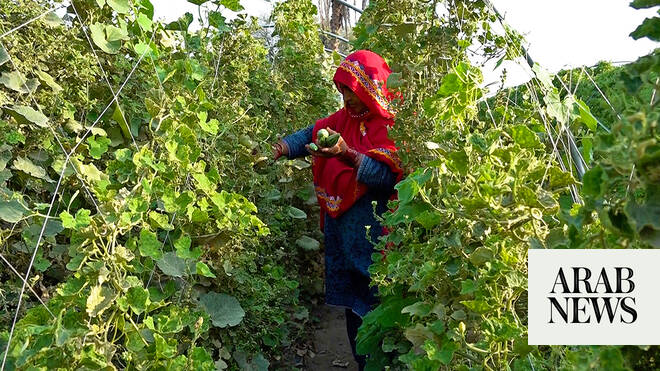
KHAIRPUR: Sukhai intently moved about the tunnel farm, plucking out bitter gourds under the harsh, relentless sun. The vegetable is grown usually during the summer months but in the fields of Sindh’s Thari Mirwah village, that isn’t necessarily so.
Sukhai, a 23-year-old intermediate student, is one of several women in her village in district Khairpur battling the effects of climate change through tunnel farming. The agricultural technique extends the growing season of crops by using plastic-covered, greenhouse-like structures to create a controlled environment. These tunnels protect crops from adverse weather conditions, allowing for earlier or later harvests of vegetables.
At Thari Mirwah, these tunnels are formed by fixing rods into the ground in an arch shape, forming a row of hoops. During the winter months, these rods are covered with polythene sheets to protect the crops from rain and cold weather, extending their growing season.
“In these tunnels, we grow off-season and seasonal vegetables,” Sukhai, who only uses her first name, told Arab News. “We now have cultivated bitter gourd, sponge gourd and cucumber,” she said, carrying the vegetable in a basket.
Pakistan is consistently ranked among the world’s worst-affected countries due to climate change. Irregular weather patterns, which include excessive rains and droughts, have hit the country’s agriculture sector. For example, cotton has been the worst-hit crop, with its produce decreasing to five million bales a year this financial year from a record 15 million.