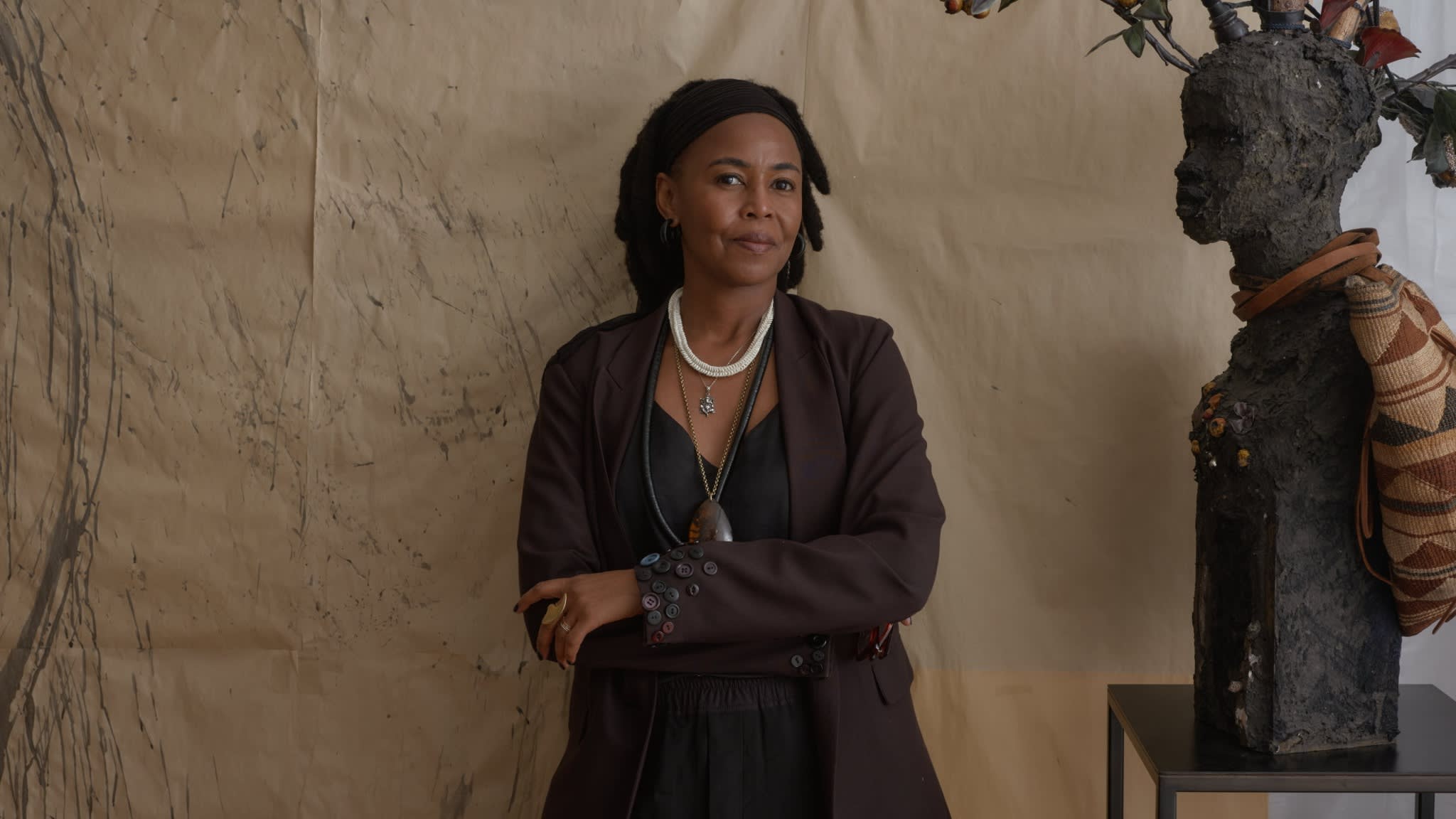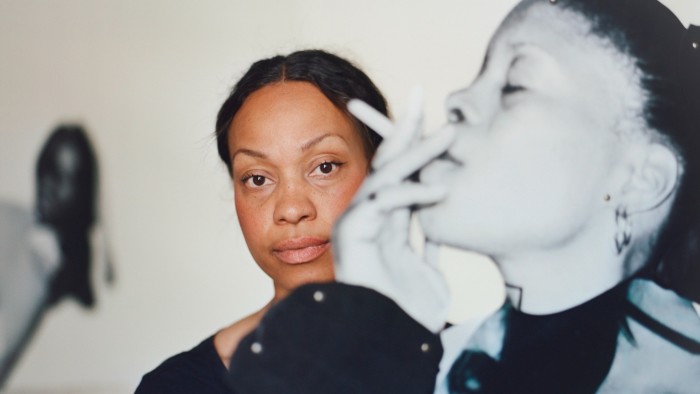
“As a white man you can feel like you’re boxed in,” says Frida Orupabo. “But not in the same way as women and certainly not Black women. It’s this understanding of who you are before you manage to open your mouth.” As she leads me through her Oslo apartment, the Norwegian artist makes things clear with a disarmingly warm smile. “Don’t write about me as a crazy maniac.”
Orupabo, whose enigmatic works reconsider racial stereotypes, has a white Norwegian mother and a Black Nigerian father, who returned to Nigeria when Frida was an infant. “Even though I’m a Norwegian-Nigerian artist, I was born and raised in Norway and Norway is the culture that I know.” Her art, however, asks whether that culture knows her.
Orupabo, 39, whose work will be presented at Art Basel by Galerie Nordenhake, has a distinctive visual language, created by layering and collaging images appropriated from colonial archives — often ambiguous shots of Black women — which are reworked into sometimes fanciful, often unnerving compositions.
Orupabo’s source material includes vintage pornography, Porky Pig cartoons, medical pictures and photographs of combs and black gloves
On Lies, Secrets and Silence, her largest institutional exhibition to date, was staged at the Bonniers Konsthall, Stockholm, and Astrup Fearnley Museet, Oslo, in 2024-25. It surveyed her gothic, whimsical interests: her source material includes vintage pornography, Porky Pig cartoons, medical pictures and photographs of combs and black gloves. Her “Big Girl II” (2024), a larger-than-life-size paper collage, constructs a Black woman out of several historical images: a jigsaw-puzzle of skin tones in one figure. The woman looks directly at the viewer. Like many of her collages, it is both engaging and unsettling.