Home
Storia in 1 fonti
NP View: Mark Carney's online surveillance state
Skip to Content Subscribe Our Offers My Account Manage My Subscriptions FAQ Newsletters Canada Canadian True Crime Canadian Politics Health World Israel & Middle East Financial Post NP Comment Longreads Puzzmo Diversions Comics NP News Quiz New York Times Crossword Horoscopes Life Eating & Drinking Style Sponsored Play for Ontario Travel Travel Canada Travel USA Travel International Cruises Travel Essentials Culture Books Celebrity Movies Music Theatre Television Business Essentials Advice Lives Told Tails Told Shopping Buy Canadian Home Living Outdoor Living Kitchen & Dining Tech Style & Beauty Personal Care Entertainment & Hobbies Gift Guide Travel Guide Amazon Prime Day Deals Savings National Post Store More Sports Hockey Baseball Basketball Football Soccer Golf Tennis Driving Vehicle Research Reviews News Gear Guide Obituaries Place an Obituary Place an In Memoriam Classifieds Place an Ad Celebrations Working Business Ads Archives Healthing Epaper Manage Print Subscription Profile Settings My Subscriptions Saved Articles My Offers Newsletters Customer Service FAQ Newsletters Canada World Financial Post NP Comment Longreads Puzzmo Diversions Life Shopping Epaper Manage Print Subscription HomeNP CommentNP View: Mark Carney's online surveillance stateLast updated 2 days ago You can save this article by registering for free here. Or sign-in if you have an account.Prime Minister Mark Carney participates in an event marking the Pride season and flag raising ceremony by the visitor entrance on Parliament Hill in Ottawa on Tuesday, June 9, 2026. Photo by HYUNGCHEOL PARK/PostmediaMark Carney is building a surveillance state online.Enjoy the latest local, national and international news.Exclusive articles by Conrad Black, Barbara Kay and others. Plus, special edition NP Platformed and First Reading newsletters and virtual events.Unlimited online access to National Post.National Post ePaper, an electronic replica of the print edition to view on any device, share and comment on.Daily puzzles including the New York Times Crossword.Support local journalism.Enjoy the latest local, national and international news.Exclusive articles by Conrad Black, Barbara Kay and others. Plus, special edition NP Platformed and First Reading newsletters and virtual events.Unlimited online access to National Post.National Post ePaper, an electronic replica of the print edition to view on any device, share and comment on.Daily puzzles including the New York Times Crossword.Support local journalism.Create an account or sign in to continue with your reading experience.Access articles from across Canada with one account.Share your thoughts and join the conversation in the comments.Enjoy additional articles per month.Get email updates from your favourite authors.Create an account or sign in to continue with your reading experience.Access articles from across Canada with one accountShare your thoughts and join the conversation in the commentsEnjoy additional articles per monthGet email updates from your favourite authorsSign In or Create an AccountorWhat else can you call a government that’s working to outlaw online anonymity? That plans to ID internet users as if going online is the same as entering a bar? That plans to create the equivalent of a human rights tribunal for offensive speech online?These are just some of the consequences that will come from Bill C-22, which could effectively ban VPNs, and Bill C-34, the proposed internet censorship scheme. While they’re not law yet, there’s little standing in their way now that the Liberals have a majority. Indeed, despite the chorus of objections that have been raised to Bill C-22 by the tech sector and by Canadian civil society, the Liberals fast-tracked it and passed it in the House of Commons on Thursday.The initial draft of Bill C-22 permitted the government to build a back door into the personal data of every Canadian — thereby breaking encryption and effectively banning the use of VPNs, which mask a user’s internet provider address. It also forced every online service provider to hold on to that data for one year.This newsletter from NP Comment tackles the topics you care about. (Subscriber-exclusive edition on Fridays)By signing up you consent to receive the above newsletter from Postmedia Network Inc.We encountered an issue signing you up. Please try againThis was fortunately narrowed by the House of Commons this week: under the current version of the bill, online providers can no longer be forced to store browsing data, social media activity, or the “substance” of content transmitted by an individual. The maximum time that a government can order them to hold on to data is six months. Furthermore, the bill states that online service providers don’t have to follow an order to break encryption if doing so would “introduce a systemic vulnerability related to that service.”But what that meant still isn’t clear: the bill defined “systemic vulnerability” as a vulnerability that “creates a credible risk, based on recognized international technical standards, that secure information could be accessed by a person who does not have any right or authority to do so.” It did not include risks involving information targeted by a search warrant.It’s an improvement, but it’s of little consolation. Google has pointed out that “systemic vulnerability” is defined narrowly to the point it could create security risks, and Meta told the Globe and Mail that more work was needed to address its security concerns.Meanwhile, other major problems remain. The bill would allow the public safety minister to make secret orders compelling online service providers to reveal personal data to the government, which those online service providers would be prohibited from notifying the subject of the search. In other words, prepare for warrantless searches made for secret reasons against targets who won’t be allowed to know. It’s a system primed for abuse — especially when taken in concert with the proposed law on online censorship.Bill C-34 proposes that most websites with a social component or an AI chatbot are to be locked behind a to-be-determined verification mechanism. Nominally, the purpose of this is to protect children, but of course, it means collecting more information on users.While the bill provides for age-verification data to be destroyed after it’s been used, it could still make it easier to track the online behaviour of individuals by forcing users to make accounts to browse websites, and would put their personal privacy in the hands of unsecured age-verification services. For example, in April, the European Union’s forthcoming age verification app was hacked soon after cybersecurity experts got their hands on the code.Overall, it means more information being tracked, which means a bigger digital footprint, which means more material that the government can use to scrutinize what you say online — whether your name is attached to your comments or not.The most egregious part of Bill C-34 is the new tribunal it would bring into existence to adjudicate online remarks — something that’s very hard to do without invasive digital tools. It would be called the “Digital Safety Commission of Canada,” and like a panel of Reddit moderators, it would take complaints and adjudicate reports of “harmful content.”The commission would regulate two types of online content: stuff that’s already illegal (such as images of sexual abuse) and stuff that’s currently legal but offensive (such as comments that foment hatred, that is, the “detestation or vilification” of groups protected by human rights law in their communicated context). We already have police to deal with the first, so we can expect that the commission would spend most of its time on the second.Which, really, can mean a lot of things. Cruel comments about obese people, or even harsh comments about lacking a healthy lifestyle, could be perceived as an expression of hatred against people with disabilities. So, too, could the factual reporting of crime statistics, or discussion about a particular criminal who is a member of a Charter-protected minority. Even ridiculous complaints could find themselves going to a hearing — just look at how B.C.’s human rights paragons hear out the far-fetched claims of transgender individuals.Canadians have it bad enough with human rights commissions punishing the expression of opinion already. At the very least, though, there was some shelter in anonymity. The Liberals are planning to take that away by eroding data security, giving themselves the tools to surveil our online activity in secret, and marching us before handpicked internet-comment adjudicators when we say something too harmful for their comfort.National Post Join the Conversation This website uses cookies to personalize your content (including ads), and allows us to analyze our traffic. Read more about cookies here. By continuing to use our site, you agree to our Terms of Use and Privacy Policy.
Raccontata da nationalpost.com
Timeline cronologica
- ·

NP View: Mark Carney's online surveillance state
Skip to Content Subscribe Our Offers My Account Manage My Subscriptions FAQ Newsletters Canada Canadian True Crime Canadian Politics Health World Israel & Middle East Financial…
- ·
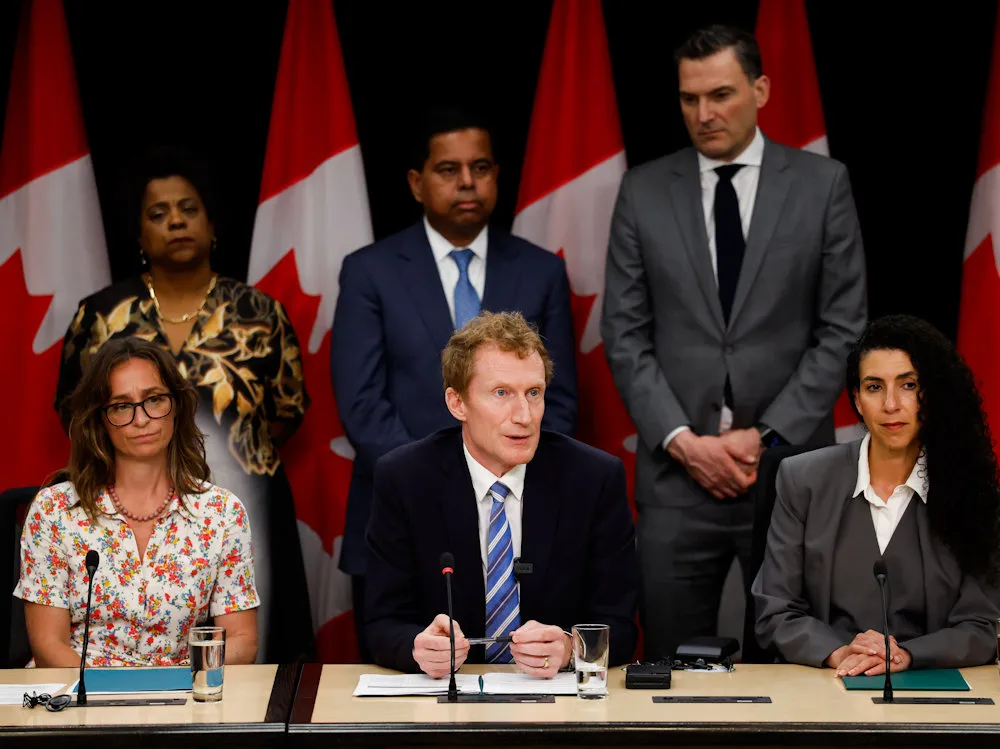
FIRST READING: The worst-case scenarios that Carney's 'social media ban' could enable
Ottawa could get sweeping powers to decide who's able to use the internet, and even what AI chatbots are allowed to say.