Home
Storia in 1 fonti
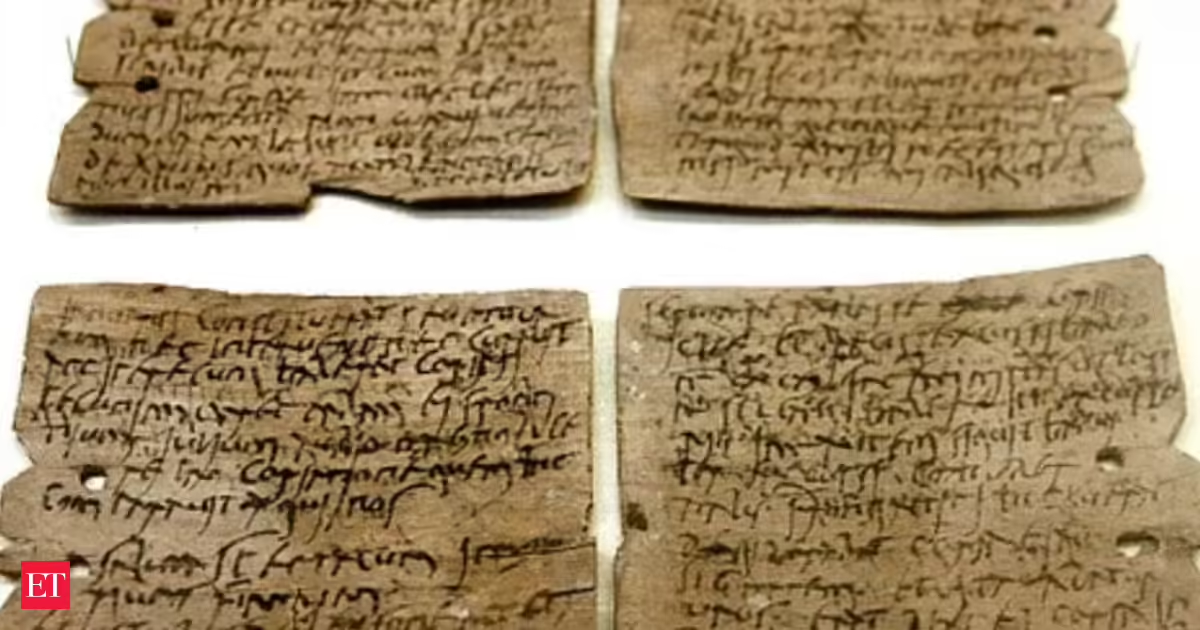
In 1973, archaeologists in a muddy Roman fort trench found thin wooden tablets, and Vindolanda gave Roman Britain its own handwriting
People usually picture stone walls, military forts, crumbling ruins, and the remains of an empire that announced itself through architecture and engineering when they imagine Roman Britain. What they rarely imagine is handwriting; yet one of the most important discoveries ever made along Hadrian’s Wall was not a monument or a weapon but a collection of thin wooden writing tablets recovered in 1973 from the Roman fort of Vindolanda.These fragile pieces of wood transformed historians’ understanding of life on Rome’s northern frontier because they preserved something unusually personal: the written words of the people who actually lived there. Research published in Frontiers in Environmental Science has since shown that Vindolanda’s unique waterlogged conditions created an environment capable of preserving organic materials that would normally disappear, allowing wood, leather, and written documents to survive for nearly two thousand years.Tablet 343: Letter from Octavius to Candidus concerning supplies of wheat, hides and sinews | Wikimedia CommonsThe ground itself became an archiveMost Roman writing tablets made from wood would have rotted away centuries ago, leaving historians dependent on stone inscriptions, official records, and scattered literary references. At Vindolanda, however, the situation was very different because the fort sat within waterlogged deposits where low-oxygen conditions dramatically slowed the processes that normally destroy organic material.A peer-reviewed study published through Frontiers in Environmental Science examined the site’s preservation conditions and found that microbial activity, soil chemistry, and sustained wetness helped protect fragile materials including leather and wood.The tablets survived not because they were hidden in a special container or deliberately preserved, but because the ground itself served as a protective environment, shielding them from the natural decay that erased similar documents elsewhere in the Roman world. This is what makes Vindolanda so unusual. The site is not simply a place where archaeologists found tablets; it is a place where nature accidentally created one of Roman Britain’s most valuable archives.Roman Britain suddenly became more humanThe importance of the tablets extends far beyond their physical survival because they provide direct evidence of everyday life in a way that ruins alone never could. Walls can tell archaeologists where people lived, and artifacts can reveal what they used, but written words reveal what people thought, requested, recorded, and communicated. That distinction matters because Roman Britain often appears in history through military campaigns, imperial administration, and major construction projects.The Vindolanda tablets offer a different perspective, one rooted in the routine life of a frontier fort, where people managed supplies, exchanged messages, maintained records, and navigated everyday responsibilities.Rather than presenting Rome as a distant empire, the tablets bring individual voices into the historical record. They remind us that Hadrian’s frontier was not occupied by abstract historical figures but by real people who wrote notes, kept records, and communicated much as people do today.Modern science is still learning from themA 2026 study led by researchers associated with the British Museum used noninvasive analytical methods including Raman spectroscopy, X-ray fluorescence, and scanning electron microscopy to examine the tablets without damaging them. Published in Heritage Science, the study demonstrated that carbon-based inks used on Vindolanda tablets could be differentiated by their source materials, opening new possibilities for understanding writing practices and material choices in Roman Britain.This means the tablets are not simply museum pieces; they remain active research objects capable of answering questions that archaeologists were not even asking when they were first excavated in 1973. Advances in imaging and materials science continue to reveal new details from the same fragile pieces of wood that emerged from a muddy trench more than fifty years ago.Archaeologists at work in Vindolanda, 2006 | Wikimedia CommonsA frontier fort became one of Rome’s greatest archivesVindolanda changed the study of Roman Britain because it demonstrated that ordinary records can sometimes survive when environmental conditions are exceptional. Before the discovery, historians knew a great deal about emperors, generals, and official institutions, but far less about the daily experiences of people living on the empire’s edge. The tablets helped close that gap by preserving evidence of communication, administration, and everyday life that would otherwise have been lost forever.Their continued importance also highlights an essential lesson in archaeology: discoveries are often shaped as much by preservation as by excavation. The tablets survived because water, soil chemistry, and microbial conditions happened to align in a way that protected them for centuries. Had those conditions been slightly different, Roman Britain might have lost one of its clearest written voices, which is why Vindolanda remains such an important site today. The wooden tablets are small, fragile, and visually unremarkable compared with many famous archaeological treasures, yet they achieved something far more difficult. They gave Roman Britain its own handwriting, allowing people separated by two thousand years to speak again through words preserved by mud, water, and extraordinary luck.
Raccontata da economictimes.indiatimes.com