Home
Storia in 1 fonti
Ponder This Challenge - April 2026 - The Unlabeled Clock
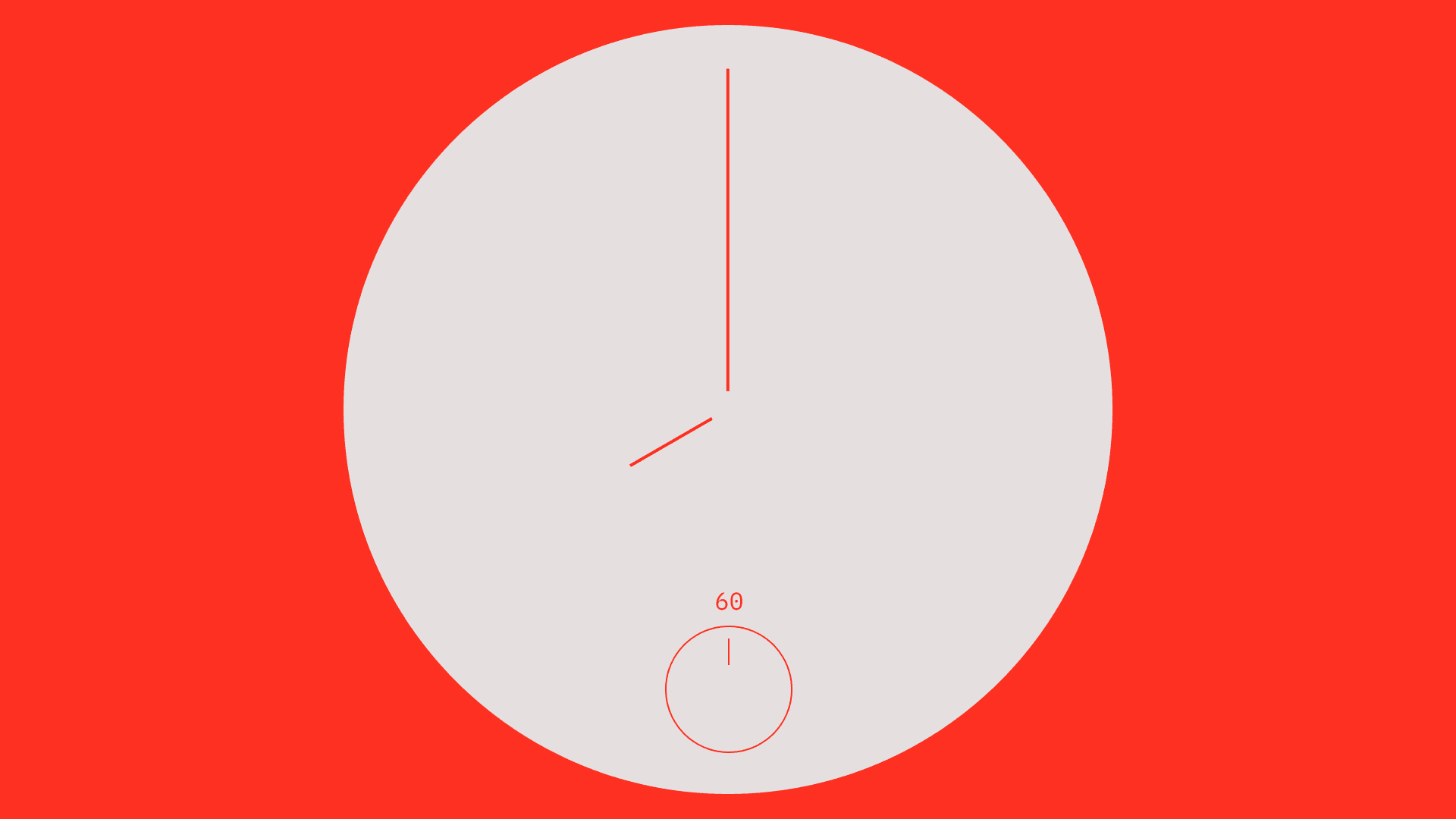
The expected numerical solutions are:1541414(30, 36, 40) => 3458432This time, the phrasing of the puzzle, even after corrections, remained confusing to many solvers and we apologize for this. However, most wrong answers arose from the initial thinking that one should consider time to be discrete, looking only at moment of the form HH:MM. The riddle explicitly noted the clock's hands move continuously, and hence simple enumeration of moments of the form HH:MM is not sufficient to solve the riddle; a different approach is required.We can model the current time as a value t∈[0,1)t\in[0,1) and the locations of the clock's hands becomeH(t)=tH(t) = tM(t)=12t (mod 1)M(t) = 12t \text{ }(\text{mod } 1)S(t)=720t (mod 1)S(t) = 720t \text{ } (\text{mod } 1)Let us define a three-component vector A(t)=(H(t),M(t),S(t))A(t)=(H(t), M(t), S(t)). Use the indices 1,2,31,2,3, i.e. A1(t)=H(t)A_1(t)=H(t), A2(t)=M(t)A_2(t)=M(t), A3(t)=S(t)A_3(t)=S(t).Now, an ambigous moment arises from two distinct times t,ut, u such that we can permute the elements of A(t)A(t) and rotate them (i.e. add some rr modulo 1) and obtain A(s)A(s). Hence, let pi∈S3pi\in S_3 be some permutation and r∈[0,1)r\in [0,1) be the rotation value, and we consider the system of three modular equations:A1(u)=Aπ(1)(t)+r (mod 1)A_1(u) = A_{\pi(1)}(t)+r\text{ } (\text{mod } 1)A2(u)=Aπ(2)(t)+r (mod 1)A_2(u) = A_{\pi(2)}(t)+r\text{ } (\text{mod } 1)A3(u)=Aπ(3)(t)+r (mod 1)A_3(u) = A_{\pi(3)}(t)+r\text{ } (\text{mod } 1)Subtracting the third equation from the first two, we obtain a system of two modular equations without rr:A1(u)−A3(u)=Aπ(1)(t)−Aπ(3)(t) (mod 1)A_1(u)-A_3(u) = A_{\pi(1)}(t)-A_{\pi(3)}(t) \text{ } (\text{mod } 1)A2(u)−A3(u)=Aπ(2)(t)−Aπ(3)(t) (mod 1)A_2(u)-A_3(u) = A_{\pi(2)}(t)-A_{\pi(3)}(t) \text{ } (\text{mod } 1)Such modular equations can be solved using standard linear algebra. We demonstrate this in the case π(1)=2,π(2)=3,π(3)=1\pi(1)=2, \pi(2)=3, \pi(3)=1. In this case we obtain the modular equationsH(u)−S(u)=M(t)−H(t) (mod 1)H(u)-S(u) = M(t)-H(t) \text{ } (\text{mod } 1)M(u)−S(u)=S(t)−H(t) (mod 1)M(u)-S(u) = S(t)-H(t) \text{ } (\text{mod } 1)i.e.u−720u=12t−t (mod 1)u-720u = 12t-t \text{ } (\text{mod } 1)12u−720u=720t−t (mod 1)12u-720u = 720t-t \text{ } (\text{mod } 1)Which reduces to finding solutions to the linear system
Raccontata da research.ibm.com