Home
Storia in 1 fonti
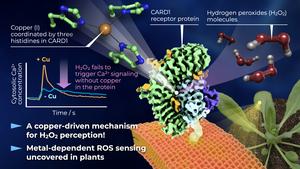
Researchers unravel a copper-based ’sensor’ that underpins signal detection in plants
Researchers at the Institute of Transformative Bio-Molecules (WPI-ITbM), Nagoya University, together with collaborators from RIKEN Center for Sustainable Resource Science (RIKEN CSRS) and The University of Osaka, have uncovered a previously unknown mechanism by which plants detect hydrogen peroxide (H₂O₂), a key signaling molecule involved in stress responses and immunity. Published in Nature Communications, the study reveals that plants rely on a copper-dependent sensing system, rather than the previously assumed cysteine-based mechanism, to perceive reactive oxygen species (ROS).
Raccontata da eurekalert.org