Goldman Sachs Predicts Over 50% Rally for These 3 Stocks
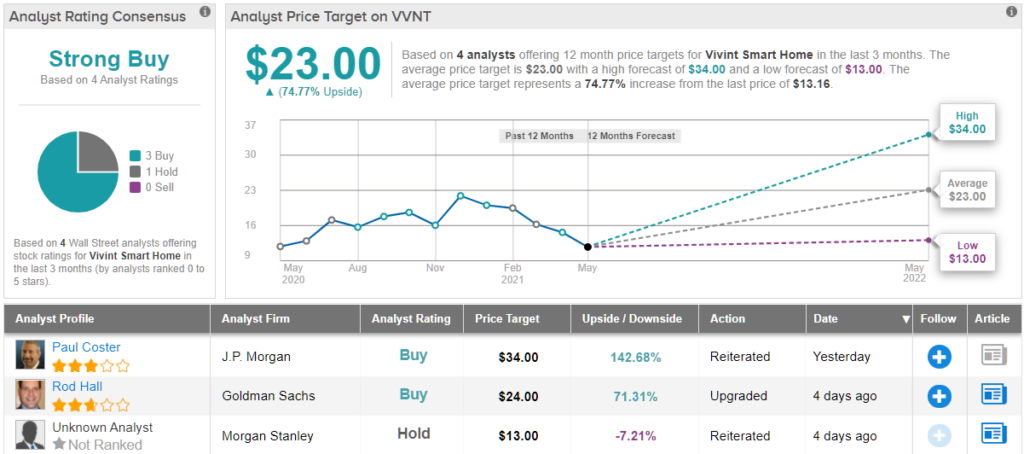
Take a good look at the headlines, and you’ll be excused for thinking that we’re back in 1979. The late Carter years are remembered as the time of ‘stagflation:’ high inflation, high unemployment, fuel shortages, and a general malaise. So far, we’ve seen fuel shortages and gas station lines across the Southeast, rising commodity and housing prices, and unemployment ticking up even as the number of job openings increases. Weighing in from investment firm Goldman Sachs, chief economist Jan Hatzius believes that the current worrisome numbers are a short-term phenomenon. “I think that it’s quite plausible that employers may be prioritizing post-pandemic hiring over seasonal hiring to some degree that then shows up as weaker numbers. That’s still going to be with us, I think, for the next couple of months. But the flip side should be stronger job growth numbers than we previously thought later in the year," Hatzius noted. Turning to inflation, Hatzius again outlines a better picture for the long-term: “Ultimately, it’s going to be more temporary. A lot of the drivers of inflation, not just the commodity numbers, but also things like the base effect and some of the impact of reopening on service prices… a lot of that is pretty short-term. It doesn’t really tell you a lot of inflation in 2022 when we think we’ll probably be back to about 2% for core PCE.” Sometimes, the market pros will go out on a limb and take a position that is clearly an outlier compared to the consensus. That’s what Hatzius is doing here, and his colleagues have his back. Using the TipRanks database, we’ve found three stocks that Goldman’s analysts have picked out for 50% or better gains. Here are the details. Vivint Smart Home (VVNT) We’ll start with an interesting take on the internet of things, the smart home niche. Vivint Smart Home is a leader in this industry, delivering home security systems and home automation, services that include security cameras, doorbell cameras, and outdoor grounds cameras. Vivint boasts over 1.5 million customers in North America. This month, Vivint has seen both good and bad news. On May 3, the company settled a court action with the US Department of Justice and the Federal Trade Commission, accepting a $20 million fine for alleged violations of the Fair Credit Reporting Act. On the positive side, the company reported solid year-over-year gains in its 1Q21 financial release. Vivant showed a 13.2% yoy gain in revenues, to $343.3 million, driving by a 20.1% increase in new subscribers. The total number of new subscribers, 60,127, was a company record for Q1. Looking ahead, Vivint gave upbeat forward guidance, predicting 2021 revenue in the range of $1.38 to $1.42 billion, and a year-end total of 1.8 to 1.85 million subscribers. For Goldman Sachs analyst Rod Hall, all of this adds up to reason for an upgrade. Hall bumped his stance on VVNT from Neutral to Buy, and set his price target at $24, suggesting an impressive one-year upside of 81%. (To watch Hall’s track record, click here) “We believe Vivint’s consumer financing partnerships position the company for sustained positive cash-flow driven by reduced upfront subscriber acquisition cost outlays. We also see valuation as attractive at current levels with a reverse DCF suggesting unlikely negative terminal growth assumptions embedded in the current stock price. Further, we see a potential entry into the insurance business as an option on additional value,” Hall explained. Overall, VVNT has received 4 recent analyst reviews, breaking down to 3 Buys versus 1 Hold and making the analyst consensus rating a Strong Buy. The stock has current trading price of $23.20 and an average price target of $13.07, indicating ~75% upside potential for the next 12 months. (See VVNT stock analysis on TipRanks) DoubleVerify Holdings (DV) The digital world has transformed the advertising and marketing industries – but along with that, has come issues in trust. DoubleVerify, a newly public company, is in the business of ensuring safety in the world of online advertising. The company offers a software platform for measurement and analytics in digital media, providing marketers with secure and accurate data to track campaigns and results. The goal: greater confidence in branding and customer reach. DoubleVerify has been in the digital ad business for over a decade, and just last month, it went public. The IPO was initially priced at $27 per share, but it opened at $35 and closed its first day’s trading at $36. Overall, the offering of 15.333 million shares was comprised of 9.977 million put on the market by the company and 5.355 million shares sold by existing stockholders. DV raised over $350 million in the offering, before expenses. Analyst Christopher Merwin initiated coverage of this stock for Goldman Sachs, and was impressed with what he saw. “DoubleVerify grew revenue 75% y/y in 2019 and 34% y/y in 2020. 2019 strength was driven by new product introduction, deepening integrations with major demand side platforms including The Trade Desk, Google and Amazon, as well competitive share gains. Given DoubleVerify’s transaction based revenue model, the company is dependent on sustained growth of the overall digital ad ecosystem," Merwin noted. The analyst added, "We estimate a total of ~141 trillion ad impressions across various digital channels as of 2020, growing to~184 trillion by 2023. Based on DV’s current transaction fee ranging from 6-9 cents per1,000 impressions, we estimate an overall TAM of $10bnn, growing to ~$14bnn by FY23..." In line with his bullish stance, Merwin rates DV a Buy, and his $47 price target implies room for a 57% upside potential in the next 12 months. (To watch Merwin’s track record, click here) This newly public stock has attracted plenty of attention in its first few weeks on the markets; no fewer than 11 analysts have weighed in, and their opinions break down 8 to 3 in favor of the Buys versus the Holds, for a Moderate Buy consensus rating. DV shares are currently trading for $29.92 and have an average price target of $39, giving the stock a 30% one-year upside potential. (See DV stock analysis on TipRanks) Zymergen (ZY) We’ll wrap up with a company that has take a unique approach to the green economy. Zymergen describes itself as a ‘biofacturing’ company, which creates new modes of manufacturing a wide range of products, from electronics, to personal care and hygiene, to agricultural technology – all with an eye toward both using and protecting the natural world. Zymergen took its business public in April, holding its IPO on the 22 of that month. The firm raised over $500 million and put over 18.5 million shares into circulation. The company’s IPO took place just four months after the public launch of the company’s first commercial product, Hyaline, a polymer film for use in electronic displays. Covering the stock for Goldman Sachs, analyst Matthew Sykes writes of the company’s potential: “The key to the equity story for ZY is first to validate their synthetic biology development and platform through the successful commercial launch and shipments of their first product Hyaline in Q1 of 2022. Subsequently, ZY will need to follow-on with additional products in the electronic films space effectively demonstrating the speed and scale at which they can develop and roll-out products faster and cheaper than those made through the traditional, petrochemical process. Demonstrating the value of the platform and diversifying their revenue base across multiple product lines and end markets will be key to establishing the sustainability and competitive advantages of the business model.” Sykes clearly sees Zymergen as capable of meeting that potential, and gives the stock a Buy rating with a $55 price target to suggest an upside of 52% in the next 12 months. (To watch Sykes’ track record, click here) Sometimes, a new stock hits all the right buttons – and Zymergen has done that for Wall Street’s analysts. The consensus here is unanimous, with 5 positive reviews backing a Strong Buy rating. The $48.50 average price target implies ~33% upside from the $36.59 trading price. (See Zymergen stock analysis on TipRanks) To find good ideas for stocks trading at attractive valuations, visit TipRanks’ Best Stocks to Buy, a newly launched tool that unites all of TipRanks’ equity insights. Disclaimer: The opinions expressed in this article are solely those of the featured analysts. The content is intended to be used for informational purposes only. It is very important to do your own analysis before making any investment.
Take a good look at the headlines, and you’ll be excused for thinking that we’re back in 1979. The late Carter years are remembered as the time of ‘stagflation:’ high inflation, high unemployment, fuel shortages, and a general malaise. So far, we’ve seen fuel shortages and gas station lines across the Southeast, rising commodity and housing prices, and unemployment ticking up even as the number of job openings increases.
Weighing in from investment firm Goldman Sachs, chief economist Jan Hatzius believes that the current worrisome numbers are a short-term phenomenon.
“I think that it’s quite plausible that employers may be prioritizing post-pandemic hiring over seasonal hiring to some degree that then shows up as weaker numbers. That’s still going to be with us, I think, for the next couple of months. But the flip side should be stronger job growth numbers than we previously thought later in the year," Hatzius noted.
Turning to inflation, Hatzius again outlines a better picture for the long-term: “Ultimately, it’s going to be more temporary. A lot of the drivers of inflation, not just the commodity numbers, but also things like the base effect and some of the impact of reopening on service prices… a lot of that is pretty short-term. It doesn’t really tell you a lot of inflation in 2022 when we think we’ll probably be back to about 2% for core PCE.”