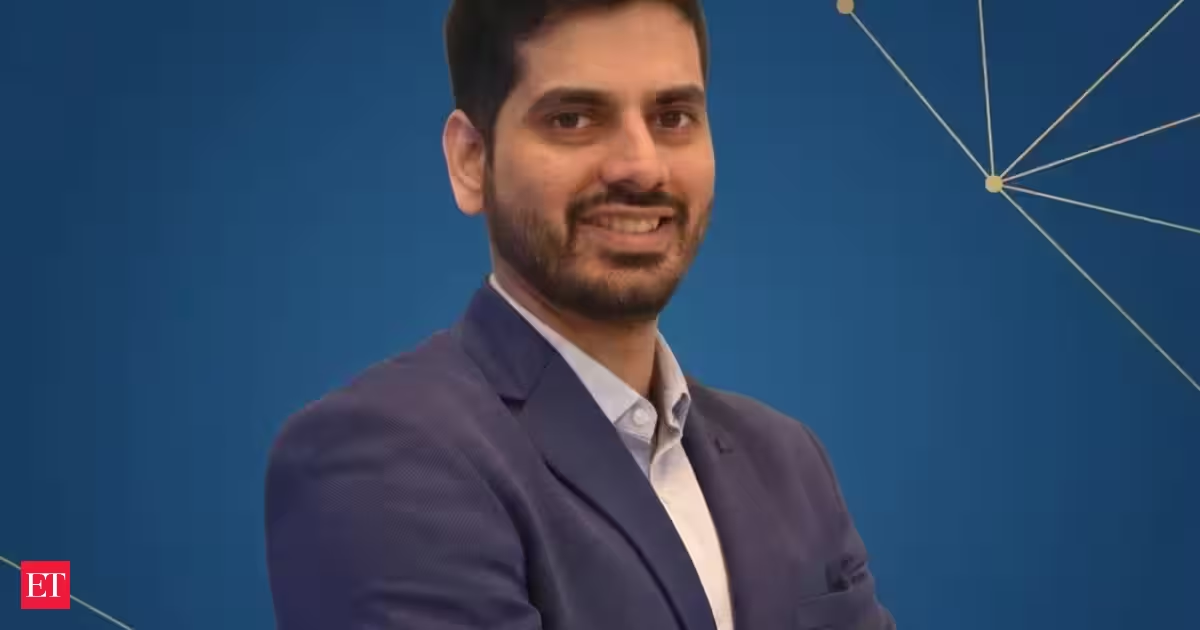
India’s financial data is moving through the ecosystem faster than any human can follow. Roughly 87 million data fetches pass through the system, with each cleared in under a second, according to fintech infrastructure firm Finarkein’s report ‘On Systems of Intelligence: Evidence and Obligations in the AA Ecosystem’, launched at the Global Fintech Festival 2026 (GFF).At that speed, the idea of someone eyeballing a file before approving a loan is slowly becoming obsolete. The bigger question is not how much data moves, but who answers when the machine gets it wrong.Technology providers in the Account Aggregator (AA) ecosystem are no longer just supplying raw bank statements. They are increasingly turning that data into a judgment — a credit score, risk flag or recommendation — that lenders act on. The analytical work once done by skilled underwriters is increasingly being absorbed into software.Also Read: True Balance scores 100% of loan applications with AI, looks beyond credit bureaus to curb defaultsNikhil Kurhe, CEO and co-founder of Finarkein, is careful about where the machine’s authority begins and ends. The verification of the data itself, he says, is entirely automated and leaves no room for human intervention.“It’s all machine-led because it’s mathematical, cryptographic, sort of proofs,” he told The Economic Times Digital at GFF 2026, likening the encryption to the security protecting a WhatsApp message. “Data is locked at the source, checked for tampering in transit, and acknowledged on arrival, all in microseconds. Individual review of that layer could not survive the volume anyway.”The judgment is automated, the accountability is notThe report also offers an uncomfortable reading of the “question of blame”. It logs close to 4,000 errors across the aggregators it studied and notes that no agreed service standard governs them.So when a lending decision rests on data that turns out to be biased or simply wrong, who takes the fall? Kurhe said the customer ultimately bears the cost by not getting “the best possible product or offer”.The problem is compounded by the lack of a clear accountability mechanism, he said. “Banks offer little more than an email support channel. Finarkein flags bad or missing data once it is decrypted on the lender’s premises, but we cannot manufacture accountability the ecosystem has not yet designed.”To address this gap, the report puts forward a 23-factor framework for judging any data intelligence product, grouped into five families: where the data came from, how the method was built, what the output claims, how the system behaves and what the provider discloses about its own work.Most of these can be measured today, and a buyer is entitled to ask for the evidence rather than take a vendor’s word. The report suggests that the factors that would usually separate a trustworthy product from a weak one — such as whether the reason given for a decision is real — are among those with the least settled measurement behind them.Also Read: Centralised interoperable digital layer can help bridge Rs 60 lakh crore MSME credit gap: ReportWho runs such a daily check is another question. Asked whether the audit sits inside the bank or becomes a new outsourced job, Kurhe described the routing side as something Finarkein handles in-house.“We have a dedicated team internally which has built this routing logic, and on a periodic basis there is a review. When an aggregator supplies false information, the system punishes that particular AA by reducing its trust score and raises an alert for his team to investigate,” he explained.The report also flags biases in the models. Deposit data makes up around 91% of everything requested, so the risk models trained on it see only a narrow slice of financial life.“People who are formally banked and have a steady cash flow, the models would inherently reward such customers, while people who may not have formal banking in place may end up being excluded,” Kurhe said.He called it a constraint of the system today rather than a permanent feature, and expects the picture to widen as wealth, insurance and capital-markets data come into play. Kurhe claimed that one large card issuer they work with is already exploring investment data to set credit limits.What is left for the underwriter?If software forms the opinion and the bank executes it, the obvious worry is that the human underwriter becomes ornamental.Speaking at a GFF 2026 panel with non-banking lenders, Kurhe said the goal was not to remove people but to make the machine as good as the best underwriters.“Firms with 30 to 50 underwriters in their SME books are building automated workflows benchmarked against the best of their 30 to 50 underwriters to strip out the variability between a strong assessor and a weak one,” he told The Economic Times Digital.According to him, the industry still isn’t fully comfortable with complete automation for complex cases in the banking, financial services and insurance (BFSI) sector, particularly in SME lending.The sector is not yet ready to let the algorithm decide alone. The human role is migrating from making each call to setting the standard the machine must meet and catching the cases that fall outside it.That is the argument of the report as a whole. As intelligence becomes something firms buy rather than something people produce, the discipline has to move with it. Buyers who once trusted an underwriter’s experience now need to interrogate a vendor’s claims and refuse the ones dressed up as facts.Finarkein’s stated aim, Kurhe said, is to give the market that vocabulary, to show buyers what good looks like “so don’t settle for anything less”.
With AI handing down verdicts, India's lenders ask who signs off on it: Report
Financial data moves rapidly through India's Account Aggregator ecosystem. Automated systems now process millions of data fetches each second. Technology providers transform raw data into credit judgments and risk assessments. Human underwriters' roles are shifting towards setting standards and handling complex cases.
TL;DRAI
Finarkein reports 87M data fetches/sec drive AI credit decisions in India's AA ecosystem without agreed accountability. Models trained 91% on deposit data exclude unbanked borrowers; lenders must audit vendors independently as no accountability framework exists.
919 words~4 min read