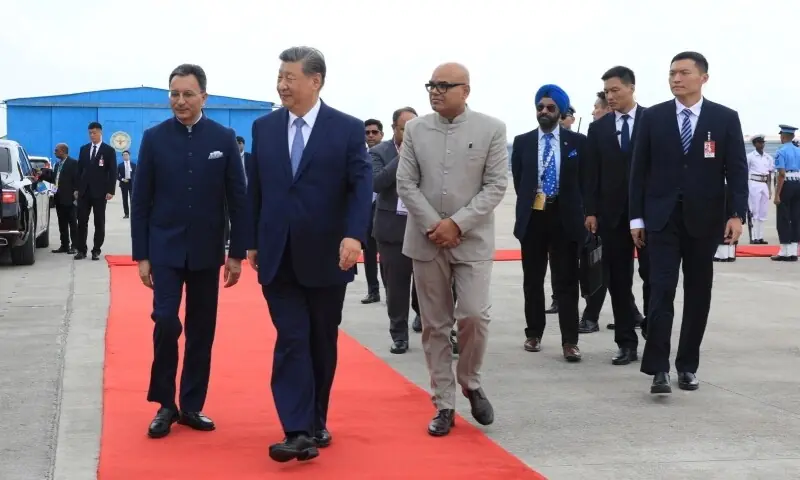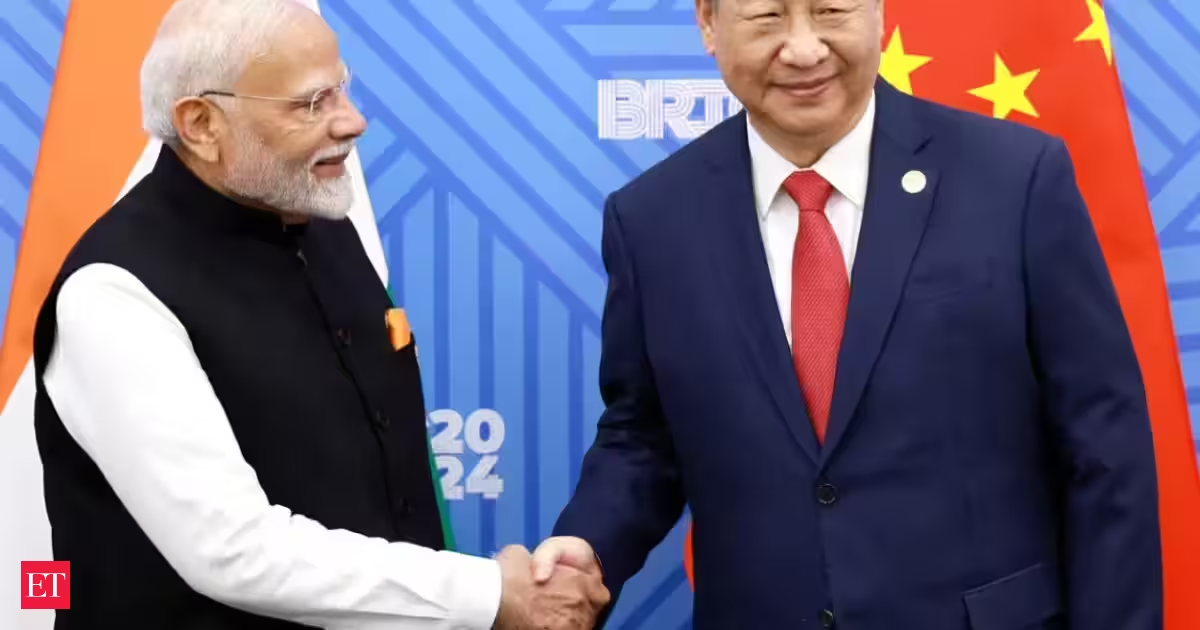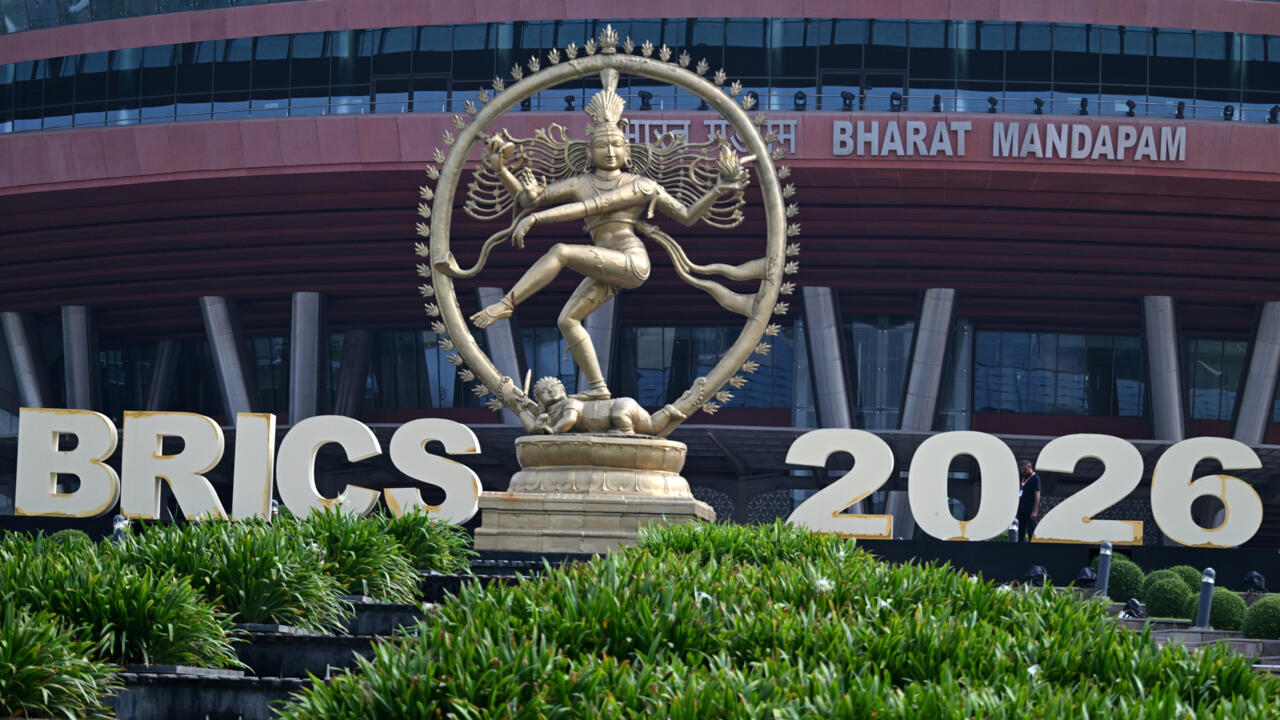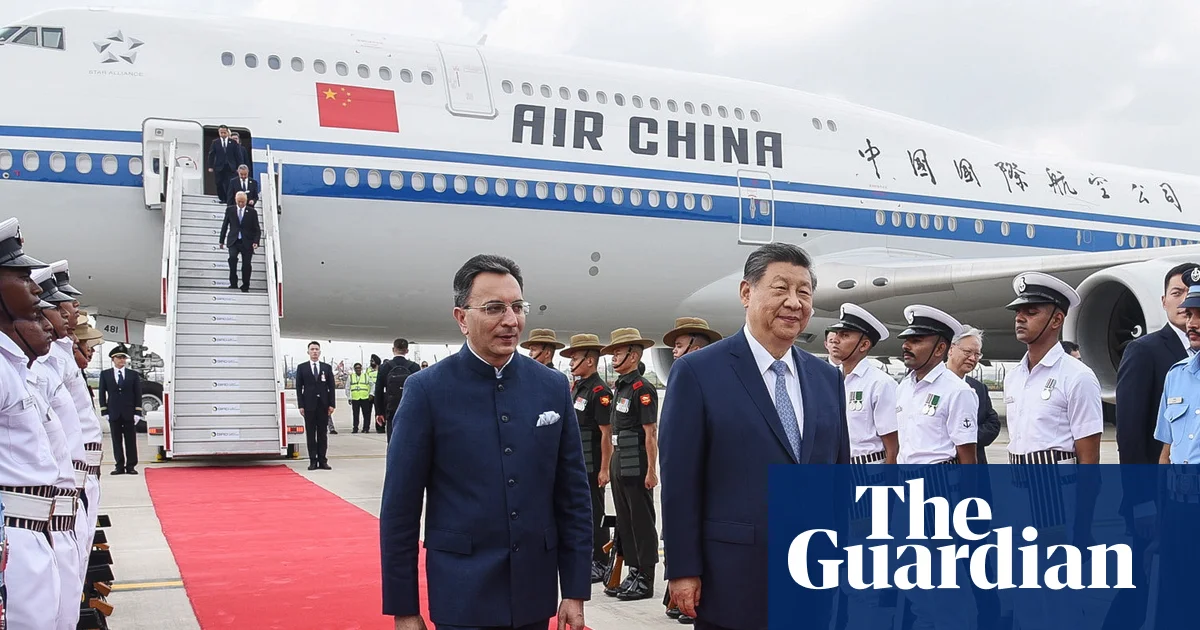
The Chinese president, Xi Jinping, has received a red-carpet welcome in India for a summit of Brics developing nations, as regional rivals Beijing and Delhi make a public display of thawing relations while quietly competing to lead at a time of shaky US global dominance.As Xi stepped off the plane, he was walked past an honour guard of Indian soldiers and traditional dancers in colourful dresses.The Russian president, Vladimir Putin, and Iranian president, Masoud Pezeshkian, had already been welcomed by the Indian prime minister, Narendra Modi, who is hosting one of the group’s most closely watched gatherings since its inception.The summit marks Xi’s first visit to India in seven years and is seen as the biggest step towards reconciliation after a deadly 2020 military clash along the disputed Himalayan border, in which 20 Indian and four Chinese soldiers were killed.Ties between the nuclear-armed Asian giants have been warming recently, with flights and high-level contacts gradually being restored. China was “willing” to work with India to properly manage differences and be “good neighbours and friends”, China’s foreign ministry said on Friday.Leaders and diplomats have been convening in India for the annual gathering of the Brics grouping, named after five of its earliest members – Brazil, Russia, India, China and South Africa – that was conceived as a counterweight to western dominance.This summit comes as wars in Ukraine and the Middle East, along with rising US-China tensions, test the bloc’s ability to find common ground.Since its inception in 2009, Brics has expanded as a forum for major emerging economies to include Egypt, Ethiopia, Indonesia, Iran, Saudi Arabia and the United Arab Emirates (UAE). The group now rivals the US-dominated G7 forum of advanced economies, accounting for half of the global population.But its growth has also created new fractures and disunity – Iran was bombing Saudi Arabia and the UAE earlier this year, and Brics foreign ministers failed to agree on a joint statement when they met in Delhi in May.Reuters reported on Saturday that India’s summit would result in a generic joint declaration that would show unity by condemning unilateral war, but was unlikely to name any single country.Jiang Shixue, vice-president of the expert committee of the China thinktank Council for BRICs cooperation (China), said the 11 members “cannot speak with one voice on many issues”.“The only solution is to continuously strengthen political consensus,” he told the South China Morning Post.Beijing and Delhi have differing views on the role of the group.China has sought to expand Brics power as a counterweight to the US under Donald Trump’s leadership, which has launched global tariff and trade wars and retreated from multilateral institutions such as the UN, which afforded it international credibility.India has taken a more cautious approach, seeing Brics as a bridge between the west and the developing world.Chietigj Bajpaee, a senior research fellow for South Asia in the Asia-Pacific programme at Chatham House, said this week that Delhi had found it hard to maintain its policy of “strategic hedging” during such a disruptive US presidency.“India’s position can appear out of sync in a forum whose membership includes countries with more overtly anti-western agendas, including China, Russia and Iran. And two other Brics countries, South Africa and Brazil, have suffered high-profile diplomatic disputes with the US,” he wrote.“The challenge for Delhi is that it wishes to promote this worldview in a way that is non-western but not explicitly anti-western.”Agence France-Presse contributed to this report
Xi Jinping gets red carpet at Brics summit amid thaw in India-China relations
Chinese president’s arrival in Delhi seen as step towards reconciliation after deadly 2020 military clash
571 words~3 min read