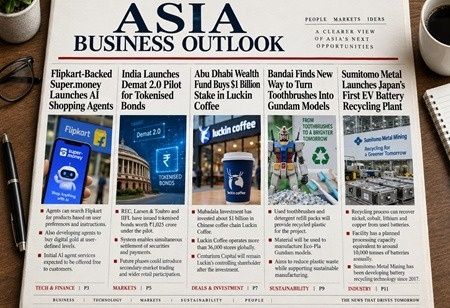
Asia's business landscape is seeing rapid changes across technology, finance, consumer markets, manufacturing and clean energy, with companies and governments increasingly investing in new digital and sustainable solutions. In India, fintech and capital markets are adopting artificial intelligence and tokenisation to reshape how consumers shop and investors access securities.Meanwhile, Gulf investors are increasing their exposure to China's consumer economy, while Japanese companies are exploring new approaches to recycling and manufacturing.From AI-powered shopping agents and tokenised bonds to recycled Gundam models and EV battery materials, these developments highlight how technology, investment and sustainability are becoming increasingly interconnected across major Asian markets.Flipkart-Backed Super.money Launches AI Shopping AgentsFlipkart-backed fintech platform Super.money has launched AI-powered shopping agents that can search for products and complete purchases based on user instructions.The move marks the company's push toward more automated digital commerce in India. The agents are initially being developed for shopping on Flipkart and other financial transactions. Super.money aims to make AI a larger part of its consumer-facing services. The agents can search Flipkart for products based on user preferences and instructions. Super.money is also developing agents that can buy digital gold when prices reach user-defined levels. The initial AI agent services are expected to be offered free to customers.India Launches Demat 2.0 Pilot for Tokenised BondsIndia has launched the Demat 2.0 pilot to explore the use of distributed ledger technology for tokenised corporate bonds. The initiative aims to modernize securities settlement by linking digital securities with India's wholesale central bank digital currency. It could eventually make bond transactions faster and more automated. REC, Larsen & Toubro and IIFL have issued tokenised bonds worth ₹1,025 crore under the pilot. The system enables simultaneous settlement of securities and payments. Future phases could introduce secondary-market trading and wider retail participation. Abu Dhabi Wealth Fund Buys $1 Billion Stake in Luckin CoffeeAbu Dhabi sovereign wealth fund Mubadala Investment has invested about $1 billion in Chinese coffee chain Luckin Coffee. The transaction gives Mubadala exposure to China's rapidly expanding coffee and consumer market.The investment was made alongside controlling shareholder Centurium Capital. Luckin's large store network and digital business model were key attractions. Luckin Coffee operates more than 36,000 stores globally. The company has built a large customer base through its app-based ordering model. Centurium Capital will remain Luckin's controlling shareholder after the investment.Bandai Finds New Way to Turn Toothbrushes Into Gundam ModelsBandai Spirits is working with Japanese consumer goods companies to turn recycled plastic from used toothbrushes into Gundam model kits. The initiative expands Bandai's efforts to create a more circular production system for its popular Gunpla products.Recycled material from everyday household products will be combined with plastic collected from model kits. The project also gives consumers a new way to participate in recycling. Used toothbrushes and detergent refill packs will provide recycled plastic for the project. The material will be used to manufacture Eco-Pla Gundam models. The initiative aims to reduce plastic waste while supporting sustainable manufacturing.Sumitomo Metal Launches Japan's First EV Battery Recycling PlantSumitomo Metal Mining has launched Japan's first EV battery recycling plant as demand for critical battery materials continues to grow. The company plans to recover valuable metals from used lithium-ion batteries and return them to the battery supply chain.The initiative is designed to reduce dependence on newly mined resources. It also strengthens Japan's domestic battery-materials supply network. The recycling process can recover nickel, cobalt, lithium and copper from used batteries. The facility has a planned processing capacity equivalent to around 10,000 tonnes of batteries annually. Sumitomo Metal Mining has been developing battery recycling technology since 2017.
Asia Today: AI, Digital Finance, Coffee, Recycling and Consumer Growth
Catch Asia’s business shifts as AI shopping agents, tokenised bonds, Gulf investment, plastic recycling and EV battery recovery reshape technology, finance and sustainable growth.
TL;DRAI
Super.money launches AI shopping agents; India issues ₹1,025 crore in tokenized bonds through Demat 2.0 pilot. Signals accelerated fintech convergence: emerging-market concurrent deployment of agentic commerce and blockchain settlement compresses industry timeline for stack modernization decisions.
591 words~3 min read