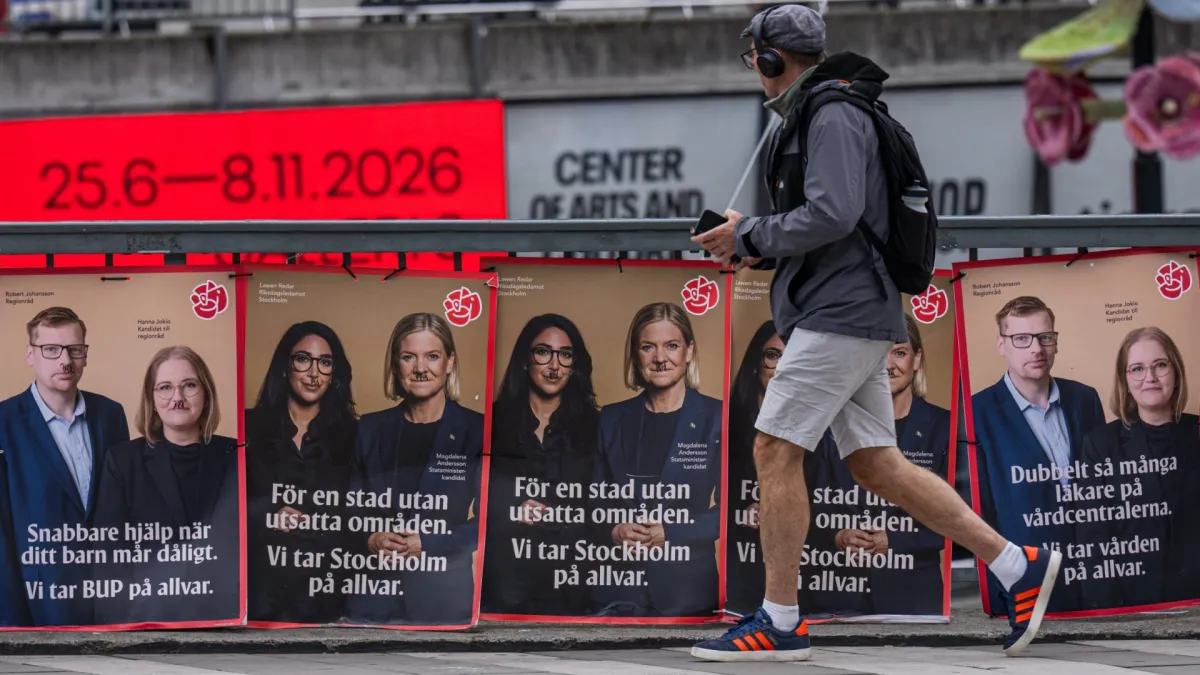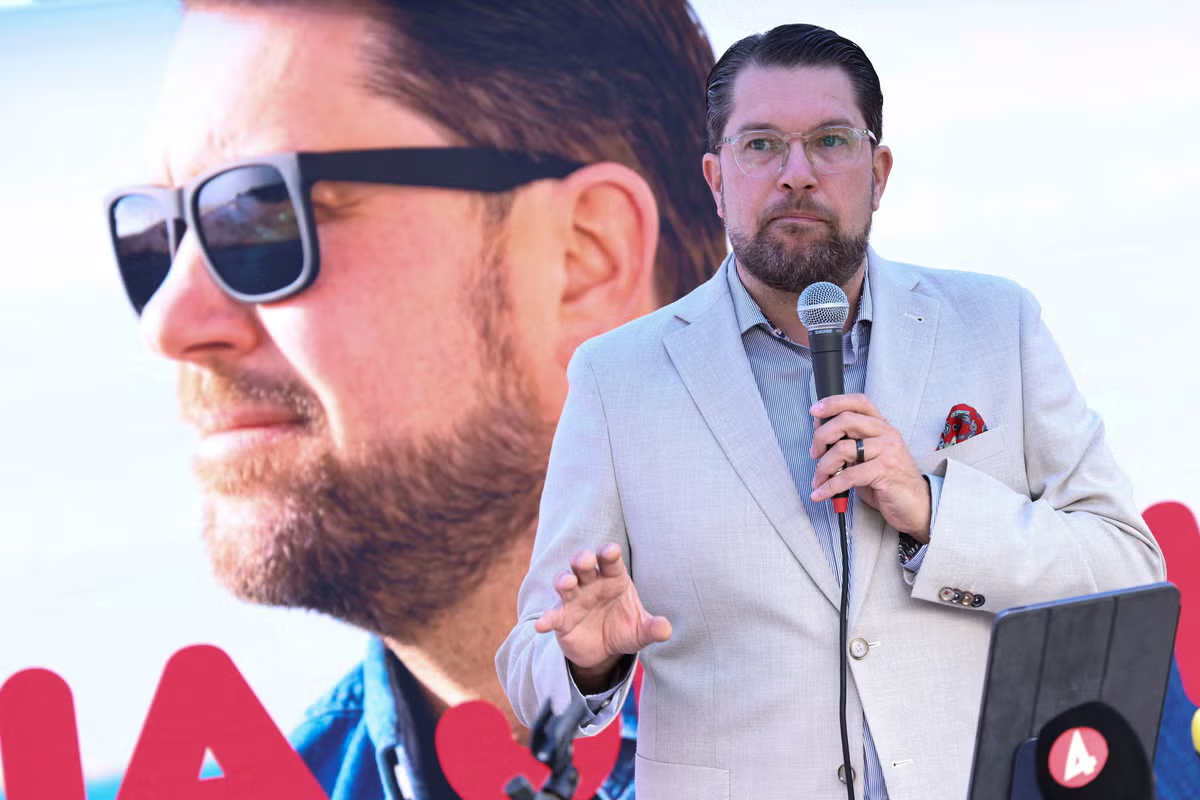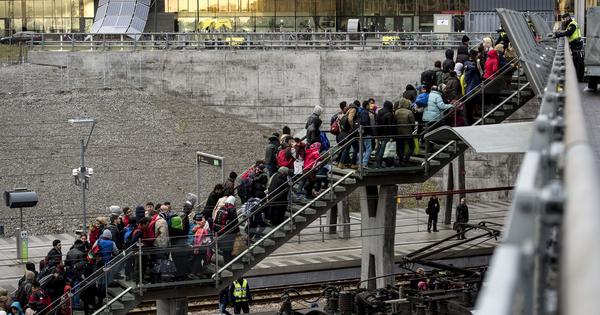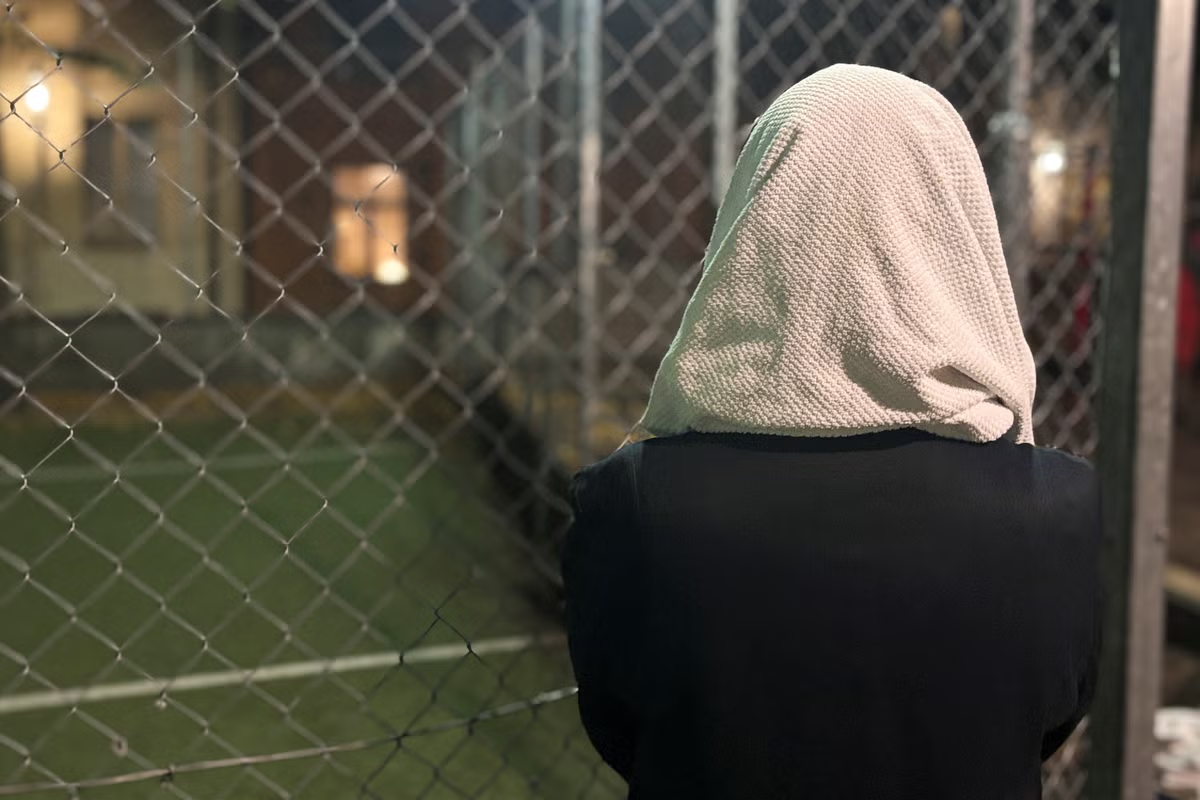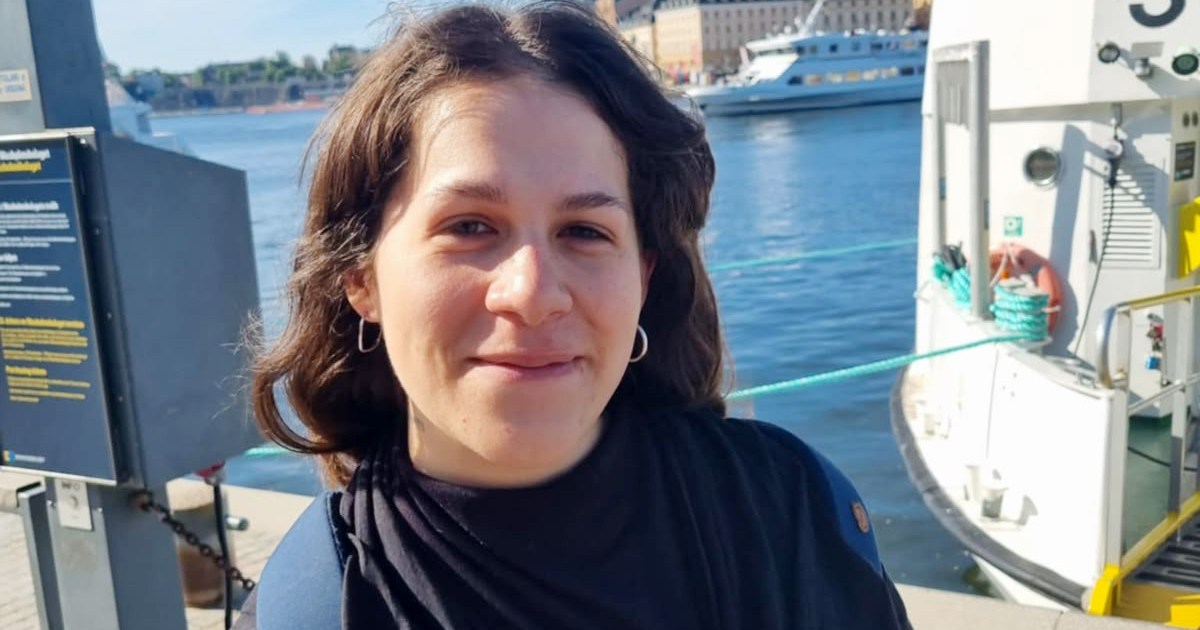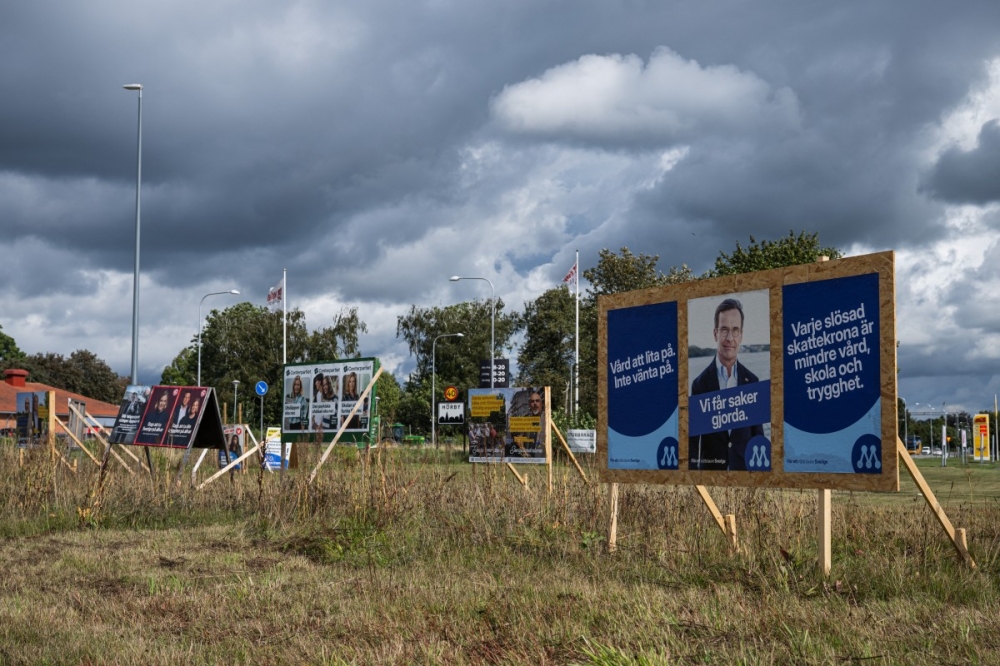
Samuel Asiamah, a 33-year-old gay Ghanian man, was lucky to flee his homophobic homeland when he did two years ago – but unlucky to seek asylum in Sweden.For decades this Nordic country was a beacon for anyone seeking refuge from oppression, with many Swedes viewing their homeland proudly as a “human rights superpower”. But Asiamah’s story indicates just how far things have changed.“If you are threatened or in imminent danger then you don’t have a place here in Sweden. People should seek help from other countries,” said Asiamah, whose asylum application is in limbo while he is locked up in a Swedish detention centre.When Asiamah filed for asylum in Sweden last February, he didn’t realise he had walked right into postwar Sweden’s most dramatic postwar shift on this issue. Along with wider migration questions and crime, the asylum issue has dominated the Swedish election campaign in advance of Sunday’s general election.Samuel Asiamah filed for asylum in Sweden last February The tipping point was the 2015 refugee crisis when Sweden found itself struggling with 160,000 asylum applications (compared with 3,300 that year in Ireland).The sheer scale of the challenge – Sweden has two per cent of the EU population but shouldered 12 per cent of asylum applications – forced a public debate on the previously taboo immigration issue.A 2016 cross-party agreement followed with tighter asylum and migration rules and was implemented by Sweden’s centre-left coalition government headed by Social Democratic prime minister Stefan Löfven.Then, in 2022, his successor Magdalena Andersson lost office to a conservative coalition government that promised a “paradigm shift” on three political neuralgic points: violent gang crime, immigration and asylum.Asylum seekers in a temporary house in Kladesholmen, Sweden, in 2016. Photograph: by David Ramos/Getty Images Heading this shift was Ulf Kristersson, leader of the centre-right Moderates, and prime minister of a minority government supported from the opposition benches by the far-right Sweden Democrats (SD).Kristersson and his government are hoping for re-election on Sunday, this time with the SD with a formal government role.Swedish Prime Minister and Moderate Party leader Ulf Kristersson takes part in a televised election debate hosted by TV4 in Stockholm, Sweden, on September 10, 2026, three days ahead of the country's general election. Photo: Jonathan Nackstrand/ AFP via Getty Images But their second-term plans are in doubt as voters are confronted with the human cost of the pared-back migration and asylum obligations. Swedes have been particularly shocked by a series of reports on so-called “teenage deportations” of young people, born and raised in Sweden to foreign national parents.Fewer headlines have been devoted to the radical slump in asylum applications, by 96 per cent since a 2015 peak to just 6,737 last year. The country has an asylum approval rate now of about 23 per cent, less than half the EU average.Despite this dramatic slide in numbers, however, migration and asylum have remained emotional political battle grounds.In January, the government increased to 350,000 Swedish Kronor (€31,371) so-called “resettlement grants” for adults ready to leave Sweden. In the election campaign, the populist Sweden Democrats flagged the policy with large posters, in train stations and on buses, reading: “Do you miss Mogadishu? The repatriation grant helps you go home.”Election campaign posters featuring Sweden Democrats leader Jimmie Åkesson (R) and candidates from other political parties are displayed. Photo: Jonathan Nackstrand/ AFP via Getty Images This has all passed by Asiamah in a detention centre in Åstorp, an hour north of Malmö. Soft-spoken and cautious, the 33-year-old relates by video call how he was raised by his grandmother in the Ghanian countryside before moving aged 18 to the capital, Accra, to live with his religious mother.She nursed suspicions about his sexuality from early on, he says, and brought him for regular blessing services to her church, fearing the social disgrace of a homosexual son. “She was upset, then furious and gradually started to neglect me, making comments about me being a shame to her and the family,” he says.The populist Sweden Democrats ran ads on buses, reading “Do you miss Mogadishu? The repatriation grant helps you go home.” When the truth came out, home life for him became a permanent battleground of fights and accusations. He struggled at school, left home at 19 and found refuge in a local LGBT group Solace. His first boyfriend saw verbal taunts tip into repeated physical attacks. He still carries a scar from one such attack down his side.Then he met a man known as “Brother Kofi” who promised to get him to Europe. Asiamah stole 60,000 Ghanian Cedi (€4,526) from his mother’s savings and was flown, via Mauritius, first to France and then Sweden in November 2024, where his trafficker abandoned him.Homeless for a week, a woman invited Asiamah to her home but “when she realised my sexual preferences, told me to leave”.“One snowy day, I was on the street alone, the police found me and asked what I was doing. I told them I had moved to Sweden and needed help,” he said.He filed for asylum in Malmö last February, an unpleasant process with a “mean” case officer. Just last May, he pointed out to her that the Ghanian parliament passed a new Bill to criminalise the promotion of LGBTQ+ activities with prison sentences of up to 10 years, including a provision demanding friends and family members inform on each other.[ Swedes to decide if its government takes a further leap to the rightOpens in new window ]His case officer dismissed this as irrelevant, Asiamah says, because he has not experienced this new regime personally.Matters began to deteriorate when he ran away from his asylum camp and was detained in the Åstorp detention facility, despite having valid asylum papersSix months on, his lawyer cannot get answers on why Asiamah is still locked up, sharing a room with two others.He has fixed meal times and limited time outdoors and some of his fellow inmates are violent criminals. The hardest part, Asiamah says, is not knowing what will happen next. Neither the Swedish migration authority or the migration ministry replied to The Irish Times’ requests for commentSwedish authorities want him to contact the Ghanian embassy to arrange his return, but Asiamah refuses to co-operate. He fears the consequences of a jail sentence waiting for him in Accra.[ Europe can’t have it both ways on migrationOpens in new window ]“There is a difference between co-operation and placing your life in jeopardy,” he says. “If people in prison know you are homosexual you will be brutalised and assaulted and you could lose your life.”Asiamah is being assisted by a Malmö-based asylum support group. The main organiser asks for The Irish Times not to name the group nor them – another sign of the shift in the mood in Sweden.“It used to be seen as a victory in Sweden to protect people here from unsafe situations, but these people have been so dehumanised now that getting rid of them quickly is the new victory,” said the group organiser. “We need to talk about why people are seen now as a nuisance and talk about the reason for that, too.”Acknowledging what it sees as the new normal, Amnesty International Sweden has denounced politicians who “falsely accuse people with a migrant background of major social problems” allowing the normalisation of racism.Malmö-based migration researcher Henrik Emilsson sees Sweden’s new migration and asylum policy as an over-correction of the previous policy that dominated public discourse until 2015.This narrative, he says, argued that Sweden should be better than other countries with a stronger humanitarian tradition. It was a narrative, Emilsson argues, rooted in a national guilt complex.“We felt we didn’t suffer in the second World War, that we were hypocrites to support Hitler until he was losing, and we are now privileged and have to take on responsibility in the world,” said Dr Emilsson, a senior lecturer at the University of Malmö.This pre-2015 stance was often at odds with public opinion, he says, which was consistently less welcoming to refugees than their politicians. Now the political pendulum has swung in the other direction, he says, with politicians “changing everything in the most extreme way possible on migration, pushing things to the limit”.He sees little likelihood of any softening after Sunday’s election, given tougher new EU migration rules in effect since July.Across Europe, people like Asiamah and the Malmö asylum organisation supporting him, are unsure what the new migration pact will bring. All they know is that European politicians are working on asylum innovations far beyond the Continent.As Asiamah tells his story via videocall from his Swedish detention centre, five EU migration ministers are meeting across the Øresund Bridge in Copenhagen to agree final details to shift so-called “return hubs” for unsuccessful asylum seekers to countries outside the EU.Denmark's minister for immigration and integration Morten Boedskov, Netherlands' minister for asylum and migration and deputy prime minister Bart van den Brink and Greece's minister for asylum and migration Thanos Plevris. Photo: Liselotte Sabroe/Getty Images Weeks after Ireland distanced itself from the programme, Dublin has decided to join after all. Host countries under consideration include Nigeria and Uganda. Both countries have the death penalty for people found guilty of criminalised same-sex activity.Asiamah is alarmed to hear of this discussion, fearing what it will mean for him. “They are mixing up people who really need help from the authorities, and safety,” he says, “from bad people, religious extremists and Islamist gangs.”As Sweden, Ireland and other countries toughen up their migration and asylum policies, Samuel fears a terrible fate awaits him in the near future.“Sometimes I feel very empty. I used to cry a lot,” he said. “I am a very sensitive person and I read a lot, but sometimes I used to have suicidal thoughts.”Sometimes he thinks of his ex-boyfriend from Ghana. Where is he now? “Canada,” he says, sadly. “They let him stay.”
Sweden’s election puts hardline migration overhaul under scrutiny
As voters head to the polls on Sunday, Sweden’s transformation from humanitarian haven to asylum hardliner is under scrutiny
1,638 words~7 min read