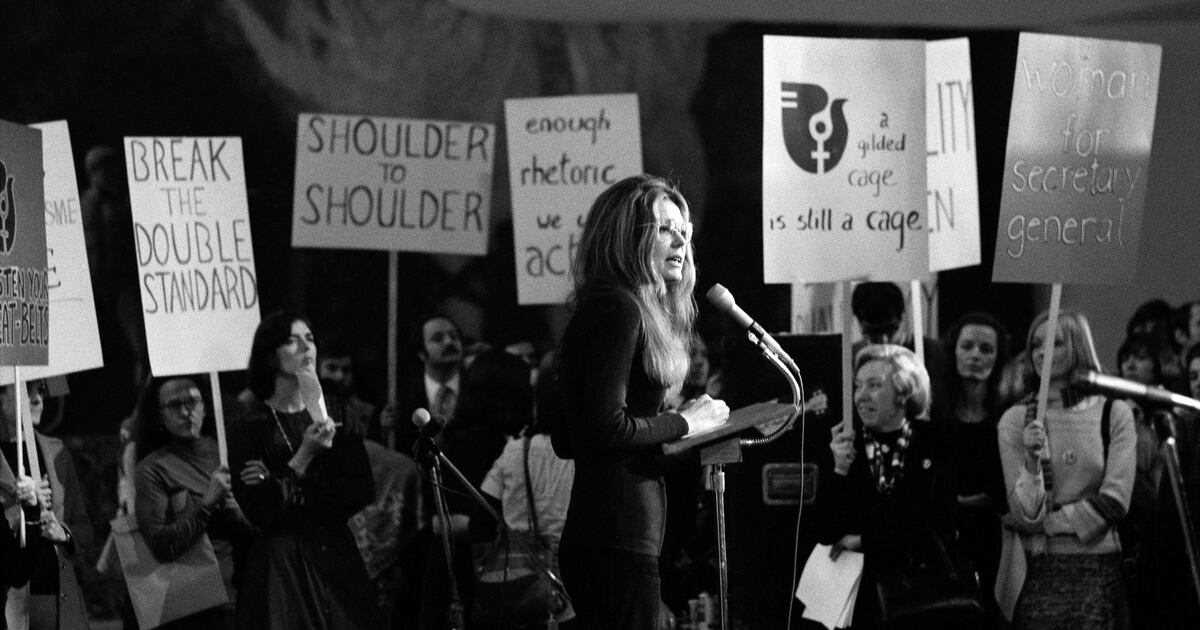
Gloria Steinem, the feminist crusader who galvanised the modern women’s movement, helping millions of women develop a sense of self-worth and gain a measure of equality, died on September 2nd at her home in New York City. She was 92.For more than half a century, Steinem personified the women’s movement and became its most enduring symbol; her tinted aviator glasses and curtain of streaked-blond hair parted in the centre made her one of the world’s most recognisable women.She was an unlikely revolutionary. Growing up a transient in the US midwest, she was 10 when her parents divorced, and she was left to care for her mentally anguished mother. She had scant formal education until sixth grade.But she read voraciously, graduated from college with honours and believed fiercely that women should be able to live whatever life they chose.Her own feminist awakening didn’t come until her mid-30s, when, as a journalist in 1969, she attended a “speak out” of women discussing their illegal abortions.She led protests and consciousness-raising sessions, wrote essays and delivered speeches, delved into political organising, helped establish rape crisis centres and shelters for battered women and founded numerous groups that promoted women and raised money for their causes.And she and a cadre of feminists had the audacity to start a publication that flew in the face of traditional women’s magazines. The first glossy national periodical created, owned and run entirely by women, Ms. magazine, founded in 1971, sought to channel a rising sense of women’s empowerment and eradicate sexist assumptions that permeated the culture.“When we started, there was not even a term for sexual harassment,” Steinem often said. “It was just called life.”Gloria Steinem in New York in May 1984. Photograph: Neal Boenzi/The New York Times Gloria Steinem with Patricia Carbine, a fellow founder of Ms. magazine, in New York in May 1987. Photograph: Angel Franco/The New York Times Indefatigable, she wrote essays and lectured into her 90s. She authored nearly a dozen big nonfiction books; her latest, An Unexpected Life, is scheduled for publication this month.Steinem defied the stereotype of “women’s libbers” as sexless, humourless and dateless. She led a glittering social life and enjoyed relationships with many high-voltage men, including director Mike Nichols and real estate and publishing mogul Mort Zuckerman. She called Franklin A Thomas, the path-breaking president of the Ford Foundation, the love of her life.But she spurned marriage (mostly) and remained child-free, a choice she said she never regretted.Her lifestyle and unapologetic beliefs made her a lightning rod, adored (though not always) by liberals, demonised (always) by conservatives.Steinem began her career in New York as a freelance writer in 1960. When she was first job-hunting in New York, an editor at Life turned her away. “We need a reporter,” he told her, “not a pretty girl.”She broke through with a witty exposé, A Bunny’s Tale, for Show magazine in 1963. Squeezing into a too-small corset, she worked undercover as a cotton-tailed server at the Playboy Club in New York. Her article was praised for revealing the degrading work conditions in that male-fantasy cocoon. But she regretted writing it, for a time anyway, because some used it to dismiss her as frivolous.She was jolted into feminism in 1968 when she reported on a group of women in Greenwich Village discussing their illegal abortions. Angered that they had been made to feel like criminals, Steinem, who had a secret abortion in England in 1957, wrote her first openly feminist essay, titled “After Black Power, Women’s Liberation”.Steinem speaks at a rally in New York in February 1968. Photograph: Robert Walker/The New York Times Gloria Steinem joined by, from left: writer and activist Betty Friedan; author and philanthropist Elinor Guggenheimer; and lawyer and activist Eleanor Holmes Norton at a meeting of the National Women's Political Caucus in New York in 1971. Photograph: Don Hogan Charles/The New York Times The first issue of Ms. was published in December 1971 and ran as an insert in the year-end issue of New York, thanks to editor Clay Felker, who financed and promoted it. The first full stand-alone issue came out in January 1972, again with Felker’s backing.Gloria Marie Steinem was born in Toledo, Ohio, on March 25th, 1934, the daughter of Leo and Ruth (Nuneviller) Steinem. Her father, whom she adored, was a peripatetic antiques dealer, a big dreamer with no money.For years, the family spent summers in rural southern Michigan. When autumn came, they travelled to warmer climes in a house trailer. Steinem grew up an itinerant with no full year of formal schooling until sixth grade. She said she learned to read from road signs along the highway and buried herself in books.Her mother had been one of the first woman reporters and editors at The Blade of Toledo. She had a nervous breakdown, became addicted to a sedative and spent two years in a sanatorium, all before Gloria was born.When Gloria was about 10, her parents divorced, and her sister, Susanne, left for Smith College in Massachusetts.Gloria followed in her sister’s footsteps to Smith, where she majored in government. She graduated magna cum laude and Phi Beta Kappa in 1956.She was drawn to India, just a decade into its independence, by the legacy of Mahatma Gandhi. She had won a Chester Bowles Asian fellowship to study there, but she quickly abandoned her classes. Wearing a sari, she walked through southern India with followers of Gandhi, absorbing lessons about “talking circles” and grassroots organising.Steinem speaks at a conference in New York in September 1979. Photograph: Sara Krulwich/The New York Times After returning to the United States, she spent a year in Cambridge, Massachusetts, as a director of the Independent Research Service, a non-profit educational foundation that recruited and provided government support for US students to attend communist-run youth festivals in Europe. The magazine Ramparts subsequently reported that the foundation had been partly funded by the CIA, and Steinem came under criticism from the left. She dismissed the entire venture as harmless, telling The New York Times in 2016 that no one in the CIA had ever told her what to do or say and that she had never reported to the agency.She moved to New York in 1960 and began working as a freelance journalist. At the time, women were not taken seriously as writers; she wanted to cover politics but was stuck with celebrity profiles and fashion.Still, she was prolific. Her articles appeared in Vogue, Cosmopolitan, Esquire, Family Circle and Life, among other magazines. She was a contributing editor at Glamour and New York.At the same time, Steinem moved comfortably in the sophisticated milieu of New York’s intelligentsia and dated powerful men.Gloria Steinem at her home in Manhattan in February 2026. Photograph: George Etheredge/The New York Times Gloria Steinem hosts a 'talking circle' at her home in the Upper East Side of Manhattan in September 2025. Photograph: Nina Westervelt/The New York Times In 2000, Steinem overlooked her antipathy toward marriage and wed David Bale, a social justice activist born in South Africa (and the father of actor Christian Bale). She was 66. She initially denied rumours that she had married him because he needed a green card, but years later conceded that this had been the case. The marriage lasted three years before he died in 2003, at 62, from brain lymphoma.Steinem had faced her own recurring battle with cancer (of the breast), starting in 1986, after which she suffered from total exhaustion and depression and underwent psychoanalysis. She then spent several years writing and rewriting Revolution From Within: A Book of Self-Esteem.It was her first long public look at herself, and it disappointed some feminists, who saw her introspection as a retreat from much-needed social activism.Revolution From Within wasn’t the only time that she disappointed her natural allies. In an opinion column in the Times in 1998, she defended president Bill Clinton against numerous sexual allegations, saying that his advances toward various women had not been unwelcome or coercive.Steinem devoted much of her life to writing. One of her best-sellers was Outrageous Acts and Everyday Rebellions (1983), her first collection of essays. Other books included Marilyn: Norma Jean (1986), a sympathetic portrait of Marilyn Monroe, and Doing Sixty and Seventy (2006), a reflection on women and ageing.Steinem is survived by what she called her “chosen family” – her close friends. Her mother died in 1981, and her sister, Susanne Steinem Patch, in 2007.Ms. magazine reached its peak circulation in 1989, with 540,000 subscribers, but its finances were constantly in peril. In less than a decade, its circulation fell to 200,000, and the owner threatened to close it.Cobbling together a group of venture capitalists and entrepreneurs, Steinem formed Liberty Media for Women, which acquired Ms. for $3 million. In 2001, the Feminist Majority Foundation took over and kept the magazine alive. The magazine now publishes quarterly.This article originally appeared in The New York Times.2026 The New York Times Company
Gloria Steinem: The face of the women’s movement was an unlikely revolutionary
Steinem’s own feminist awakening didn’t come until her mid-30s
1,482 words~7 min read


