Parlotype's UI was English-only, with the copy baked into markup and C#: 211 literal attributes across 26 .axaml files, roughly 200 string literals across 48 view models, plus the tray menu, the dialogs and the toasts. I wanted Russian and Spanish, and I wanted the ninth language to cost one translation file and nothing else.
Most of that work is mechanical, which makes it a good fit for an agent. I ran it as a directed session with Claude Code: I made the architectural calls and reviewed everything, the agent did the extraction, the translations, the tests and most of the implementation. The result is on master. 389 keys in three languages, 122 files changed, +11,467 / -618.
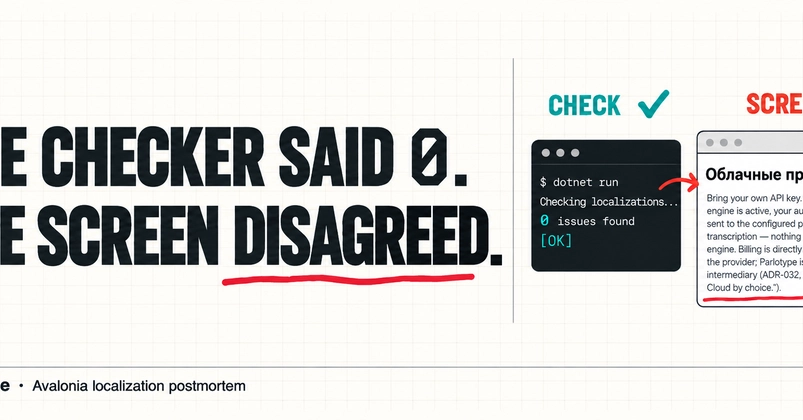
I built the guardrails before the bulk work: a parity script, an xUnit mirror of it, two Claude Code hooks and a skill file. Three user-visible defects shipped past all of them anyway. Each one was a different category of blind spot, and none was a translation error. That is what this post is about.
Some context on me: twenty years across C, C++, Java and Scala, about two years into .NET. This is the second postmortem from Parlotype, a local voice-to-text desktop app I build in the open with .NET 10 and Avalonia 12.