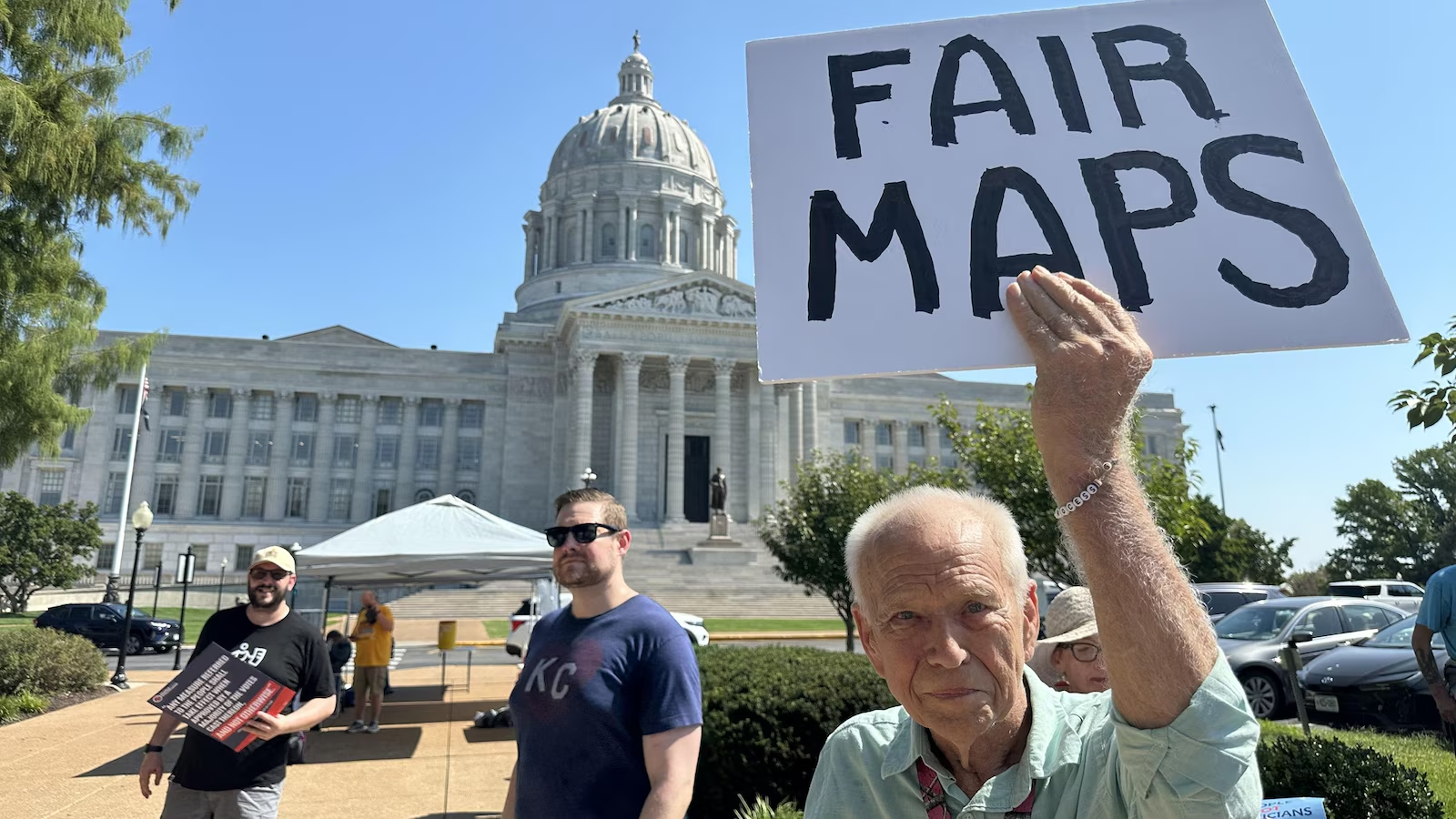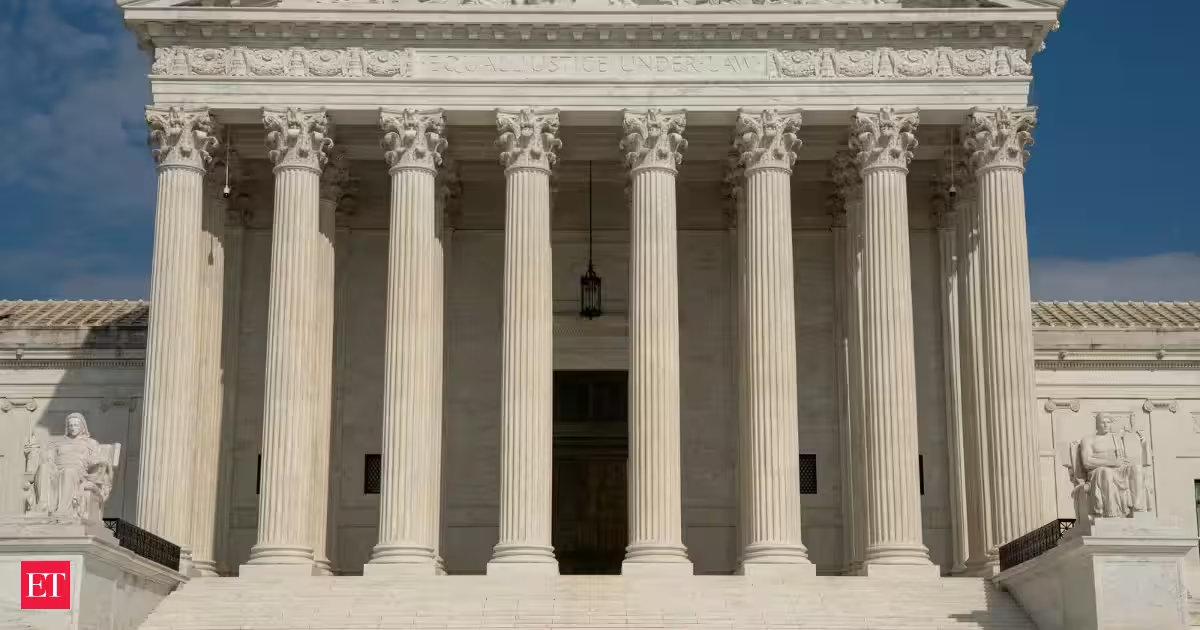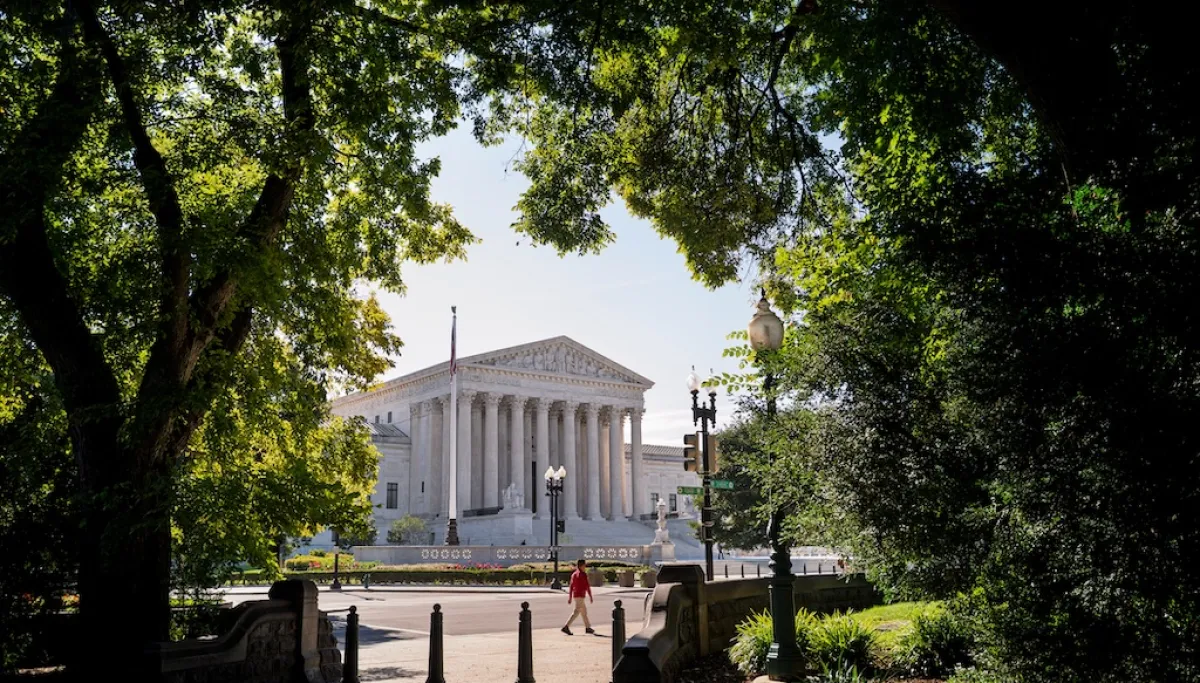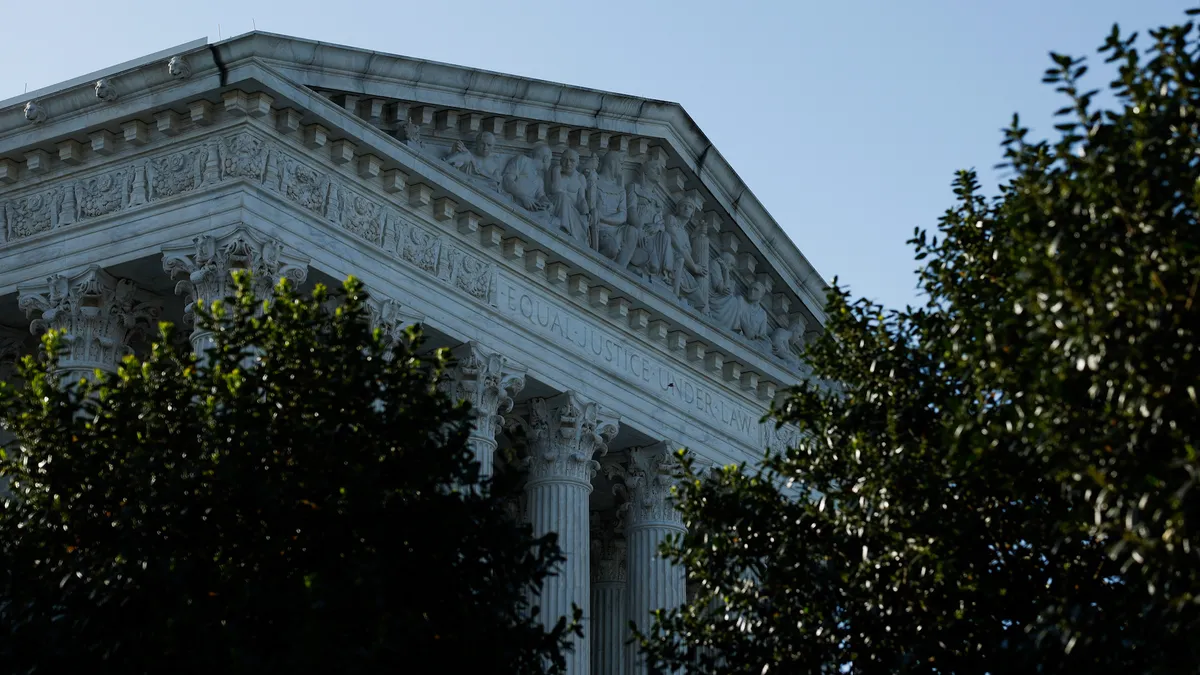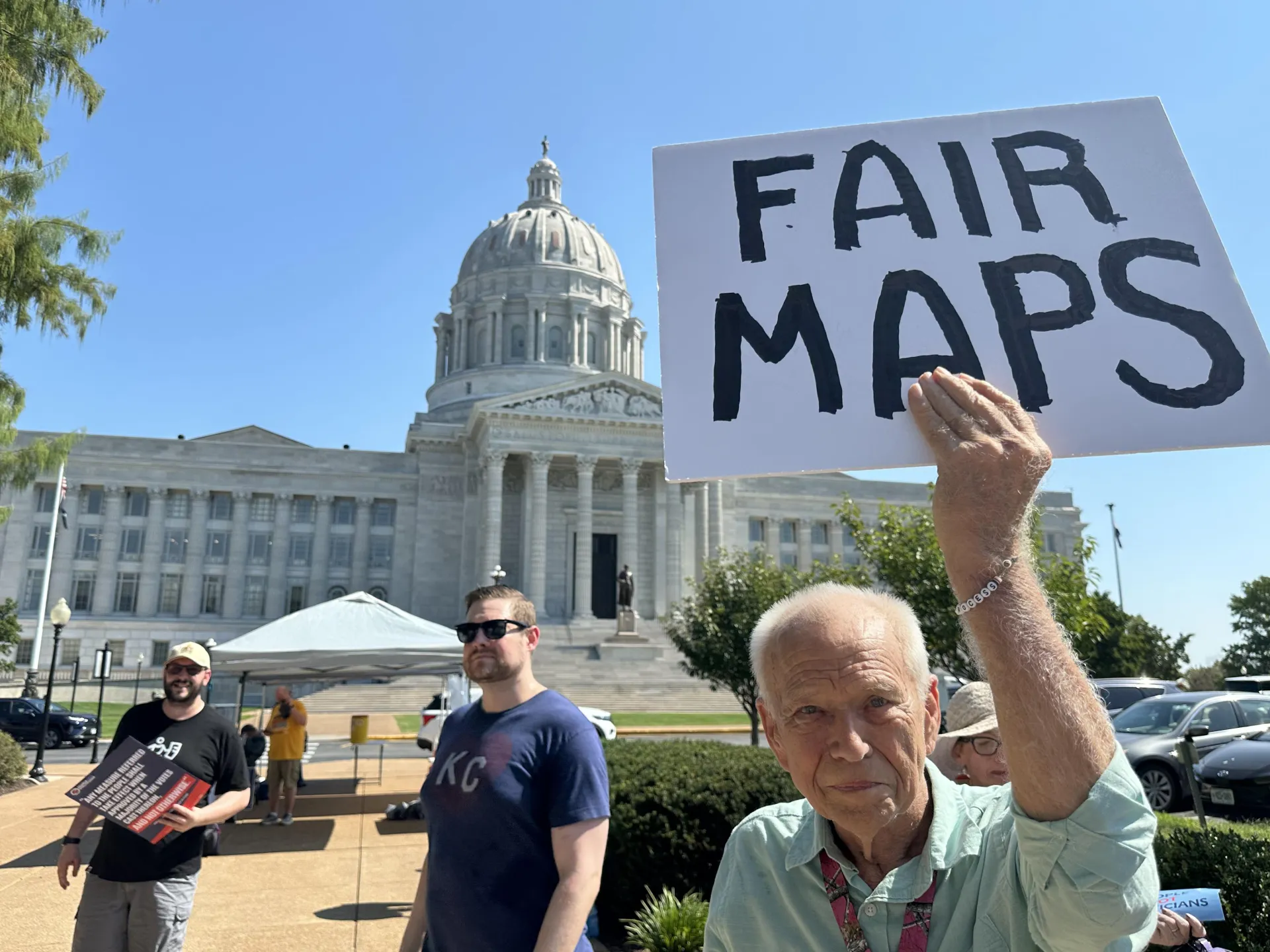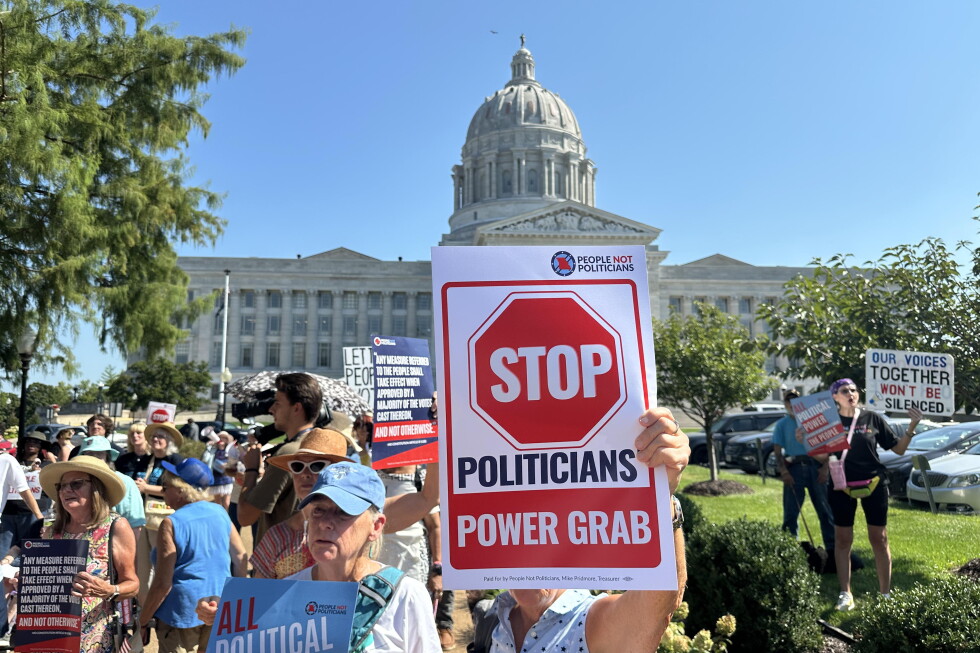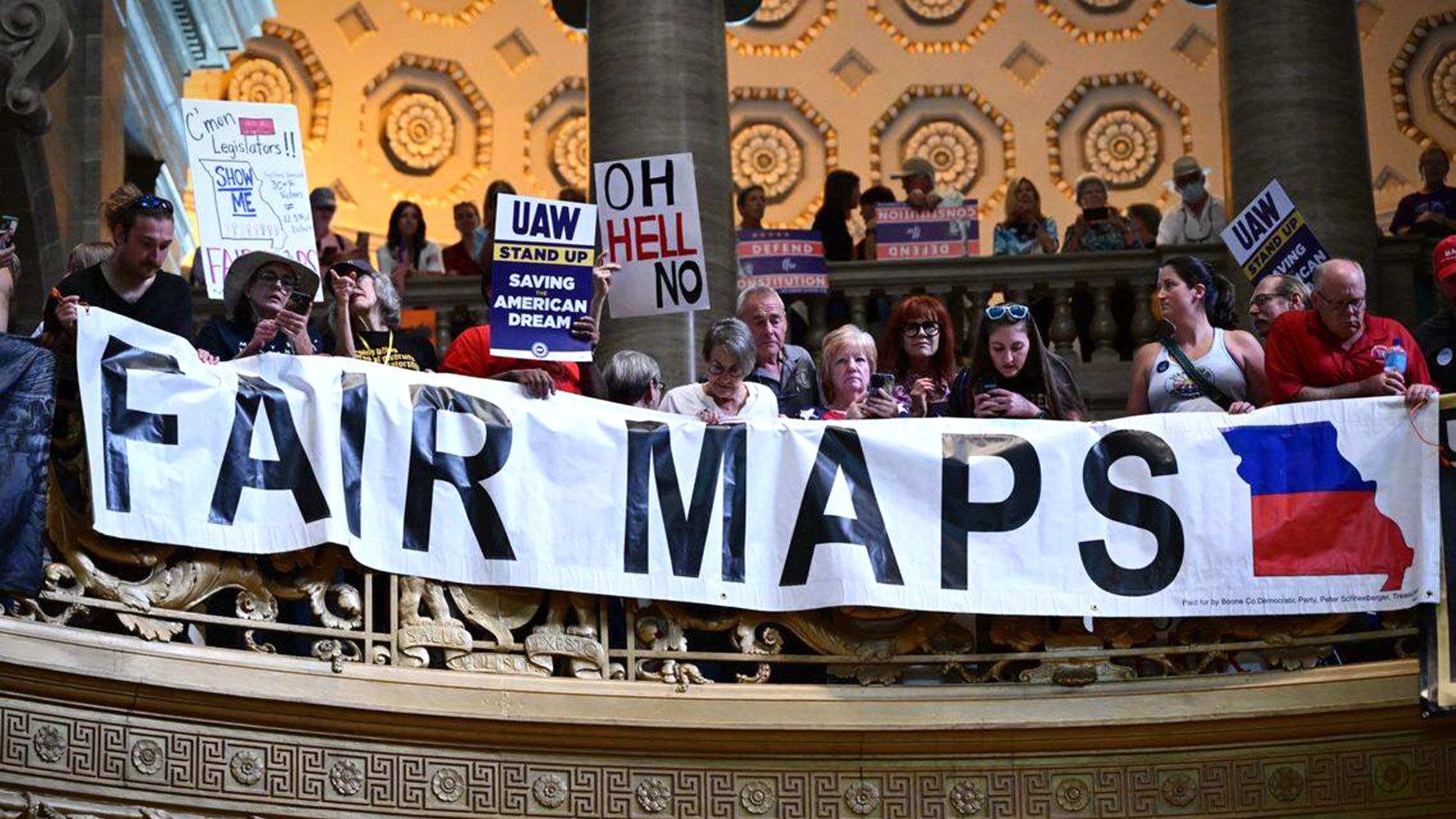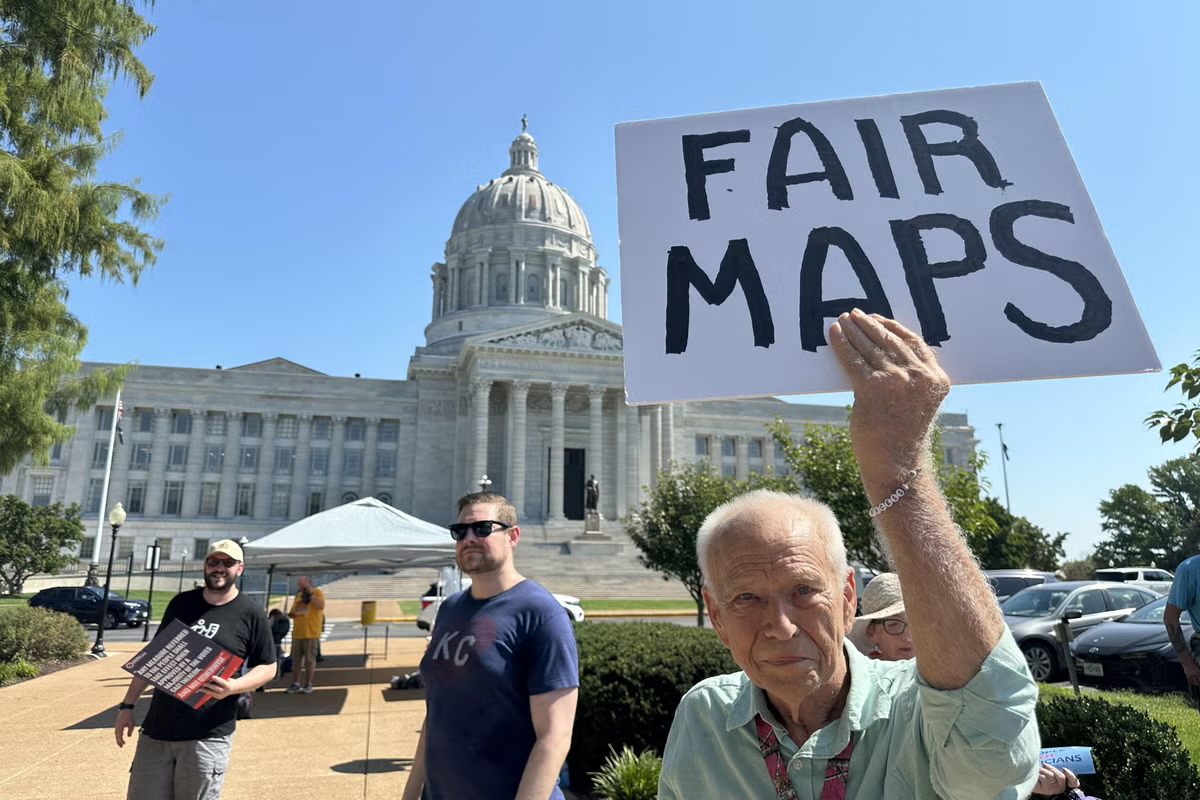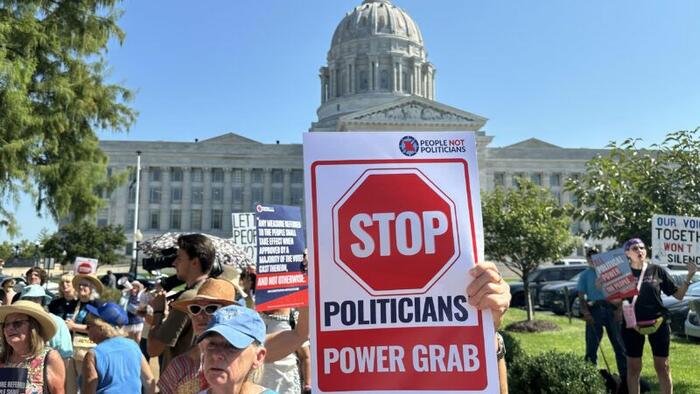
The U.S. Supreme Court blocked Missouri Secretary of State Denny Hoskins on Thursday from using the state's Republican-drawn 2025 congressional map, an order that puts Missouri back under the districts adopted in 2022. The order ran one page, disclosed no vote, gave no reasoning, and drew no noted dissents.In this photo taken with a smartphone, people opposed to a congressional redistricting plan rally outside the Missouri Capitol in Jefferson City, Mo., Wednesday, Sept. 2, 2026. (AP Photo/David A. Lieb)Missouri Republicans drew the new map - known as HB 1 - during a 2025 special session called by Gov. Mike Kehoe, part of a wider redistricting push President Trump encouraged. It was intended to give Republicans seven of the state's eight House seats, reworking the Kansas City-based 5th District held by Rep. Emanuel Cleaver, one of Missouri's two Democratic members.Opponents submitted more than 300,000 signatures late last year to put the map to a statewide vote. Hoskins rejected the petition on Aug. 4 - the day of Missouri's primary - arguing the state constitution "does not authorize a referendum on congressional redistricting plans passed by the General Assembly."The Missouri Supreme Court disagreed unanimously on Sept. 3, holding that the constitution "authorizes a referendum as to 'any act of the general assembly' and no exception applies." Because the petition was "legal, sufficient, and timely," the court concluded, the new map was never in effect and will not take effect "unless and until approved by the voters at the November 2026 general election."The court also dismantled Hoskins' warning that abandoning the new map would cause confusion and expense, calling the argument "wholly unpersuasive" and noting that "these arguments are particularly misplaced given the secretary's delay created" the problems he was complaining about.The constitutional argumentHoskins went to the U.S. Supreme Court that Friday night, telling the justices Missouri was "genuinely unsure whether it can switch its governing congressional map in time to run a timely federal election." His core claim was an elections-clause theory: that the Constitution gives state legislatures, not voters signing a petition, the power to set the "Times, Places, and Manner" of federal elections. He added that the state ruling disenfranchised "hundreds of thousands" of voters by moving them into districts where they would be "forced to vote on General Election candidates they had no role in choosing."Richard von Glahn, who led the referendum committee People Not Politicians, argued the justices had no power to review a ruling resting purely on state law, and that on the merits Hoskins' "Elections Clause theory runs headlong into more than a century of precedent recognizing that state constitutional referendum procedures may constrain congressional-redistricting legislation."Justice Brett Kavanaugh, who handles emergency matters from Missouri, turned Hoskins down Tuesday afternoon without referring the request to the full court.Then it got complicatedLess than an hour later, a federal judge ordered the opposite. Chief U.S. District Judge Stephen Clark issued a temporary restraining order requiring the state to use the 2025 map, in a case filed Sept. 4 by Rep. Robert Onder, a Republican representing Missouri's 3rd District, among others. Clark acknowledged that "conducting state elections in accordance with the Missouri Constitution undoubtedly qualifies as an important interest," but found the federal challengers faced irreparable harm "because many Missouri voters would have to cast their general-election votes for candidates whom they had no role in nominating."Missouri spent the next two days under directly conflicting orders from its own supreme court and a federal one. Hoskins had instructed election administrators to implement the 2022 map immediately after the state ruling. On Sept. 8 he sent a second email telling them to use the 2025 map instead - the act that put him in contempt proceedings.Von Glahn's team went to the Eighth Circuit Tuesday night. That court declined. They returned to Kavanaugh Wednesday afternoon with a 25-page filing, and this time he referred it to the full court. Attorney Abha Khanna told the justices Clark's order "has been in place for mere hours, but the chaos it guarantees has already taken root," and that leaving it in place would cause the disruption Purcell forbids "by subjecting election officials to irreconcilable judicial commands on the eve of an election, with a federal court inserting itself to wreak havoc on the State's elections."Their central procedural argument: Clark lacked authority to act without convening a three-judge court, which federal law generally requires for constitutional challenges involving congressional apportionment.What Thursday's order does and doesn't doThe order stays Clark's ruling - the second time the dispute reached the Supreme Court in a single week - and resolves nothing else. It does not decide standing, the three-judge-court question, or the merits. The stay holds while the appeal proceeds in the Eighth Circuit, and ends automatically if the justices decline to hear the case."The law is the law, the Missouri constitution is clear, as was the Missouri Supreme Court," von Glahn said in a statement, adding that Hoskins "has shown that he cannot effectively do the job he was elected to do."Hoskins' lawyers had filed minutes before the ruling came down, warning that election authorities were already preparing ballots under the 2025 map and that switching back risked the Sept. 19 deadline for military and overseas ballots. The U.S. solicitor general joined the state in opposing the stay.The order came the same morning Hoskins was due before the Missouri Supreme Court to argue why he should not be held in contempt over that Sept. 8 email. He had asked Clark to block the state proceeding. Clark declined.Missouri's deadline to finalize general election ballots has already passed. Some counties paused work on congressional ballots entirely while others prepared the portions unaffected by the fight. Voters will decide the map itself in November as Proposition A. The first ballots go out Sept. 19.
Supreme Court Blocks Missouri Republicans' New Congressional Map
Justice Brett Kavanaugh, who handles emergency matters from Missouri, turned Hoskins down Tuesday afternoon without referring the request to the full court.
963 words~4 min read