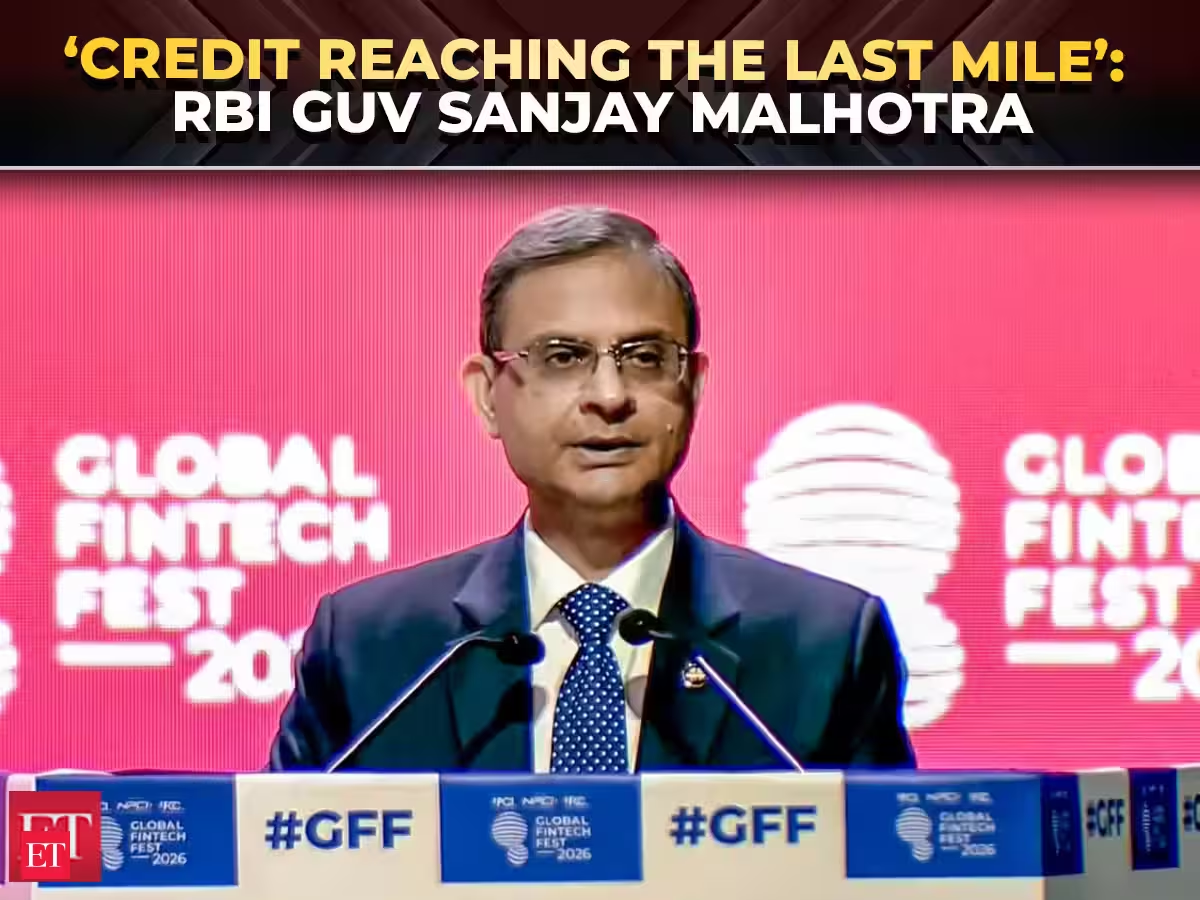
Mumbai: Reserve Bank of India (RBI) Governor Sanjay Malhotra during the Global Fintech Fest 2026, in Mumbai, Maharashtra, Thursday, Sept. 10, 2026
| Photo Credit:
RBI Governor Sanjay Malhotra on Thursday cautioned fintechs against a mindset of structuring a business around the gaps between regulatory categories, or of scaling first and seeking clarity or forgiveness later.In his keynote address at the Global Fintech Festival 2026,said: “The sandbox and pilot mechanisms we have built exist precisely so that innovators can engage with us early, test assumptions under supervision, and shape rules that are workable for genuine innovation. “A firm that engages transparently not only earns regulatory goodwill but also gains faster, more durable pathways to scale. On the other hand, a firm that seeks to outrun the rules realises that the rules catch up, sooner or later, and at a much higher cost to itself and to the trust of the customers it serves.”The RBI keeps regulation light-touch where innovation is nascent and risk contained, and steps in only when activity grows to scale so as to become a systemic risk or for reasons of consumer conduct.The Governor underscored that financial institutions must take systemic responsibility that scales with size. He noted that many fintechs may be outside the perimeter of prudential regulation - and rightly so, since proportionate regulation should not burden early-stage innovation.But as a firm’s payment volumes, lending book, or user base grows to a point where its disruption could meaningfully affect the financial system, that firm acquires a responsibility that goes beyond its balance sheet or its shareholders.“I would describe this as the obligation to be not just “too big to fail” but “too significant to be careless.” Operational resilience, business continuity, and cybersecurity are not burdens to be minimised; they are the price of the scale a firm has achieved,” Malhotra said.The Governor highlighted that the harder work of reaching those still outside the system is where “potential to impact” is least realised today, and where it matters the most.“Too much of the industry’s efforts, understandably, gravitates toward customers who are already banked, already digitally literate, already visible to a credit bureau, just because the underlying cost-benefit justifies it.“I would only ask that connecting the last man standing in the queue remains the focus of today’s innovation and not merely a footnote to it, as fintechs have a big role to play in this,”he said.Consumer trustThe Governor emphasised that mitigating risks pertaining to opacity, bias and exclusion, concentration and herding, cybersecurity, data privacy and security, and erosion of human judgement, among others, while adopting AI is important for maintaining consumer trust.The Governor asked fintechs to treat data as a fiduciary responsibility, not a business asset.“Every fintech in this room holds something more valuable than capital: it holds the data - financial and non-financial - of real people. This data must be treated the way a trustee treats assets held for a beneficiary: collected with clear purpose, used strictly within the consent given, and protected as though it were one’s own,” he said.Malhotra noted that the Account Aggregator framework was built precisely to formalise consent-based, purpose-limited data sharing, so that no single entity, including the aggregator itself, can see or exploit the underlying data.The Governor urged every fintech to internalise this architecture as a value, rather than merely comply with it as a rule. Where a firm treats customer data as a monetisable asset first and a responsibility second, trust erodes and once it does, it does not return easily, he cautioned.Published on September 10, 2026