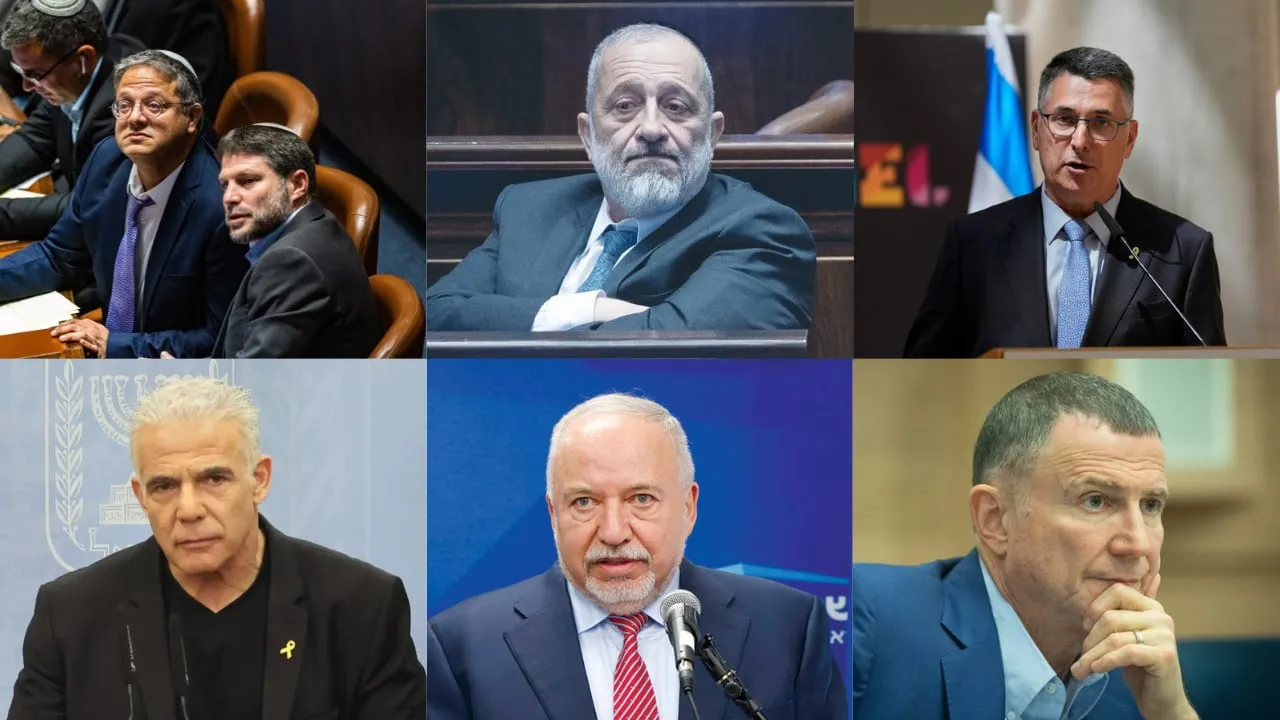
As dynamics in Israel’s political sphere continue to shift rapidly, several key figures in Prime Minister Benjamin Netanyahu’s coalition and the opposition bloc have played significant roles.Following the October elections, the influence of these figures could change dramatically, depending on the balance of power between Netanyahu’s camp and the opposition bloc, as they battle to form the next government.Netanyahu’s coalition blocFrom within Netanyahu’s coalition, two far-right figures have held highly influential roles in the government while continuing to make international headlines: Finance Minister Bezalel Smotrich and National Security Minister Itamar Ben-Gvir.Bezalel SmotrichBezalel Smotrich is the leader of the Religious Zionist Party and has voiced his commitment to remaining in Netanyahu’s bloc.Smotrich has pushed to expand Israeli settlements in the West Bank, with over 100 initiated during his tenure, creating tension for Israel’s diplomatic efforts, and leading him to also be declared persona non grata by several European countries.Finance Minister Bezalel Smotrich leads the Religious Zionist Party, which is polling at around four seats. (credit: MARC ISRAEL SELLEM/THE JERUSALEM POST)He serves as the head of the Settlements Administration, a Defense Ministry body that manages matters in West Bank settlements and advances construction and housing in the area.The far-right minister’s statements calling for West Bank annexation often drew sharp international condemnation, as well as criticism for harming Israel’s global standing.As finance minister, Smotrich had also faced criticism over state budgets approved during the government’s term, which allocated significant amounts of funding to the haredi (ultra-Orthodox) sector.Smotrich pushed for sweeping reforms in the country’s dairy sector, calling for lower milk and cheese prices by addressing monopolies that dominate the market. The government did not pass the reforms during its term because of opposition within the coalition.Smotrich has aimed for continued efforts to advance the reforms and called for addressing the high cost of living by increasing free market competition.Itamar Ben-GvirItamar Ben-Gvir, leader of the far-right Otzma Yehudit party, has also been a controversial and highly influential figure.Internationally, Ben-Gvir’s statements and actions, including repeated trips to the Temple Mount with calls to break the status quo, have led multiple European countries to declare him persona non grata.One condition of Otzma Yehudit’s coalition agreement with Netanyahu was a law mandating the death penalty for terrorists. The controversial legislation, which is largely aimed at Palestinians convicted of terror offenses, was passed in March 2026.Otzma Yehudit party chairman and National Security Minister Itamar Ben-Gvir attends a supporters’ conference ahead of the upcoming general elections in Netanya, September 1, 2026. (credit: ERIK MARMOR/FLASH90)As national security minister, Ben-Gvir also led reforms in Israel’s prison service, significantly worsening conditions for Palestinian inmates, arguing that both the death penalty and harsher prison conditions create deterrence.Otzma Yehudit had repeatedly pushed against hostage deals during the Israel-Hamas war. In January 2025, the party briefly left Netanyahu’s coalition over disagreements on a ceasefire deal.Ben-Gvir, who oversees the police, has been criticized for the spike in crime during the government’s term, specifically in the Arab sector.He remains a key Netanyahu ally, pushing for a far-right stance and the formation of another right-wing government. His party has been polling at approximately eight seats in most recent polls.Arye DeriAnother key figure is Arye Deri, who leads the haredi Shas party and is one of Netanyahu’s most vital coalition partners.Deri has been sharply criticized for his position regarding haredi conscription to the IDF amid the IDF’s severe manpower crisis.He visited arrested haredi draft evaders in military prison in June. Shas stated that he “sought to encourage the detainees,” emphasizing that the party supports them and was working for their swift release and the regulation of their status.The Sephardic haredi party was able to make numerous demands throughout the government’s term while threatening to halt coalition voting when haredi-backed bills were not advanced rapidly enough.Head of Shas party Aryeh Deri and Shas spiritual leader Rabbi Yitzhak Yosef visit at the scene of suspected arson and vandalism at a Jerusalem synagogue which is often frequented by Rabbi Yosef, June 8, 2025. (credit: YONATAN SINDEL/FLASH90)Two of the contentious bills supported by Shas, which passed in the Knesset recently, were a bill to enshrine Torah study as a fundamental value in the country’s Basic Law, along with a bill to temporarily freeze arrests of haredi draft evaders.Shas also resigned from the government in July 2025 following the fallout in negotiations when developing a bill to enforce conscription to the IDF.Deri has been a fierce critic of Attorney-General Gali Baharav-Miara and the decisions made by the High Court ordering the state to take concrete steps to revoke key financial benefits from draft evaders and to move toward criminal enforcement against them.The alliance between Netanyahu and Shas is expected to continue. Prime ministerial candidate Gadi Eisenkot, who heads the Yashar party and is part of the opposition bloc, has also indicated that he would be willing to form a coalition with Shas.Meanwhile, most opposition party leaders have vowed not to sit in a government with the haredi parties.Gideon Sa’arForeign Minister Gideon Sa’ar has held the crucial role of managing the country’s international diplomacy and external relations. He continues to be an ally of Netanyahu and sits in his government, despite previously refusing to be part of it.Sa’ar resigned from the Likud in 2020 after heavily criticizing Netanyahu. He then formed his own party, which merged with Benny Gantz’s political alliance, before ultimately splitting from Gantz and forming his current New Hope-United Right party.However, in 2025, Sa’ar announced that he would return to the Likud ahead of the elections.Before the Likud primaries in August, it was decided in a controversial move that Netanyahu would have the ability to reserve eight slots for his own picks. Sa’ar was one of three ministers to receive a reserved slot.Foreign Minister Gideon Sa'ar hold a press conference at the Foreign Ministry in Jerusalem, September 8, 2026 (credit: CHAIM GOLDBERG/FLASH90)As foreign minister, Sa’ar has taken on countries after they adopted an anti-Israel approach, such as Spain, Ireland, and Turkey.He has also urged the European Union to designate the Islamic Revolutionary Guard Corps (IRGC) as a terrorist organization.The government voted in June to formally recognize the Armenian genocide, following a resolution proposal put forth by Sa’ar.Sa’ar has consistently held diplomatic meetings with foreign leaders throughout the world. In January, he met with the president of Somaliland, Abdirahman Mohamed Abdullahi, after Israel was the first country to recognize Somaliland as an independent state.Opposition bloc and anti-Netanyahu campTwo key figures in the opposition bloc seeking to replace Netanyahu in the upcoming elections have played prominent roles in challenging the government: opposition leader Yair Lapid and Yisrael Beytenu chairperson Avigdor Liberman.Yair LapidYair Lapid has led the centrist Yesh Atid party, which currently has 24 Knesset seats. As opposition leader, he has consistently rallied against the government and pushed against it on many issues.He has held Netanyahu responsible for the October 7 Hamas massacres, calling for him to be removed from office and demanding the establishment of a state commission of inquiry to probe government failures surrounding the attacks.Lapid has also accused Netanyahu of falsifying official security protocols to deflect blame during investigations into the government’s handling of the attacks.Opposition Leader Yair Lapid speaks during a press conference as part of the B'Yachad party election campaign in Tel Aviv, central Israel, August 19, 2026. (credit: AVSHALOM SASSONI/FLASH90)The Yesh Atid party merged with prime ministerial candidate Naftali Bennett’s B’yachad party in April, with Lapid agreeing to the number two slot in the party. Yesh Atid now has a limited slate of candidates on the B’Yachad Knesset list.Lapid has stated that he was putting his ego aside and taking the second slot due to the importance of uniting the political camps in the opposition bloc.He briefly served as prime minister while in a rotation government with Bennett, which was formed in 2021.Avigdor LibermanAvigdor Liberman, another fierce critic of Netanyahu and his government, has been open about his aim of becoming prime minister in the upcoming election.He served in key security and diplomatic positions in previous governments, including as defense minister, foreign minister, and finance minister. He has been in the political sphere for over three decades.Liberman holds a hawkish security stance and advocates for expanding settlements in the West Bank. He also strongly advocates for a separation of religion and state.Throughout the Israel-Hamas war and the most recent rounds of conflict with Iran, Liberman has sharply criticized Netanyahu’s military approach, arguing that it was indecisive and failed to eliminate the threats facing the country on multiple fronts.Yisrael Beytenu leader and MK Avigdor Liberman holds a press conference in Tel Aviv, May 6, 2026 (credit: MIRIAM ALSTER/FLASH90)Liberman has taken a hard-line stance on haredi conscription to the IDF, making the issue a key part of his party’s platform.He has called for legislation that would ensure there are no exemptions from IDF service and that those who evade service would be barred from receiving financial assistance from the state.Yuli EdelsteinWhile former Likud MK Yuli Edelstein was part of the ruling party throughout the government’s term, he was consistently a fierce critic of Netanyahu’s coalition and the legislation it advanced.Edelstein initially served as chairman of the Knesset Foreign Affairs and Defense Committee, but was ousted from the position last July after leading efforts to advance legislation on haredi conscription.Edelstein was then part of the small group of lawmakers in Netanyahu’s coalition to speak out and vote against the series of legislation that was later advanced by the haredi parties – with government backing – which critics argue encouraged draft evasion.MK Yuli Edelstein attends a House committee meeting at the Knesset, the Israeli Parliament in Jerusalem on, August 4, 2025. (credit: Yonatan Sindel/Flash90)He stated in July that he was leaving Likud to forge a new political path, subsequently announcing that he was running in the elections with former Israeli ambassador to the UN Gilad Erdan’s Unity party.The former Likud members sought to provide an alternative to right-wing voters dissatisfied with Likud and Netanyahu’s coalition partners. They vowed to uphold right-wing principles and fight for universal IDF conscription.Recently, the party ultimately dropped out of the election race, when polling indicated that it would not pass the electoral threshold.Amid the instability of Israeli politics, particularly during elections, it will soon become clear how the political influence of Netanyahu’s various challengers and partners will shift.No. 14: Isaac Herzog >><< No. 16: Bill AckmanThe 50 Most Influential Jews 2026 Full List
No. 15: Bezalel Smotrich, Itamar Ben-Gvir, Deri, Gideon Sa'ar, Yair Lapid, Avigdor Liberman, and Edelstein | The Jerusalem Post
Following the October elections, the influence of these figures could change dramatically, depending on the balance of power between Netanyahu’s camp and the opposition bloc.
1,726 words~8 min read