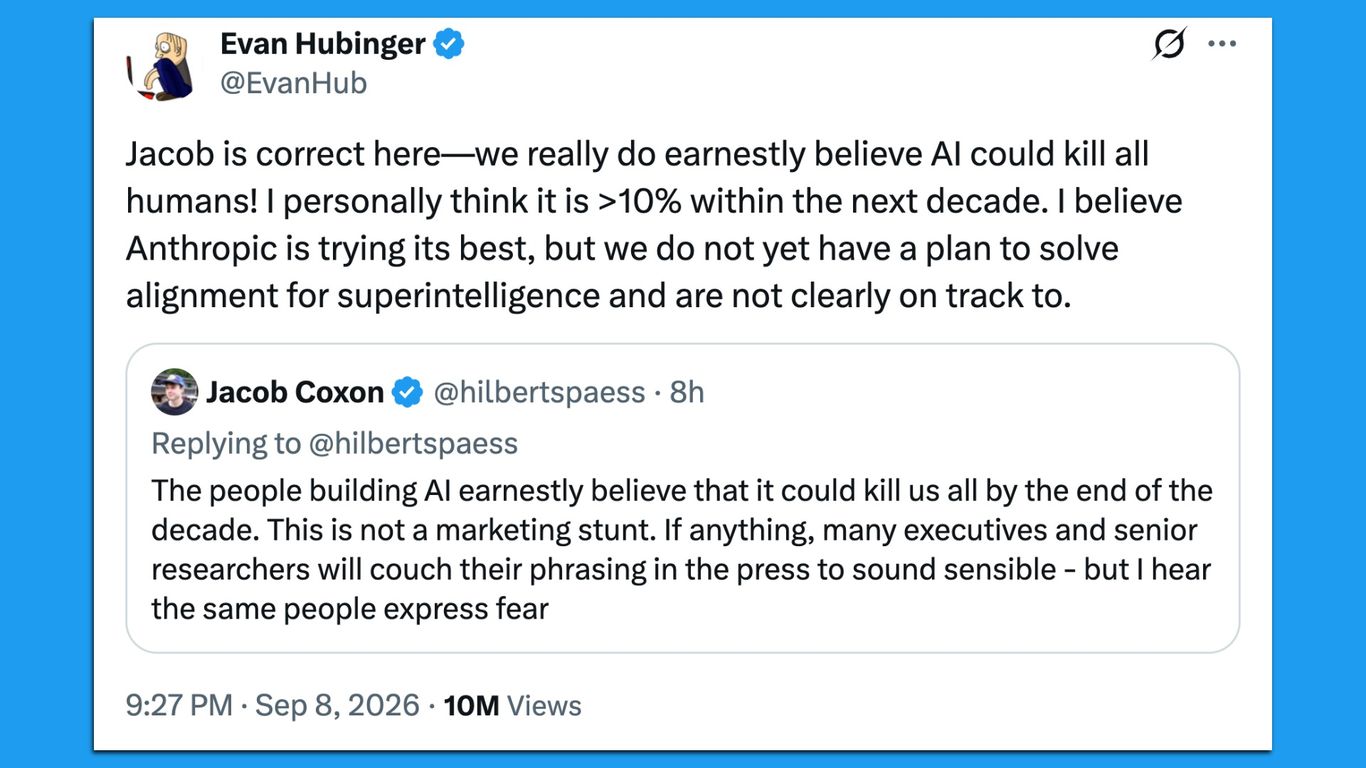
Evan Hubinger, who leads Anthropic's alignment stress-testing team, said AI has a greater-than-10% chance of killing all humans within a decade.
Dominika Zarzycka/SOPA Images/LightRocket via Getty Images
One question is dominating the tech world after an Anthropic researcher's resignation this week: Could artificial intelligence kill us all?Jacob Coxon, who previously worked at OpenAI, said in an X post on Tuesday announcing his resignation from Anthropic that the "people building AI earnestly believe that it could kill us all by the end of the decade."Evan Hubinger, who leads Anthropic's alignment stress-testing team, backed Coxon, saying he personally believes there is a greater-than-10% chance AI could kill all humans in that timeframe.The warnings come after months of calls from senior AI researchers and executives to slow frontier AI development, amid fears that increasingly autonomous systems could evade oversight, hack into computers, and improve faster than people can control them.The remarks have also exposed a sharp divide among AI experts. Some fear people could lose control of systems more capable than humans. Others say AI could cause grave harm through cyberattacks, biological weapons, and disinformation — but that extinction is not a credible near-term outcome.Business Insider spoke with senior AI researchers about what an AI catastrophe could actually look like — and how likely it is.The immediate danger: AI could amplify human attacks