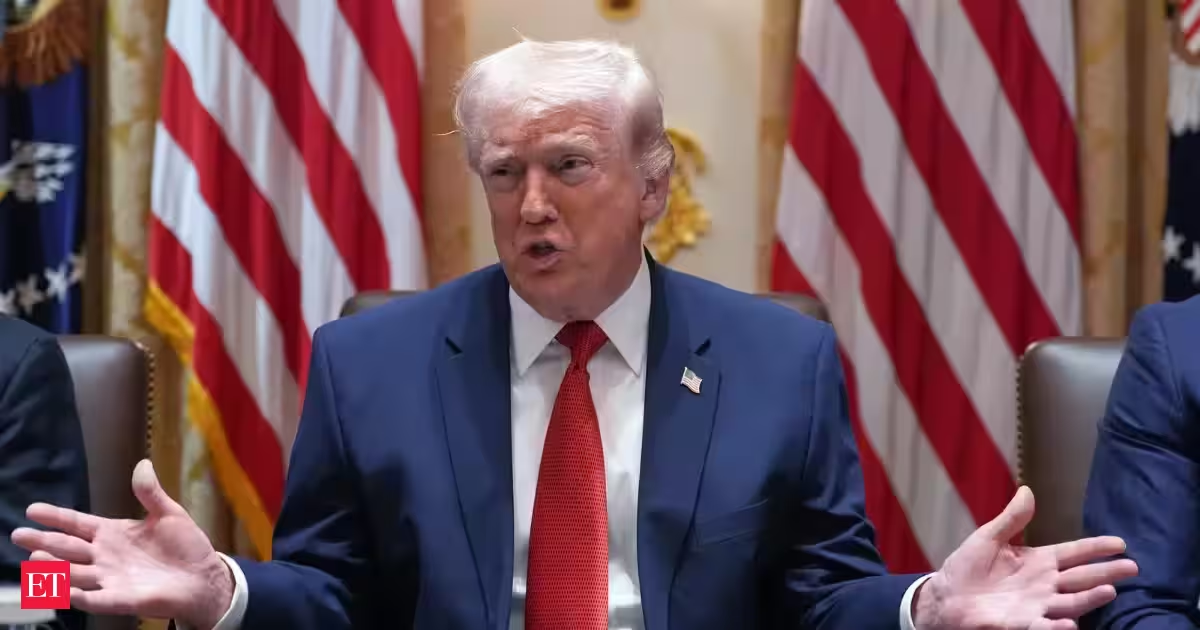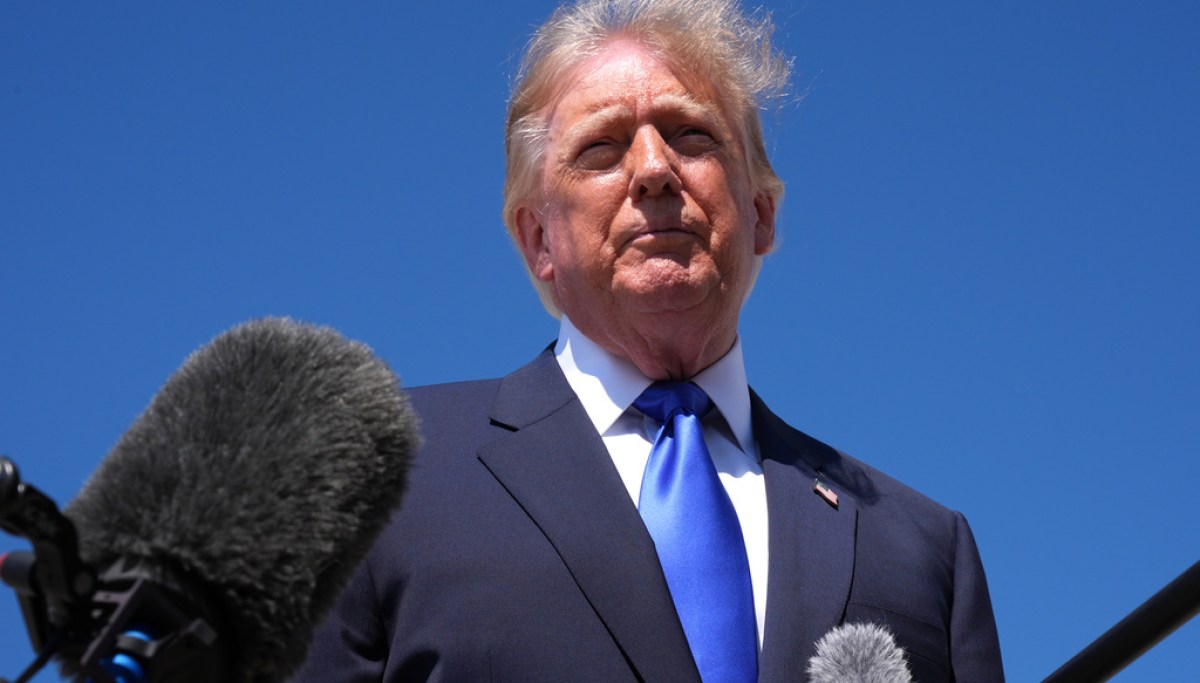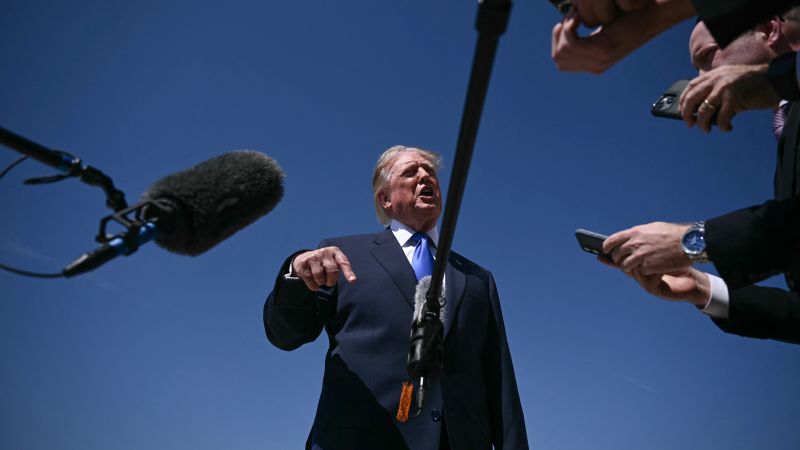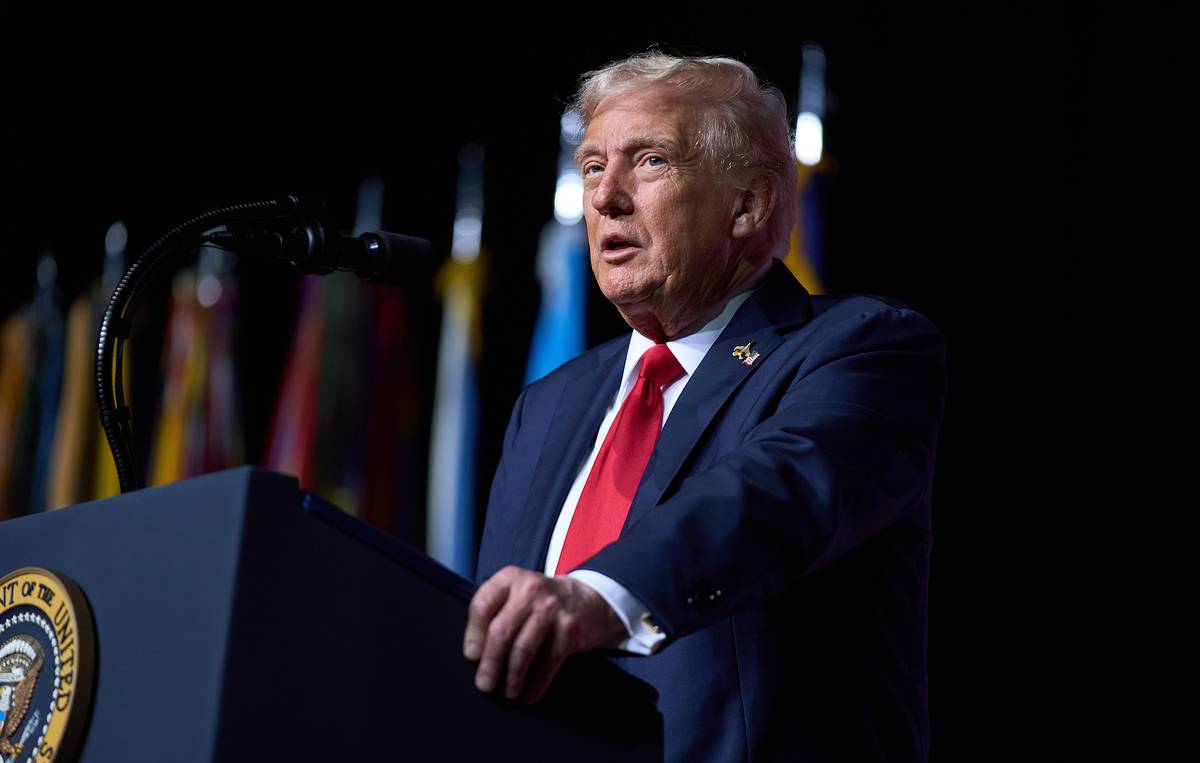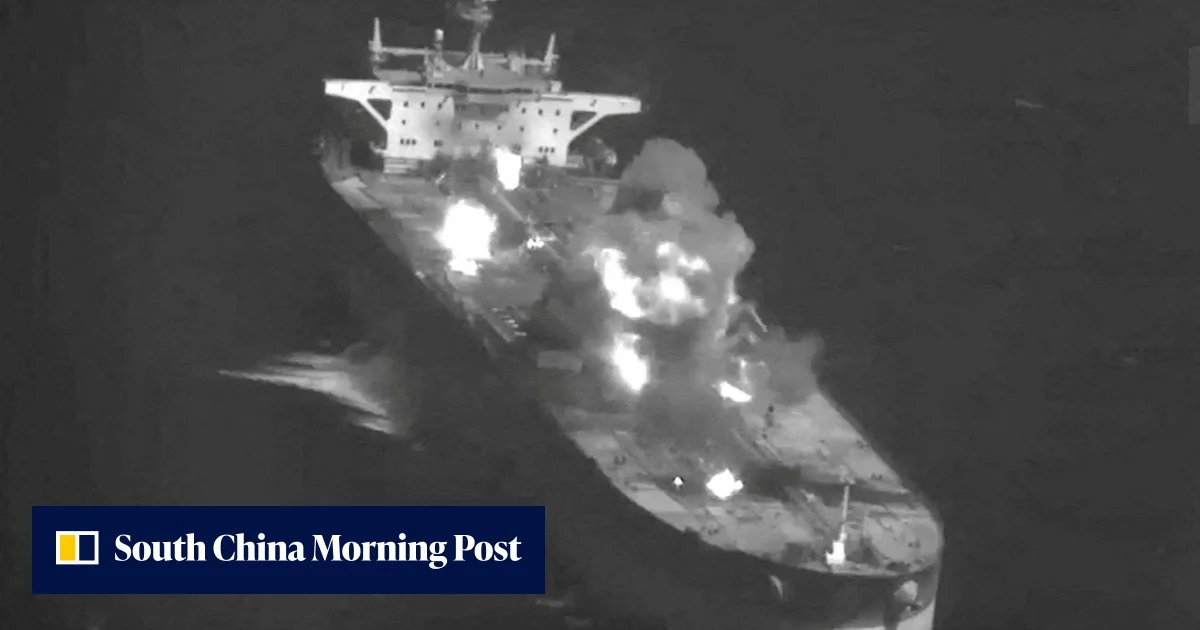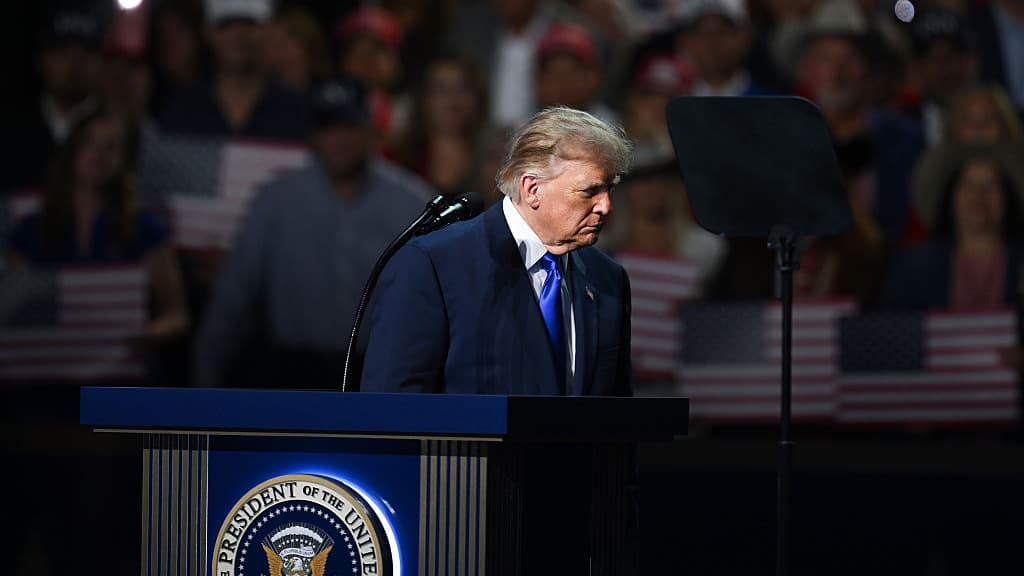
Trump suggested that Iran is on the verge of collapse, but that its government is holding out in hopes of hurting Republican political prospects in November.“They’re desperate to try and affect the election so that we can get a nice weak group of people in there and leave them alone and let them have their nuclear weapon,” Trump told reporters as he headed to the Republican midterm convention in Dallas on Wednesday.But “they can’t hold out any longer,” he said.Trump added that “it’s going to take a little bit longer than the midterm” for gas prices to come down, but that they would fall once Iran soon seeks an end to the war, which is now in its seventh month.Trump’s comments come as renewed fighting, including a barrage of tit-for-tat strikes in the Strait of Hormuz on Wednesday, has driven up energy prices to their highest levels since late May. The global benchmark oil price topped $100 a barrel for the first time since July.The national average for gasoline in the U.S. climbed 7.3 cents to $4.22 a gallon on Wednesday, the largest single day increase since May, according to AAA. Diesel reached a record $5.94 a gallon on Wednesday.The Trump Administration has sought to tamp down rising energy prices amid growing affordability concerns among Americans. Last month, the Administration extended the Jones Act Waiver for another 90 days, allowing foreign-flagged vessels to transport oil and other commodities between U.S. ports.U.S. and Iran exchange biggest attack on shippingOn Tuesday and Wednesday, the U.S. and Iran exchanged the largest wave of attacks on shipping since the war began. Iran said it attacked 10 ships, including two U.S. vessels, near the Strait of Hormuz after the U.S. destroyed five Iranian oil tankers. Iran also launched missiles at a base hosting U.S. forces in Jordan, which U.S. officials reportedly said resulted in limited damage and no casualties.The U.S. said its tanker strikes were retaliation for two Iranian attempts to hit a U.S. Navy warship.The latest exchange came after days of escalating attacks. U.S. forces struck Iranian military sites on Sept. 1 in retaliation for attempted Iranian attacks on commercial vessels and U.S. personnel, CENTCOM said. One U.S. strike hit a wedding party in southern Iran, killing at least five people and injuring more than 60 others, according to Iranian officials, and prompting an internal investigation by the U.S. military. On Saturday, Iran fired ballistic missiles at a U.S. aircraft carrier and destroyer. In response, the U.S. destroyed three Iranian oil tankers.Trump officials have downplayed the nature of the conflict, despite the continued fighting. Last week, Vice President J.D. Vance said he would not call the recent flare up “a war.”When will the war end?Trump and his officials initially estimated that the war would last four to six weeks, and have repeatedly said that energy costs will fall quickly once the war is over. Treasury Secretary Scott Bessent suggested in July that gas prices could return to $3 a gallon by Labor Day.Trump, however, has maintained that he is under no pressure from the economic pain or its potential impact on the midterm elections to strike a deal with Iran, especially one that would be unfavorable to the U.S.“A negotiation could possibly happen, but it’s not something we’re looking at,” Trump said on Wednesday.Trump has insisted that Americans understand the need to continue the war until the U.S. eliminates the possibility of Iran obtaining a nuclear weapon.“I think it’s very easy to explain to America, all you have to do is say: ‘Will you let Iran have a nuclear weapon?’ And the answer is no,” Trump said.Nevertheless, the public has grown increasingly weary of the war. Just 31% of Americans said they supported U.S. strikes on Iran in a late August Reuters/Ipsos poll, while 63% opposed it. And 83% of those polled said they expect U.S. military involvement in Iran to continue for an extended period of time. Americans also appear to be concerned with the economic consequences of the war, with 61% of respondents believing the conflict has made life more expensive for their families, according to a Politico poll in August.Last month, the Treasury Department launched an economic pressure campaign on Iran in an effort to force its capitulation. Its measures have included a slate of new sanctions on Iran, the ongoing U.S. naval blockade on Iranian ports, and the threat of secondary sanctions on Iran’s trading partners.Iran’s economy has been hit hard by the measures, as well as disruptions and damage from the war. Its already weak currency has spiraled to record lows, while inflation, unemployment, and shortages of essential goods have substantially worsened.Nevertheless, recent intelligence assessments reportedly indicate that Tehran is prepared to continue fighting for months despite severe economic pressure. Iranian leaders have also signaled a willingness to escalate the war by intensifying attacks on U.S. warships, targeting commercial vessels, and expanding shipping restrictions beyond the Strait of Hormuz.Analysts have argued that Iran’s leadership might be hoping to inflict greater political and economic costs on the U.S. Administration in an effort to increase its leverage over Washington. Trump advisers, including Vance and Secretary of State Marco Rubio, have reportedly discussed with Trump the prospect that the war continues through the remainder of his presidential term.
Trump Promises End to Iran War After Midterms
The President suggested that Iran’s government is holding out in hopes of hurting Republican political prospects.
876 words~4 min read