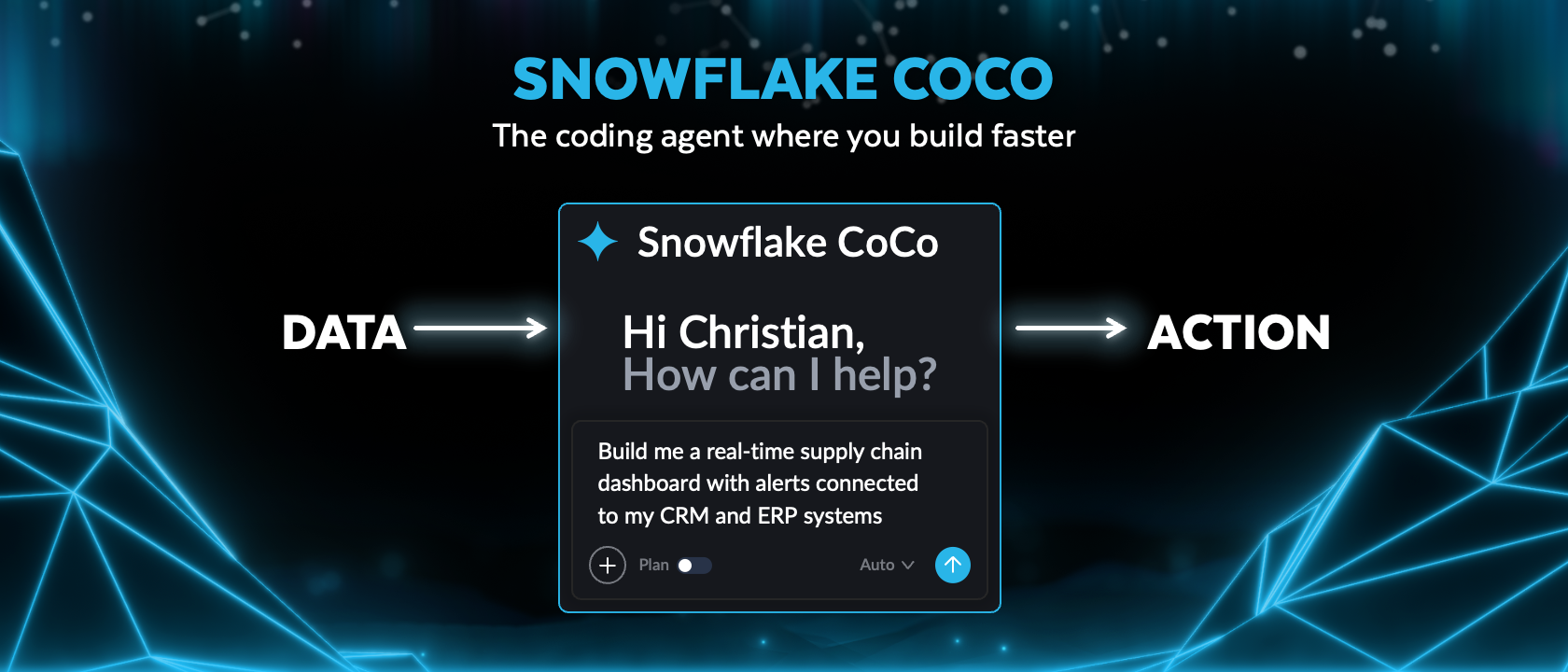
AI slop is everywhere. And for some reason people are still impressed that someone was able to write a simple natural language prompt and wait for the AI coding agent to pump out a large amount of code or text. Generative AI coding tools are the future and are completely reshaping the software and data engineering landscape. But the fact that AI coding agents can generate essentially infinite code isn't that interesting.What matters instead is how professional data engineers should think about and use these tools. Anyone can get an AI agent to produce a result — that's not an accomplishment. What separates a professional data engineer from everyone else is the ability to use AI tools to create repeatable, high-quality outcomes. That's the goal of this post: to share emerging best practices for data engineering with AI coding agents, and particularly with Snowflake CoCo.In this post you'll find four best practices for professional AI-assisted data engineering, the reasons why CoCo outperforms generic coding agents for Snowflake and ways to build skills and plugins that make your team's workflows reproducible.Best practices for data engineering with AI coding agentsThere are a few overall best practices to mention before we get into setup:Start minimal, and iterate from failures: Resist the urge to overengineer things up front. Run prompts, notice what the agent gets wrong, then add a rule.Understand the model is already intelligent: Recent frontier models are trained on current data and capable of most data engineering tasks. You generally only need to tell the model what it can't infer.Treat conciseness as a hard constraint: The context window is fixed and shared during the session. Challenge every sentence: Does the agent actually need this?Make reproducibility the goal: Instructions, skills and tools turn individual expertise into repeatable, high-quality outcomes.There are two more that deserve special attention because we're already seeing people use coding agents in ways that create real problems.First, agents don't replace enterprise data engineering tools. AI coding agents can help data engineers design, build and monitor data pipelines — but in production, they should use the tools built for them: dbt for transformation and DCM tools, such as schemachange, Flyway or Terraform, for deployment. Using agents to execute activities directly in production without established tooling introduces fragility.Second and closely related: Agents should not make changes directly in production. Even with clear instructions, agents are dynamically generating content as they run, which means the output is nondeterministic. Allowing nondeterministic processes to act directly in a production environment has always been a bad practice. Adding AI doesn't change that.Frontier LLMs are already very effective for most data engineering tasks. Most AI coding tools that use them are genuinely useful. But for data engineers working with Snowflake, CoCo is the best choice. Here's why:
CoCo: Snowflake's AI Coding Agent for Data Engineers
Learn how data engineers use Snowflake's AI coding agent CoCo to build reproducible pipelines — covering setup, Skills, Plugins, and best practices.
TL;DRAI
Snowflake launches CoCo, AI coding agent with LLM inference in its infrastructure, via CLI, Desktop and Snowsight. For data engineering professionals, value lies in building reproducible, production-safe workflows with enterprise tools—not direct agent execution in production.
1,587 words~7 min read