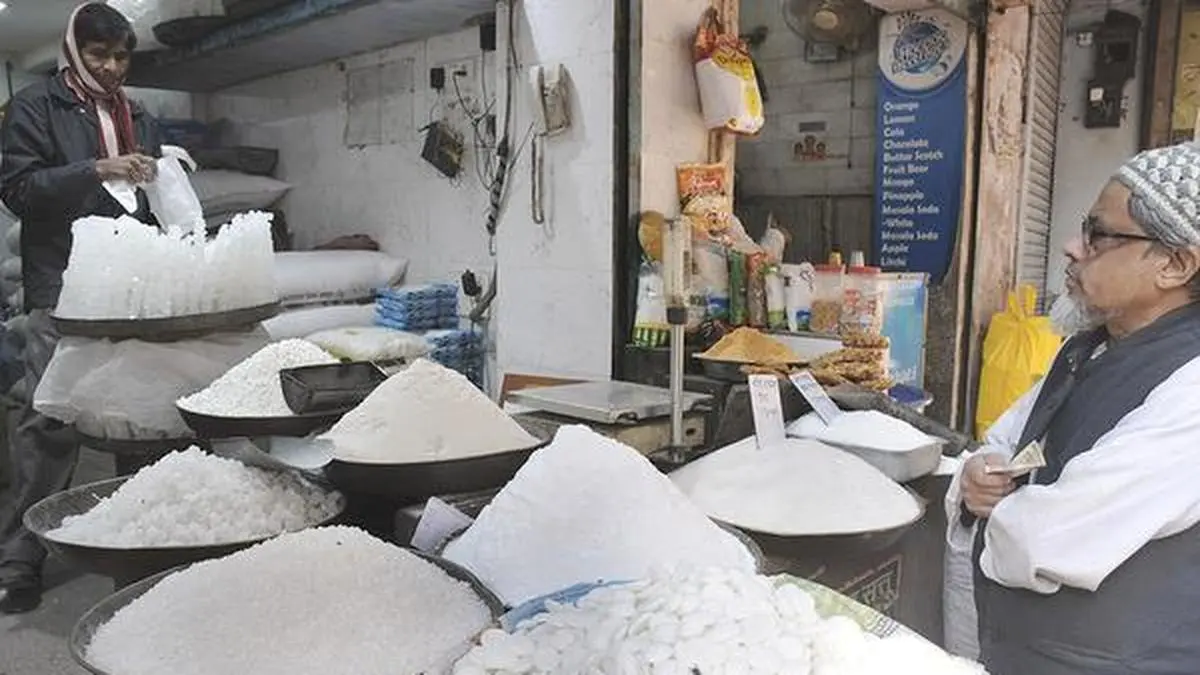
NEW DELHI, 19/01/2016: A sugar trader awaits buyers at the Khari Baoli market in Delhi on January 19, 2016. Sugar production is up by close to 7 per cent at over 11 million tonnes till date in the current 2015-16 season.
| Photo Credit:
The sugar industry has aligned itself to absorb another shock as the government may soon issue order restricting the use of sugarcane juice/syrup and B-heavy molasses for making ethanol, potentially leaving only C-heavy molasses (CHM) for the biofuel. In 2023, the government issued such an order that helped it avert a shortage in domestic market.Addressing a conference organised by India Sugar & Bio-Energy Manufacturers Association (ISMA) in New Delhi on Wednesday, Madhav B. Shriram, Vice-President, ISMA, said that the industry is ready to use CHM, which contains nil sucrose, for ethanol as it will also help increase more sugar available in the domestic market.Currently, the government is besieged with the problem of high level of sugar prices in retail market, majorly at about Rs 70/kg at small grocery shops. A number of measures has been taken in the past few weeks including imposing stock limit, allowing import at zero duty, permitting already imported sugar (for re-export purpose) for domestic sales, mandating mills to ensure lifting within seven days of sales execution. It has also been working now to persuade mills to start crushing sugarcane earlier than normal in October.Second windowLater, speaking to media, ISMA President Niraj Shirgaokar said sugar imports continue to make commercial sense even as domestic prices of the sweetener soften. Industry sources said that the ex-refinery cost of imported sugar after processing now stands at Rs 52/kg and as the government has opened second window seeking application to import raw sugar, the domestic mills have also realised how important it is.Already nearly 8 lakh tonnes (lt) of raw sugar has been permitted by the government after which it opened the window for another round of applications for the remaining quantity of 10 lt permitted under zero duty (TRQ scheme), sources said adding about 70,000 tonnes have arrived in India which were probably purchased on high sea or diverted from some other destinations. Because about 40 days transit is needed to import raw sugar from Brazil.“Imports are still viable despite declining domestic prices,” Shirgaokar said on the sidelines of the fourth edition of The India Sugar & Bio-Energy Conference 2026.Early crushing woesEx-mill prices have fallen to Rs 43-44 a kg from a peak of Rs 65-67 a kg recorded two weeks ago, he said, adding that the impact on retail prices will take another one to two weeks to become visible.ISMA officials said that it has flagged to the government the operational challenges mills are likely to face with early crushing. “We have apprised the government of the difficulties mills might face in starting early crushing. Discussions with the government are ongoing,” Shirgaokar said, adding that the industry remains optimistic about the outlook for the coming year on both production and ethanol allocation, even as it awaits clarity on the next crushing season.According to ISMA, India’s sugar production till August 31 since October 2025 was 277.5 lakh tonnes (lt) and if about 1.5 lt is added in September, the total output may rise to 279 lt in 2025-26 season. The domestic consumption is pegged at 285-290 lt.Addressing the event, EID Parry’s CEO Muthu Murugappan said there is a projection of sugar consumption in India to decline by 10 lt in next 7-8 years.Published on September 9, 2026