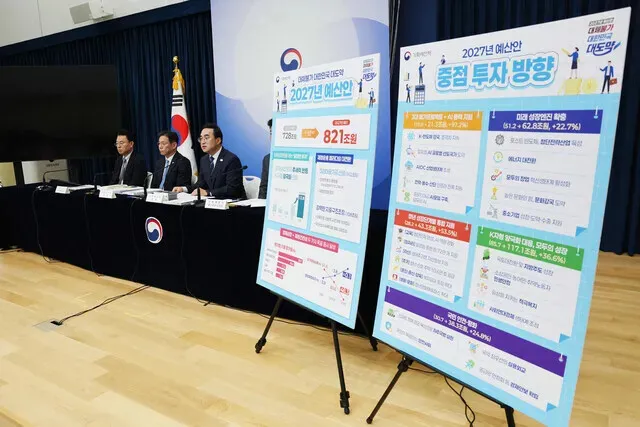
Minister of Planning and Budget Park Hong-keun gives a briefing on the 2027 budget proposal at the central government complex in Sejong on Aug. 28, 2026. (courtesy MPB)
The Korean government has drawn up an 820.9 trillion won (US$601 billion) budget proposal for next year, up 12.8% from this year’s original budget.The increase of 93 trillion won is the largest on record in both absolute and percentage terms, marking the Lee administration’s second consecutive year of expansionary fiscal policy.A year ago, government spending was needed to help the economy recover from the slowdown following former President Yoon Suk-yeol’s short-lived insurrection in December 2024. But this year is different, as the economic recovery has gained clear momentum.The government believes that the boom in tax revenue generated by the semiconductor supercycle presents an opportune time to channel fiscal resources into growth engines and boost the economy’s potential growth rate.Rather than using 100 trillion won in additional tax receipts from chipmakers to repay government debt, it plans to save the money in a separate fund that will serve as a “fiscal reservoir.”On Tuesday, the Cabinet reviewed and approved the 2027 budget proposal, identifying its chief objectives as raising the potential growth rate and reducing polarization.One remarkable part of the proposed budget is that despite the highest spending increase on record, which includes investments in growth drivers, Korea’s economic growth and soaring tax revenues are expected to improve key indicators of fiscal health.The government projects that total revenue next year will rise 30.4% from this year’s original budget to 880.8 trillion won. Fueled by the semiconductor boom, national tax revenue, including corporate and income taxes, is projected to jump by nearly 50% to 584.4 trillion won.With total revenue exceeding total expenditure, the fiscal balance will improve substantially. The consolidated fiscal balance — calculated as total revenue minus total expenditure — is projected to record a surplus of 59.9 trillion won next year.Korea is expected to post a deficit of just 3.1 trillion won in the managed fiscal balance (calculated as total revenue minus total expenditure minus social security fund surplus), a more rigorous measure that excludes current surpluses in the National Pension Service and other social security programs to give a clearer picture of the underlying fiscal position.That deficit is equivalent to 0.1% of gross domestic product (GDP), which comes fairly close to balancing the budget.That’s also a 3.8-point improvement from the managed fiscal deficit of 3.9% of GDP in this year’s original budget. That improvement is aided by a dramatic increase in nominal GDP, the denominator in the calculation.At the same time, Korea’s national debt-to-GDP ratio is projected to fall 3.3 points from 51.6% to 48.3%. The debt itself will rise modestly by 106 trillion won from this year’s original budget to 1.52 quadrillion won.The government cited the need to maintain stability in the bond market as its reason for not using tax revenue windfall to pay back more debt.Korea plans to issue a total of 222.8 trillion won in Korea Treasury bonds next year, with 96.3 trillion won in net bond issuance. The government explained that applying a big chunk of the increased tax revenue to repay debt would reduce bond issuance, potentially weakening liquidity and the trading base in the government bond market.“We sought to strike a balance between reducing debt and keeping the bond market stable,” said an official from the Ministry of Planning and Budget.Instead, the government will establish what it calls a Future Response Fund with 162.3 trillion won in “extra” tax revenue, or the amount exceeding the 6.2% average annual growth rate in domestic tax revenue over the past decade. From that fund, 45.4 trillion won will be invested in four areas: young people, growth engines, balanced regional development, and education and talent.Another 12.5 trillion won or so will be used to reduce new government bond issuance. The government plans to hold the remaining 104.4 trillion won in reserve to address fluctuations in tax revenue or bolster fiscal capacity in the event of a revenue shortfall.The priority investment targets in next year’s budget are the Lee administration’s three “megaprojects” concerning semiconductors, physical AI and AI data centers, along with the AI sector more broadly. Funding for these areas will nearly double from 10.8 trillion won this year to 21.3 trillion won next year.The government will put 2 trillion won into a special account for semiconductors to accelerate the construction of production bases in the greater Seoul area and in the southwest.Additionally, more than 2 trillion won will be invested in speeding up the construction of semiconductor infrastructure, including power and water supplies and industrial complexes, while more than 3 trillion won will go toward R&D in physical AI and pilot projects applying it to manufacturing, construction and agriculture.Nearly 5 trillion won will be used to support the development of a domestic AI model through the purchase of 10,000 top-of-the-line graphics processing units (GPUs) based on Nvidia’s Vera Rubin platform, among other initiatives. With that model, the government plans to provide a free public service called “AI for All.”The government has further allocated 43.3 trillion won to provide broad spectrum support for young Koreans based on their needs at various points in their life, including education, jobs, assets, housing, marriage, and having and raising kids. The three-part package includes dropping income requirements and expanding eligibility for government-backed savings accounts designed to help young people build nest eggs, creating more (and bigger) public housing catered to young people near metro stops and other sought-after areas, and providing stipends for marriage and childbirth as well as basic child allowances. Another 33 trillion won will go to combat disparities between different regions in the country as part of the government response to K-shaped economic recovery. Around 10 trillion won will be used to foster growth engines in five regional hubs and three special regions, with the flagship program being a newly created special subsidy that will support up to 50% of construction costs for anchor companies that invest big in the provinces. The measures include restructuring long-overdue debts incurred by small businesses affected by COVID-19 and expanding the basic income program for rural areas to 35 population-declining regions from the current 17.After Tuesday’s Cabinet meeting, the administration plans to submit the budget proposal to the National Assembly on Thursday for review, with final approval expected in early December.By Park Su-ji, staff reporterPlease direct questions or comments to [english@hani.co.kr]