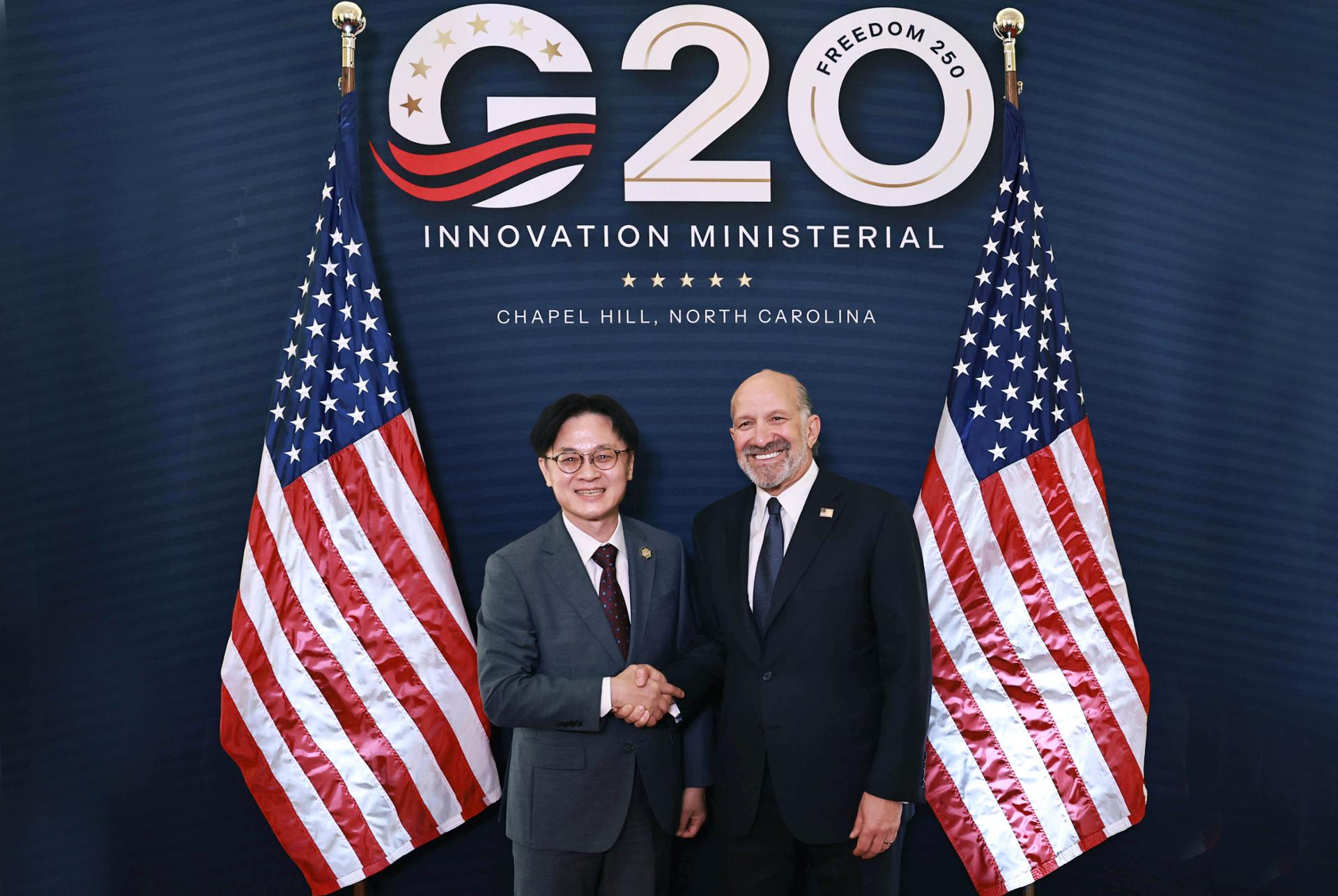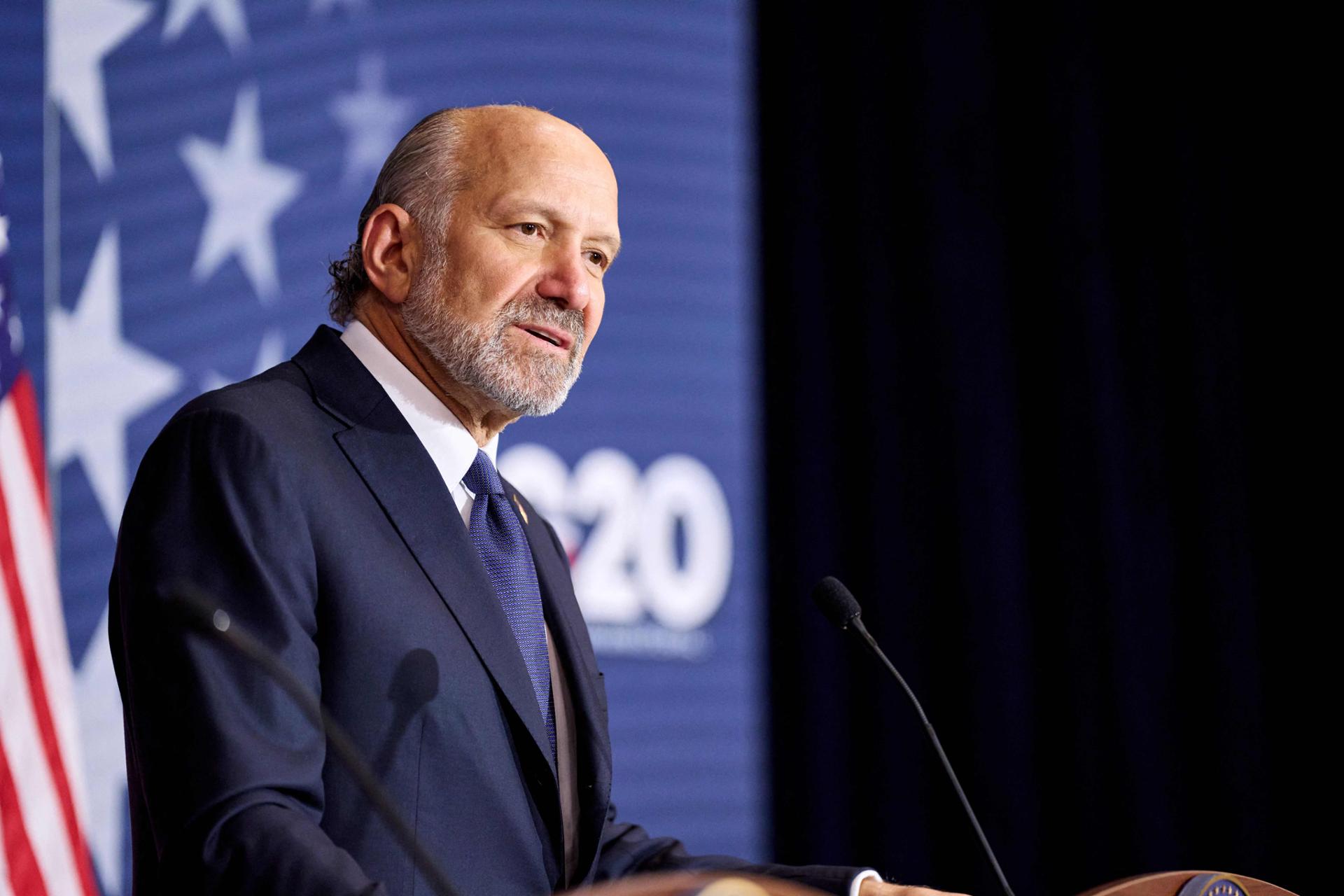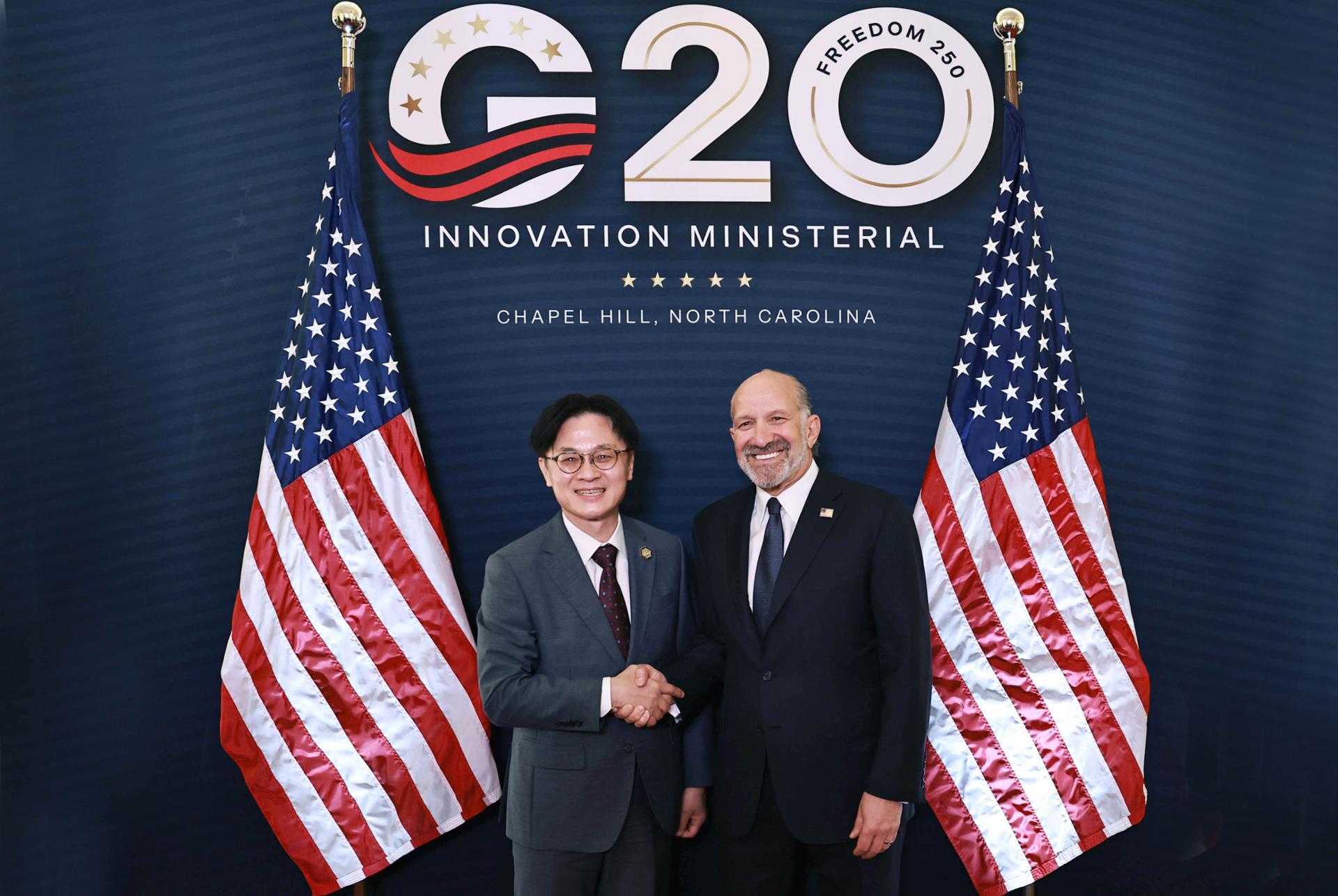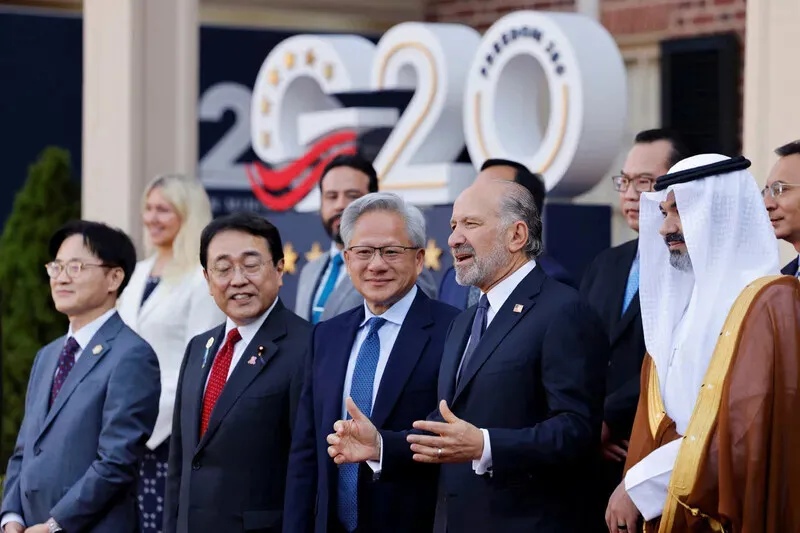
Nvidia CEO Jensen Huang joins US Secretary of Commerce Howard Lutnick and other delegates for a group photo at the G20 Innovation Ministerial summit in Chapel Hill, North Carolina, on Sept. 2, 2026. (Reutres/Yonhap)
US Commerce Secretary Howard Lutnick has confirmed plans for targeted semiconductor tariffs that would penalize companies that do not manufacture chips in the US. The new policy would tie tariff rates to whether chipmakers have production facilities in the US, stepping up pressure on foreign companies to invest in American manufacturing. The move poses new geopolitical and economic challenges for a joint initiative by the Korean government and chipmakers to build massive semiconductor complexes in Yongin, south of Seoul, and in the southwest Honam region, with the goal of establishing Korea as a powerhouse in advanced chips for artificial intelligence.Speaking to CNBC on the sidelines of the G20 Innovation Ministerial in Chapel Hill, North Carolina, on Wednesday, Lutnick said the administration was working on a “targeted, thoughtful tariff policy” for semiconductors.“If you build here, you don’t pay, but if you don’t build here, expect to pay to enter the greatest market in the world,” he said, adding that “all the companies know [the tariffs are] coming.”Lutnick had already stepped up pressure on Korean chipmakers on July 9, saying that he wants Samsung and SK Hynix to build production facilities in the US.The new semiconductor tariff regime is expected to offer lower rates to companies investing in US chipmaking while imposing higher tariffs on those that do not.Lutnick drew an analogy to the Trump administration’s approach to pharmaceuticals.“We gave tariff relief to companies who built their innovative pharmaceuticals in America and did MFN (most-favored-nation). So that’s what you should look for in semiconductors,” he said.Under pharmaceutical tariffs announced in April, the US imposes a 100% tariff on imported patented drugs and ingredients, while companies with approved plans to move production to the US qualify for a reduced rate of 20%.The semiconductor tariffs could also extend well beyond the chips themselves. Politico reported last month that the Trump administration was considering tariffs on finished products containing semiconductors, including laptops, gaming consoles and servers for AI data centers. Lutnick confirmed in the interview Wednesday that Politico’s reporting was “exactly right.”At the moment, the US only imposes semiconductor tariffs on certain products, including advanced AI chips such as Nvidia’s H200 that are imported into the US and then reexported.Washington’s latest move is widely seen as part of a broader effort to expand domestic semiconductor production and build out the industry’s US supply chain.Chang Sang-sik, the director general of the Institute for International Trade at the Korea International Trade Association, said Washington was steadily ratcheting up pressure on foreign chipmakers to invest in the US.“Taiwan is one of the main targets of the semiconductor tariffs, and its tariff treatment has already been tied to US investment. That means Korea will have some tough decisions to make,” he said. Under a trade agreement reached by Washington and Taipei in January, Taiwanese semiconductor companies such as TSMC, the world’s biggest contract chipmaker, can import chips tariff-free during construction of new US facilities at volumes of up to 250% of those facilities’ planned production capacity, with imports above that threshold receiving a preferential tariff rate. Once the plants are built, companies can continue importing tariff-free volumes equal to 150% of their new US production capacity.Lutnick said Wednesday that global chipmakers including TSMC and US memory manufacturer Micron had committed to a combined US$1.2 trillion in US investment. He also said Taipei would announce another US$20 billion-30 billion in US investment next week.Increasing pressure from Washington could complicate the Korean government’s attempts to coordinate major investments by Samsung Electronics and SK Hynix, which announced in late June that they would spend about 800 trillion won building new semiconductor fabs in Korea’s southwestern Honam region.