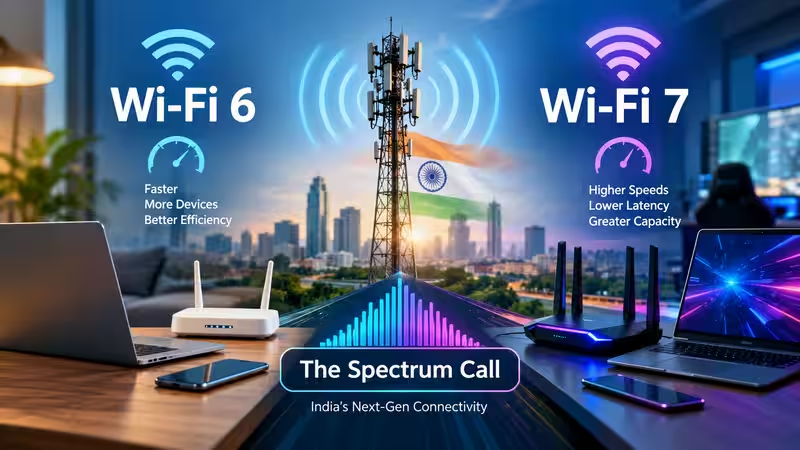
Key highlightsWi-Fi 7 (802.11be) lifts the theoretical ceiling from Wi-Fi 6's 9.6 Gbps to roughly 46 Gbps via 320 MHz channels and 4096-QAM.Multi-Link Operation, Wi-Fi 7's signature feature, lets a device hold two bands simultaneously for steadier latency and handoffs.The 320 MHz channel exists only in 6 GHz spectrum; India de-licensed 5925-6425 MHz for indoor use on 20 January 2026.India's 500 MHz release permits one full 320 MHz channel or three 160 MHz channels; the upper 6 GHz band stays reserved for possible 6G use.Flagship phones already ship with Wi-Fi 7 silicon, but some India units still have 6 GHz disabled in software pending enablement.For most Indian homes on sub-gigabit broadband, a good Wi-Fi 6 router remains the rational buy; Wi-Fi 7 earns its premium above gigabit.What is the actual difference between Wi-Fi 6 and Wi-Fi 7?Wi-Fi 6, certified in 2019 and known to engineers as IEEE 802.11ax, was built for efficiency. It introduced OFDMA, which chops a channel into resource units so a router can talk to several devices in one transmission, along with 1024-QAM modulation and a theoretical ceiling of 9.6 Gbps. Wi-Fi 7, standardised as IEEE 802.11be and completed in 2024, keeps that machinery and widens every pipe. Channels double from 160 MHz to 320 MHz, modulation rises to 4096-QAM, and Multi-Link Operation arrives. Vendor documentation puts the same-radio speed gain at roughly 2.4 times, and a per-spatial-stream rate of 1.2 Gbps on Wi-Fi 6 becomes 2.88 Gbps on Wi-Fi 7 with the shortest guard interval.SpecificationWi-Fi 6Wi-Fi 7IEEE standard802.11ax (2019)802.11be (2024)Bands2.4 GHz, 5 GHz (6E adds 6 GHz)2.4 GHz, 5 GHz, 6 GHzMax theoretical rate9.6 Gbps46.1 GbpsWidest channel160 MHz320 MHz (6 GHz only)Modulation1024-QAM (10 bits per symbol)4096-QAM (12 bits per symbol)Multi-link operationSingle-band linkSupported (two bands simultaneously)Interference handlingOFDMAOFDMA plus preamble puncturingSecurityWPA3WPA3Which Wi-Fi 7 features matter in daily use?Start with 4096-QAM, because it is the most misunderstood. Quadrature amplitude modulation packs data into radio symbols, and moving from 1,024 to 4,096 constellation points raises the theoretical rate by 20 per cent. Those extra points, however, demand a very clean signal, so 4096-QAM engages only at close range with a strong link. Across a typical flat it fades long before the advertised ceiling does. The 46 Gbps figure, meanwhile, assumes 16 spatial streams; a phone carries two or three, which is why real handsets top out closer to 5 Gbps in vendor testing. The marketing number measures the standard's ceiling rather than any device's speed.Multi-Link Operation is the feature with the most visible everyday value. Today's routers broadcast on several bands, but each device joins one; Wi-Fi 7 lets client and router hold two links at once, spreading traffic like cars across two highways or shifting load the moment one road jams. A call stays up as a phone roams from 6 GHz to 5 GHz to 2.4 GHz, and latency stops spiking when the neighbour's network crowds a band. Wider 320 MHz channels help only where spectrum is empty, which is precisely what 6 GHz provides, and what congested 5 GHz corridors are too crowded to offer.What exactly did India decide on the 6 GHz band?On 20 January 2026, the Ministry of Communications issued the Low Power and Very Low Power Wireless Access System including Radio Local Area Network in Lower 6 GHz band (Exemption from Licensing Requirement) Rules, 2026, de-licensing 5925 to 6425 MHz for indoor low-power and very-low-power devices. Devices run licence-free, with spectrum use shared on a non-interference basis. The Department of Telecommunications had proposed the move in May 2025; the six-month gap reflected a genuine tug-of-war between telecom operators, which wanted the spectrum reserved for rural 5G and future 6G, and technology companies, which argued that Wi-Fi carries mobile data into homes far more cheaply than licensed airwaves.India's compromise mirrors the European model rather than the American one. The United States opened the entire 6 GHz range, roughly 1,200 MHz; India released 500 MHz and held back 6425 to 7125 MHz for possible auction to mobile operators. The rules restrict power to protect satellite and microwave links that still use the band.
Wi-Fi 6 Vs Wi-Fi 7: What India's Spectrum Call Changes
India de-licensed the lower 6 GHz band for indoor wireless use on January 20, 2026. This move enables Wi-Fi 7's advanced features, including wider channels and faster speeds. However, only 500 MHz of spectrum was released, limiting its full potential. Consumers with sub-gigabit broadband should consider Wi-Fi 6 routers for now. Wi-Fi 7 offers benefits for homes with gigabit speeds and demanding applications.
677 words~3 min read