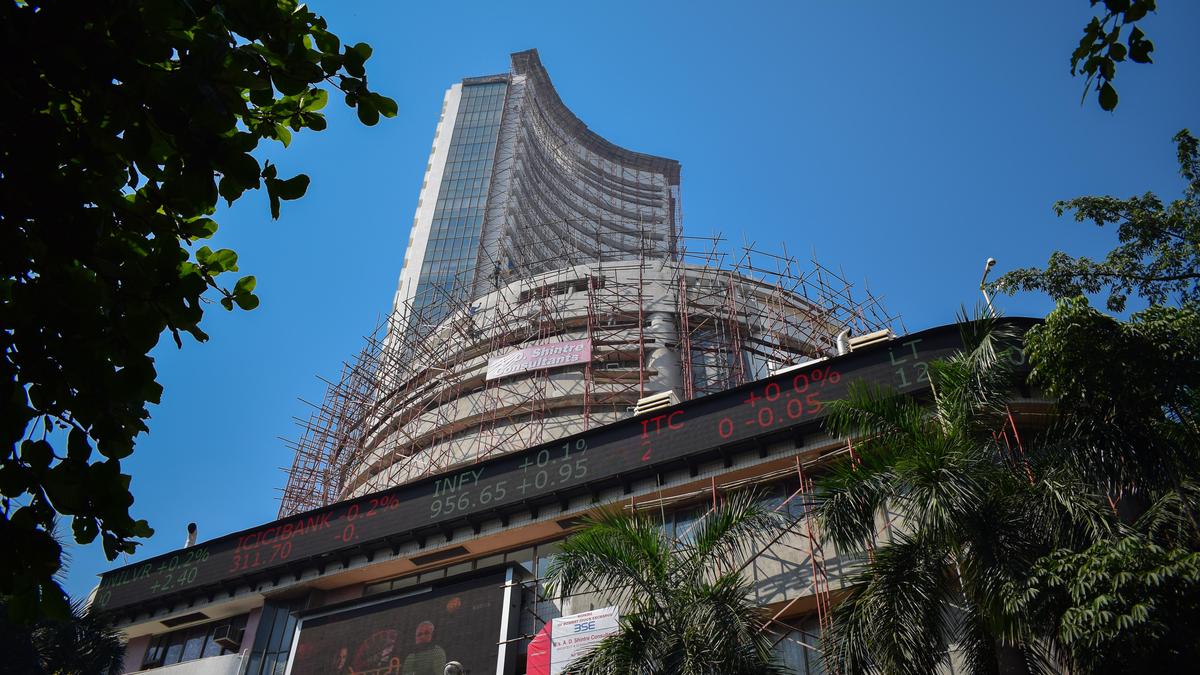
The Indian stock market tumbled for the third straight day, with Sensex and Nifty closing in the deep red as soaring oil prices and other concerns spooked investors.Sensex tumbled over 813 points to close at 74,764, while the Nifty50 dropped around 204 points to end the session at 23,431. The losses wiped off over Rs 2 lakh crore from the total market capitalisation of all companies listed on BSE, pulling it down to Rs 484 lakh crore.Infosys, HCLTech, Tech Mahindra and TCS shares dropped 2-5% each to lead losses on Sensex, while Hindustan Unilever (HUL) and HDFC Bank shares fell around 2% each. Bucking the trend, Adani Ports shares jumped around 4% while those of Tata Steel were up over 2%.Broader markets also slipped into the red, with Nifty Midcap 100 and Nifty Smallcap 100 indices falling up to 0.6%. Among the sectors, Nifty IT crashed more than 3% to lead losses, while Nifty Metal gained around 2%. The overall market breadth remained negative, with NSE seeing 2,092 declines against 1,484 advances, while 100 stocks remained unchanged.Here are six key factors behind the market downtrend today:1) Iran-US tensions escalateTensions in the Middle East escalated on Tuesday after Iranian-backed Houthis in Yemen launched strikes on several Saudi cities, further embroiling a US ally in the raging. US forces meanwhile hit multiple Iranian oil tankers and Iran struck a US base in Jordan.Iran's Revolutionary Guards today said they have attacked two US vessels and eight oil tankers in the Gulf in response to what they called a US attack on five Iranian tankers, Iranian state media reported, citing a statement from the group. The group said it attacked 10 ships attempting to cross what it described as a "prohibited and unsafe" area of the Strait of Hormuz.2) Oil prices cross $100/barrelAs a result of the latest escalations in the Middle East war, oil prices soared above $100 per barrel. After soaring near $130 per barrel earlier this year during the raging war, oil prices had sharply cooled down below $90 per barrel as brief ceasefire and negotiations spiked hopes for a sooner conclusion to the conflict. However, the latest escalations are again spooking investors about prolonged closure of the Strait of Hormuz, a critical waterway for global oil shipments."Oil market participants now [are] pricing in a more prolonged disruption to shipping flows," Hamad Hussain, senior economist at Capital Economics, told the New York Times. Capital Economics has consequently moved towards an assumption of oil prices around $100 a barrel for the rest of 2026. Its analysts said last week that energy flows from the Middle East may not return to prewar levels until early 2027. That is a substantial change from the earlier expectation that prices would fall as the initial shock faded.3) IPO frenzy weighs on D-StreetAs many as six mainboard IPOs are opening for public bidding today, including Rentomojo, Karamtara Engineering, LCC Projects, Steamhouse India, Manipal Payment & Identity Solutions, and Asset Reconstruction. Analysts believe that recent strong listings have increased investor interest in India’s primary market, which can in turn lead to some downturn in the secondary market.“The booming IPO market is sucking liquidity out of the market resulting in sustained downtrend in the Nifty,” said V K Vijayakumar, Chief Investment Strategist, Geojit Investments.4) IT stocks under pressureThe sharp fall in heavyweight IT stocks was also pulling down the market. The Nifty IT index plunged more than 3% while Coforge shares crashed 5% after the company announced the resignation of non-executive Independent Director and Chairperson Om Prakash Bhatt with immediate effect on September 8, 2026.Infosys, TCS, Tech Mahindra and other IT stocks also sharply tumbled, with Fed rate hike expectations continuing to fan investor worries.5) Rupee fallsRupee fell to 95.1050 against the US dollar, extending the decline. Persistent FII selling over the past few sessions has added further pressure on the currency, according to Jateen Trivedi, VP Research Analyst of Commodity and Currency at LKP Securities.“Going ahead, participants will closely track the US PCE Price Index this week and the Fed’s policy decision next week, with the underlying market bias increasingly pricing in the possibility of a rate hike. The rupee range can be seen between 94.50–95.25,” he added.6) FII sellingForeign investors remained net sellers of Indian equities, selling shares worth Rs 123 crore on Tuesday, according to provisional data on NSE. While this is not significant single-day sale, recent streak of FII selling has been dampening sentiment on Dalal Street.FIIs have remained net sellers of Indian equities for four out of six sessions this month so far.What lies ahead for Dalal Street?The listing gains from IPOs, which has increased to about 22% since June, are driving investors, both retail and institutional, into the IPO market, Vijayakumar from Geojit Investments noted. He said this is understandable since Nifty return so far in 2026 is negative 9.5%.Even FIIs who have sold equity for Rs 28,4000 crores through the exchanges so far this year have put in about Rs 36,000 crore in IPOs so far this year, he added. Everyone is riding the momentum in the IPO market. This frenzy has pushed up the IPO valuations, too. IPOs are getting subscribed irrespective of valuations. Investors have to be discrete while applying for IPOs, the analyst advised.“There are good and reasonably-priced IPOs. Investors can apply for these. But instead of blindly applying for all IPOs driven by FOMO, investors can now accumulate fairly-valued stocks, particularly large-caps in growth sectors. Investing in these segments and waiting patiently will reward investors handsomely while many IPOs run the risk of going below the issue price. Discretionary is the better part of FOMO,” he added.Technical view on NiftyNifty 50 index on the daily chart formed a third consecutive sizable bearish candle with a lower high and a lower low and a bearish gap above its head (23,635-23,571), signalling continuation of the corrective decline, with the Nifty closing below the July low of 23,606, said Pabitro Mukherjee, Deputy Vice President-Research at Bajaj Broking.“Immediate bias in the index continues to remain down, and only a formation of higher high and higher low on a sustained basis in the daily chart will signal a pause in the current downtrend. Follow-through weakness will signal an extension of the last 1-month decline towards the 23,300-23,200 levels in the coming sessions, being the 80% retracement of the entire previous up move 23,070-24,774. A pullback attempt from the current oversold territory will face stiff resistance around 23,800-24,000 levels, being the recent breakdown area and 20-day EMA. Previous support area is likely to reverse its role and act as resistance in the short term,” he added.Disclosure: "This article has been written by Debaroti Adhikary, who is not a SEBI-registered Research Analyst or an Investment Adviser. Debaroti Adhikary and her ‘relative(s)’ (as defined under Section 2(77) of the Companies Act, 2013) do not hold any financial interest in the companies mentioned in this article as of the date of publication. The views/recommendations mentioned in this article, wherever applicable, are those of the respective SEBI-registered Research Analyst/brokerage and have been reproduced/reported with due attribution. They should not be construed as the views or recommendations of The EconomicTimes Digital or the journalist. Readers are advised to consider the original research report and make their investment decisions based on their own assessment."
Why did stock market fall today? Oil spike, IT rout among 6 key factors behind 800-point Sensex slump; Nifty below 23,450
For the third day in a row, Indian stock markets faced a sharp decline, driven by rising oil prices and increasing tensions in the Middle East. Investors were unsettled by these factors, resulting in notable losses. Additionally, the ongoing IPO surge in the primary market diverted crucial liquidity from secondary markets. Heavy declines in major IT stocks and a depreciating rupee only added to the mounting pressures.
1,214 words~6 min read