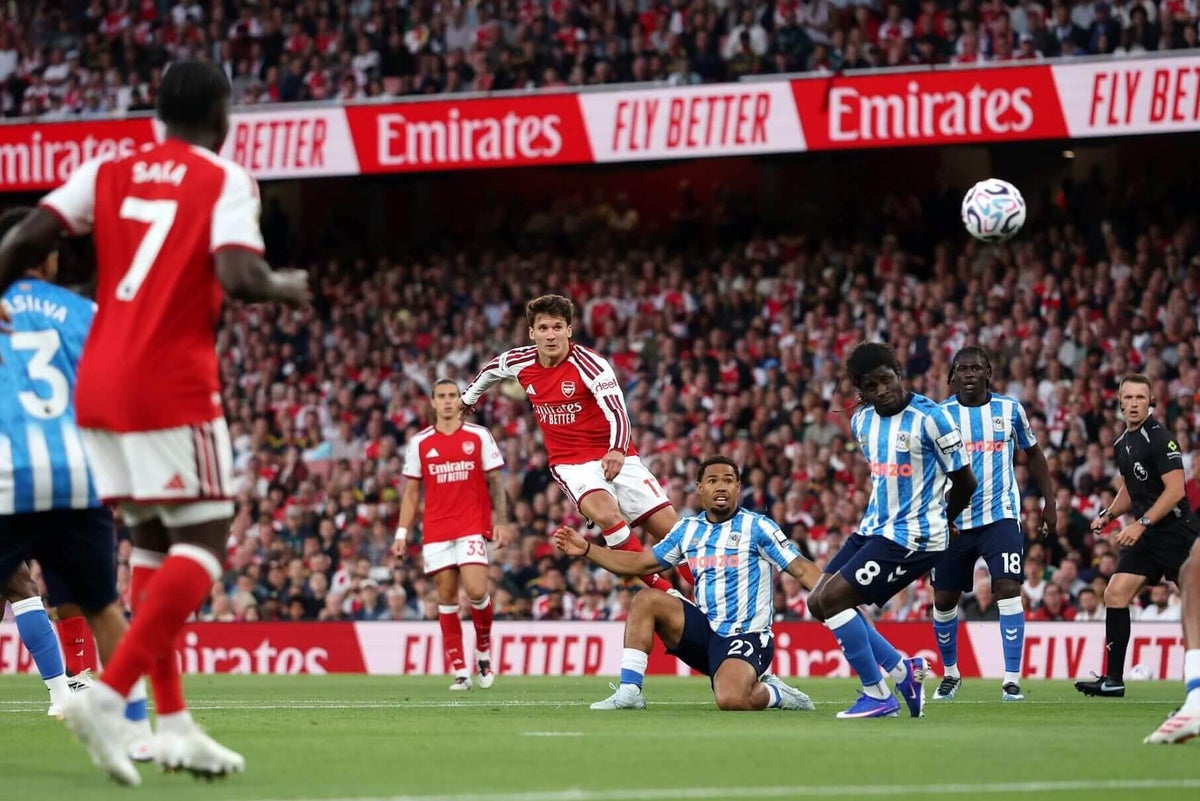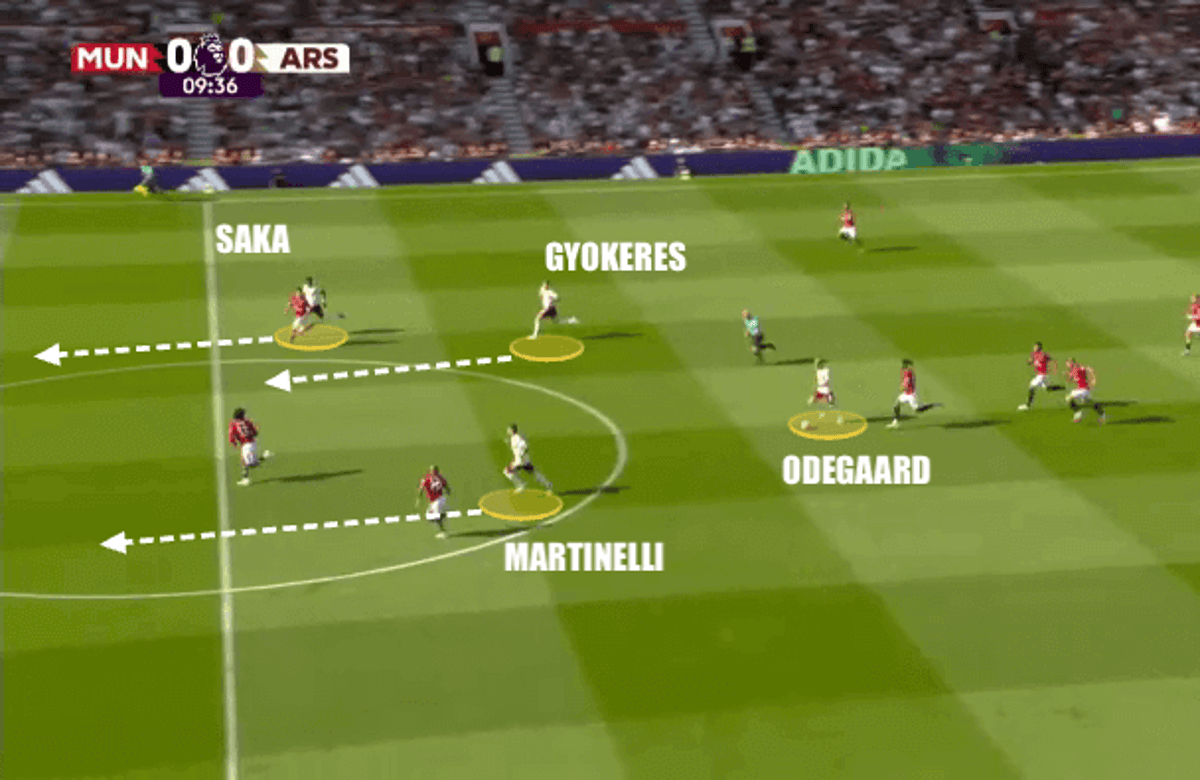
If Mikel Arteta thought winning the Premier League title would reduce the scrutiny on his tactical approach, the summer transfer window made it very clear he was wrong.With ever-increasing frequency over the last few seasons, the left-hand side of Arsenal’s forward line has been the focus of much discussion. Where the club could boast of a wealth of attacking riches on the right, with Bukayo Saka, Martin Odegaard, and Ben White often found rotating and interchanging to pull opposition blocks apart around the edges to find routes into the penalty area, on the other side of the pitch things looked a little less sanguine.Of course, there is no intrinsic need for a team to to structure their attacking play with a level of symmetry: almost every team will have a bias one way or another, depending on the tendencies of the players at their disposal. But as time went by, there was a growing consensus that Arsenal were too reliant on their right-hand side.And then the Vinicius Junior rumours started to break. Here, finally, was Arsenal’s solution to the left-hand problem. With a world-class left-sided player, so the narratives went, the asymmetry of previous seasons would be fixed and Arsenal would be able to spread their threat across the front line, bringing a much-needed injection of attacking swagger into the team.But the club had also brought in Christos Tzolis, signed for £34million ($46m) from Club Brugge. The Greek does not have the profile of a Vinicius Jr, and despite an electric showing in the Community Shield, it might have been hard for fans to accept the downgrade from Vinicius Jr and Tzolis to just Tzolis once it became clear the Brazilian was staying in Madrid. After all, was Tzolis that much of a step up compared to Leandro Trossard or Gabriel Martinelli?But Did You Notice that the Greek attacker has been offering something that neither Trossard nor Martinelli were really able to during their time in north London? He’s been finding a way of breaking opponents down on the diagonal.Odegaard scores Arsenal’s second goal against Chelsea, created by a diagonal ball from Tzolis and a dummy from Havertz (Justin Setterfield/Getty Images)In order to explain what I mean by “on the diagonal”, it’s perhaps worth talking through the evolution of the role of winger.Traditionally, you might expect a winger to be used as a width holder: a player who would receive the ball in the wide channels and look to carry it past the opposition full back towards the byline and then look to swing crosses into a striker from there.In order to maximise the chances of this sort of play coming off, it was usual to play wingers on their ‘strong’ side; that is, on the same side as their strong foot: a right-footer on the right and a left-footer on the left. This way, when arriving at the byline, the winger was able to hook their strong foot around the ball to get it into the box.As the game evolved, though, we started seeing a different use of wingers. With teams increasingly trying to control games through possession, an opening for a very different kind of winger emerged: the inverted winger — a term coined by The Athletic’s Michael Cox in 2010.
Did You Notice: How Christos Tzolis is breaking down Arsenal’s opponents with diagonals
Every season under Arteta, Arsenal have evolved in one way or another — and with the arrival of Tzolis, they have unlocked the diagonal
1,460 words~7 min read