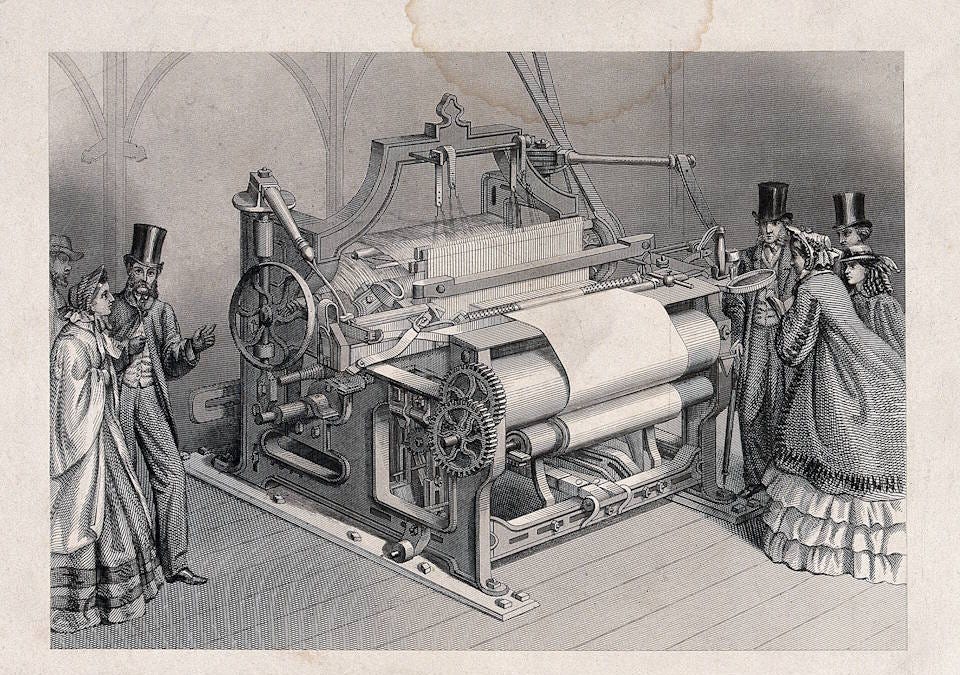
It’s Labor Day, so here’s a post about how human labor is alive and well in the age of AI.I live in San Francisco and hang out with a lot of tech people, both in the AI industry and outside of it. And one thing that almost everyone I know here believes is that AI’s main economic effect is to displace humans from their jobs. Most people don’t have concrete arguments for why this should be true; it’s just an article of faith. The conventional wisdom is pretty well summed up by the first line of this tweet:Tim Urban@waitbutwhyI really wish the rise of LLMs didn't come along with catastrophic job loss, massive privacy invasions, and maybe also the apocalypse. Because when you put those side effects aside, it is the COOLEST MOST WILD TECHNOLOGY EVER.7:46 PM · Aug 24, 2026 · 254K Views260 Replies · 228 Reposts · 4.71K LikesIn fact, AI companies themselves have spent years talking about how their inventions are going to render large swathes of humanity economically obsolete — an odd marketing pitch, perhaps, but one that seemed to reflect their honest expectations.A lot of times, San Francisco tech people are out of step with the general public. This time, though, the public seems to agree. A recent Ipsos poll found that most Americans expect AI to compete with human workers more than it complements them. And Pew finds that this belief has even strengthened in recent years:So basically, most people think AI is a job-killer. And yet somehow, this job-killer keeps stubbornly refusing to kill jobs. In the aggregate, the labor market is about as healthy as it’s ever been. The prime-age employment rate — the single best indicator of how many Americans have jobs — continues to hover near all-time highs:Of course, there are lots of other things going on in the labor market right now besides AI. But most of those things — tariffs, the Iran war, etc. — are bad for employment. It’s not easy to identify some sort of positive shock that is canceling out the job-killing effects of AI. Or maybe it is, if the shock is AI itself. Theoretically speaking, automation can create jobs just as easily as it can destroy them. Here are Acemoglu and Restrepo (2019), explaining the various ways that technology can affect the demand for labor:Automation [can be bad] for labor because of a displacement effect—as capital takes over tasks previously performed by labor…[A]utomation technology also increases productivity, and via this channel, which we call the productivity effect, it contributes to the demand for labor in non-automated tasks…[T]he displacement effect of automation has [historically] been counterbalanced by technologies that create new tasks in which labor has a comparative advantage. Such new tasks generate not only a positive productivity effect, but also a reinstatement effect—they reinstate labor into a broader range of tasks and thus change the task content of production in favor of labor. The reinstatement effect is the polar opposite of the displacement effect and directly increases the labor share as well as labor demand. [emphasis mine]In other words, automation can do three basic things. Yes, it can replace people and take their jobs. It can also make them more productive, which can both create jobs and destroy them.1 And, crucially, automation can create new jobs for people to do. Power looms replaced master weavers, but they created jobs for technicians and engineers to make the power looms work. The internet automated much of the work of travel agents, but created jobs for web designers. And so on. People who think of AI as a job-killer might not have thought of the second and third of these. Or they may have thought of them, but simply assumed they’re not a big deal. Anecdotally, a lot of tech people think that AI will keep substituting for more and more tasks until A) productivity increases just increase the demand for AI, and B) there are no new tasks left for humans to do. AI detractors, meanwhile — like Daron Acemoglu himself — often simply assume that new tasks created by AI will be “bad tasks” like misinformation and cybercrime that hurt the economy instead of helping it. But these assumptions simply might not be correct. AI might be creating lots of new tasks for humans to do. For example, software engineers are writing less and less code themselves. Instead, they’re spending more and more time telling AI to write code — that represents a productivity improvement. But they’re also trying to figure out what code to tell AI to write, making sure AI is writing the kind of code they want, integrating that code into products, and so on. Those are all new tasks. There are also a lot of software engineers working on improving AI itself, and on discovering new applications for AI. Those are new tasks as well. This helps explain why in the age of Codex and Claude Code, software developer jobs have been increasing as a percentage of total employment:Guy Berger@EconBergerThe doom of the software developer job has been greatly exaggerated...
AI keeps stubbornly refusing to take our jobs
Happy Labor Day!! Your labor is still valuable.
2,536 words~12 min read