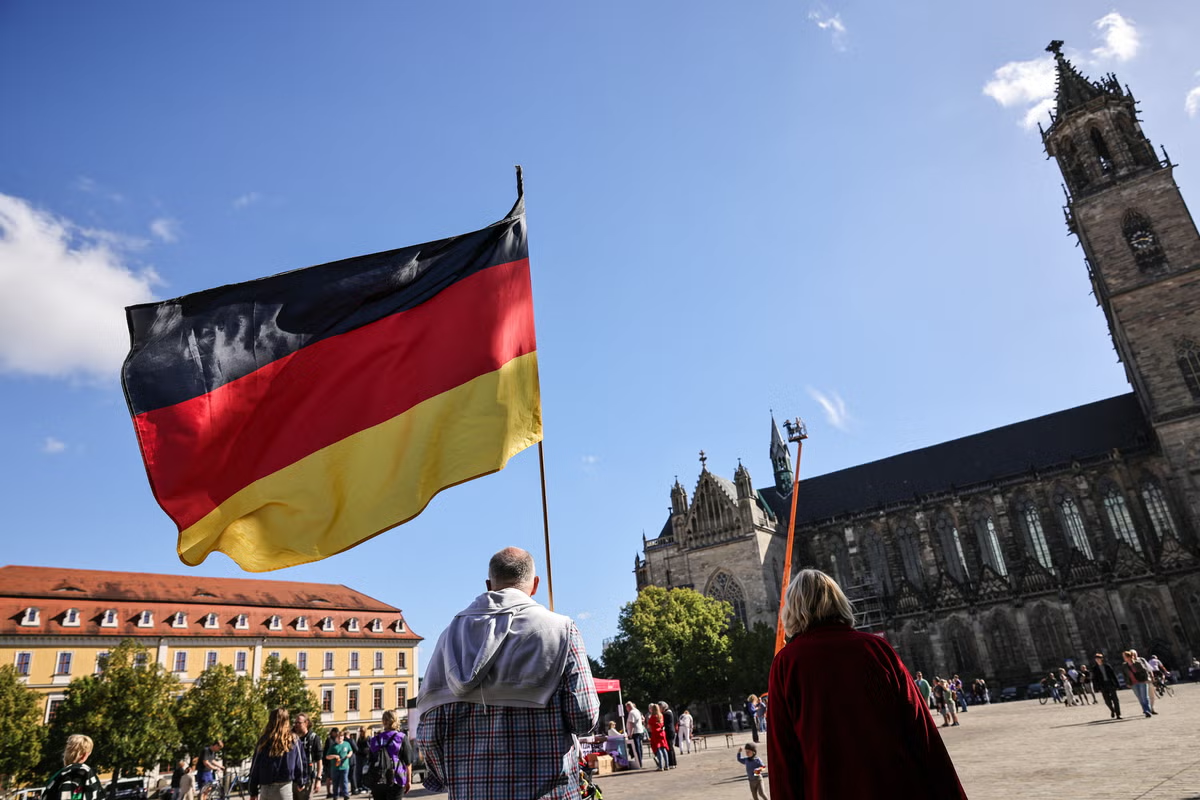
The Alternative for Germany party has a strong lead in a regional election, but it is unclear whether it will be able to form the country’s first far-right state government since World War 2, exit polls indicated Sunday.Alternative for Germany, or AfD, went into the vote in the eastern state of Saxony-Anhalt seeking an absolute majority in the state legislature to govern on its own. That would overcome the “firewall” of mainstream parties’ refusal to work with AfD.The polls for ARD and ZDF public television put AfD on about 44% of the vote.That was far ahead of the Christian Democratic Union, the centre-right party of Chancellor Friedrich Merz that currently leads the state, which was seen polling 18.5%. The Left Party was seen finishing third with about 9%.Read: Germany and France lend R5.6bn to fix broken South African metrosThe centre-left Social Democrats and Greens also were on course to remain in the state legislature, with around 8%-9% each. It was unclear whether the BSW party would get the 5% of the vote needed to win seats. The exit polls put AfD at least marginally short of an absolute majority.German Chancellor and Christian Democratic Union party leader Friedrich Merz, left, and Saxony-Anhalt State governor and top candidate Sven Schulze in Leuna, Germany, on September 3 2026. Picture: (Matthias Schrader) Merz said earlier an AfD government would be an economic own-goal. “If there were to be an absolute majority for a right-wing populist party next Monday, then international investors will think three times about whether they still invest in Saxony-Anhalt,” he said.On Saturday, thousands of people gathered in the state capital, Magdeburg, against the prospect of a far-right regional government. The AfD’s candidate for governor, Ulrich Siegmund, declared ahead of voting that “we will write history here”.Siegmund said he will only seek election as governor if the AfD wins an absolute majority, arguing that it needs to break a pattern of parties breaking their pre-election promises.Incumbent governor Sven Schulze, from Merz’s Christian Democratic Union, said he won’t work with the far-right party and his own CDU is “100%” behind him. But, if AfD finishes first yet short of a majority, he’s likely to face a difficult task to put together a stable government.There has already been one case in which AfD finished first in a state election but didn’t end up governing. That was two years ago in neighbouring Thuringia, where a CDU governor took power with a minority government.Schulze could, in similar circumstances, try to put together some kind of alliance with smaller parties. It’s likely to be a delicate exercise, because it would probably require at least some tacit support from the Left Party, a hard-left party with which the CDU refuses to form coalitions.Sunday’s vote will be followed on September 20 by two more tricky tests for Merz’s CDU and its main partners in the national government, the Social Democrats.There are state elections that day in Mecklenburg-Western Pomerania, an eastern region where a centre-left government faces a strong challenge from AfD, and in Berlin, currently led by Merz’s party.Update: September 6 2026This story has been updated with the first exit polls.AP
German exit polls suggest far-right AfD has big lead in regional election
AfD could become first far-right party to head state post-World War 2
522 words~2 min read