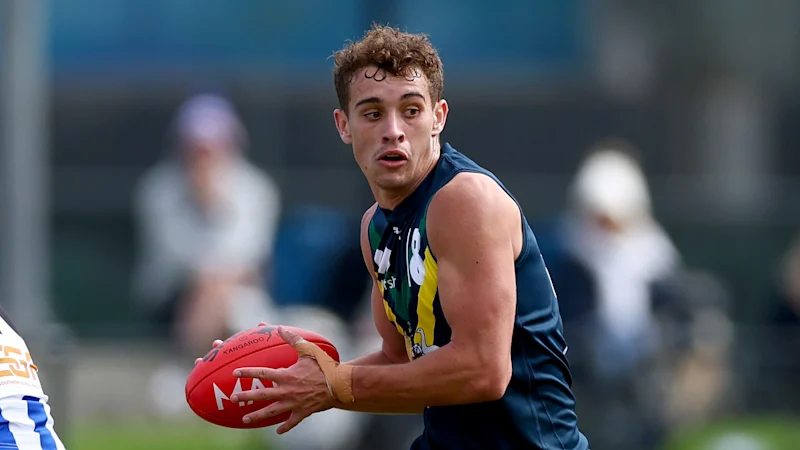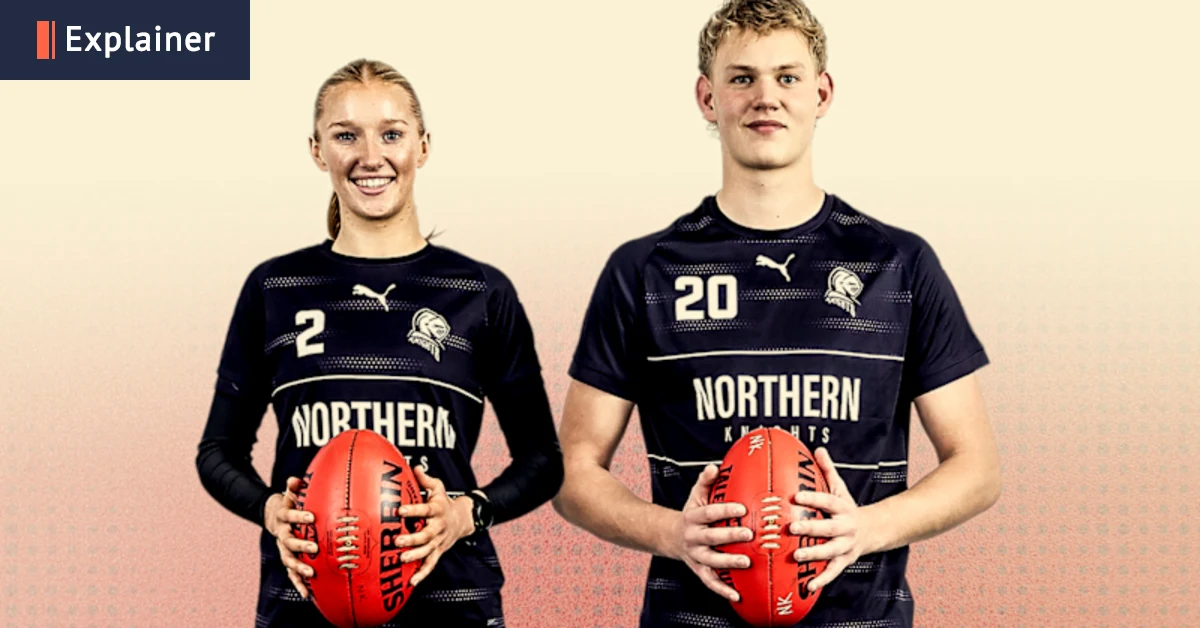
In his nearly 30 years of finding footy talent, David Walls has sat down to talk with thousands of young people who dream of becoming professional footballers. He’s watched them play from the sidelines at games and on countless hours of video; reviewed their psychological tests and physical tests; analysed their statistics; met with their coaches, employers, schoolteachers; and spent time in their orbit on training camps – to work out who they are, and who they could become.But the picture is never complete until he visits them at their family home. “You can’t bullshit in front of Mum or Dad,” says Walls, once a fresh-faced rookie himself, now head of player personnel at Fremantle footy club. “Even siblings will start to say, ‘That’s not true’,” Walls tells us. “Dads, generally, are trying to sell them as footballers and mums just want to make sure they’re good people.”Australian rules football has a rich history of freakishly talented players (Buddy Franklin, Nick Daicos, Erin Phillips) and legendary coaches (Leigh Matthews, the late Ron Barassi and Walls’ own father, Robert). Less lauded but no less critical to success are the recruiters and list managers. They determine who is in and out of a club, how to mix new blood – a handful of teen draft picks each year – with existing teams, a painstaking task that culminates in the nerve-wracking annual draft in November (for the men) and December (for the women). Theirs is not a glamorous job. At games, you’ll spot them in puffer jackets, perched on camping chairs with binoculars, pen and notebook. Other times, they’ll be hunkered down scrutinising footage, crunching player data. Many fans like to think they could do a better job. “I think every sports fan in Australia is picking their footy team or cricket team,” veteran AFL talent expert Kevin Sheehan tells us. “It’s a tough business, the business of drafting, and it’s make or break for the careers of not just the boys [and girls] but the scouts who are looking at them.”More than 624,000 children and adults play football in Australia. Whittling down the best young players takes years, money and skill. The stakes are high: the best players, like artists, can create something out of nothing while players with poor character or decision-making can drag down a whole team for years.So how do the clubs in the national league (18 men’s, 18 women’s) find the next generation of elite players? What sets a future professional apart from a skillful amateur? And how can young people maximise their chances of playing at the ’G one day?Draft contenders: 18-year-old students Maddy Meagher and Harry Van Hattum.Wayne TaylorWhat’s it like being a potential draft pick?At 205 centimetres, Harry Van Hattum stands out in a crowd. The year 12 student is confident, warm and mature. He also has a massive running leap, 103 centimetres into the air, just a touch higher than West Coast icon Nic Naitanui’s 102 centimetres jump as a junior. High-flying ruckmen are back in vogue after the AFL changed the rules this year to stop other players wrestling them away from the centre bounce, although Van Hattum wants it known ruckmen are about more than their aerial manoeuvres: “It doesn’t matter your size when you’re using it [the ball] well … I pride myself on having elite skills,” he told ESPN in August. In short, the 18-year-old has the makings of a very modern ruckman and, consequently, he’s a top prospect in November’s draft.‘I was definitely pretty nervous the first time I had a meeting with someone from a club, so I was trying to be super-professional and really well-behaved. But you have just got to be yourself …’Harry Van HattumYet it was only last year that Van Hattum put aside his other sporting pursuit, basketball – which he played at state level in under 12s and 14s – to focus on footy, and recruiters became part of his life. “It was around then I started talking to recruiters a fair bit and getting calls from them and organising home visits and stuff like that over that summer,” he tells us.On a trip to New Zealand with the AFL national academy squad, made up of 50 of Australia’s most talented draft contenders, his every interaction was noted by recruiters, on the field and off. “You sit down with them and have lunch, dinner and different meetings with them on different days,” Van Hattum says, “so you get a really good sense of what their point of view is and what they are looking for from that. I was definitely pretty nervous the first time I had a meeting with someone from a club, so I was trying to be super-professional and really well-behaved. But you have just got to be yourself, don’t lie, don’t make anything up – because obviously they will find out.”Van Hattum does a 20-metre sprint test during a talent league testing day in Melbourne in March.Getty ImagesVan Hattum has signed up with a manager, a crucial step in a junior’s progress to the AFL, and has, meanwhile, been playing footy for a dizzying array of sides: Ivanhoe Grammar, his school in Melbourne’s east; Vic Metro in the AFL national championships; the AFL academy; and the Northern Knights in the AFL Talent League, Victoria’s top under-18 competition, from which most draft picks are drawn. (Gifted players also come from state leagues, or the northern academies run by Sydney, Greater Western Sydney, Brisbane and the Gold Coast, or from next-generation academies run by all clubs for Indigenous and multicultural youth.) Van Hattum considered an invitation to play for Richmond’s VFL team, too, but enough was enough. “It’s pretty busy,” he says.Through it all, he is trying to live a normal life: studying, playing golf, hanging out with schoolmates and getting on the tools to help his dad, Rod, build a granny flat in the backyard of his family’s Kangaroo Ground property. He admits he sometimes feels like a lab rat. “It always lingers in the back of my head that there is an expectation about me and I have to perform well, but I just try to block it out of my mind and try to play to my best level and don’t think about the expectation on me every time.”Van Hattum is out of opponents’ reach during an AFL national academy game between the Australian under-18s and Richmond VFL in April.Getty ImagesJust days after the AFL grand final, Van Hattum and other promising teenage footballers (a total of 102 men and 89 women) will attend an event called a draft combine, either in Melbourne, Adelaide and Perth, where they will talk with clubs and compete in various trials (think sprints, agility tests, vertical jumps from a standing start).Among attendees will be year 12 student Maddy Meagher, who plays on the wing for the Northern Knights in the Talent League, the top under-18 competition in Victoria. “I base a lot of my game just off my speed,” the 18-year-old tells us. With a background in athletics, Meagher has climbed the footy ranks since she started about six years ago, this year juggling study with two three-hour training sessions a week for the Knights, games on the weekend and private coaching to “focus on the nitty-gritty”.Meagher (front) swoops on the ball in a match between Victoria Metro and South Australia in the AFL national championships under-18s in Adelaide in June. Getty Images Her hard work has paid off: Meagher has signed with a player agent, toured St Kilda’s facilities and met with several clubs. “Collingwood’s was just online, and Carlton’s was going to their club, and Essendon, they came to training to have a 30-minute conversation with me and a couple of other girls,” she explains, “and I’ve got Freo coming to my house.”She is ready to take the plunge and relocate if she’s drafted interstate. “I understand it would be extremely scary,” she says, “but the support that you get given is huge and, on top of the salary that you get given as an AFLW rookie, you also get extra money if you go interstate, to pay for your rent.” Clubs sometimes house newbies with a host family, another player, or a coach for a short while. Draft picks will be paid a minimum of $125,000 in 2027 in the men’s game; women will be on a base salary of $72,363.Recruiters watch players for up to three years before making a move, which they can’t do until the player is 18 by December 31 of their draft year, under both leagues’ rules. Even then, being picked can be down to timing and luck. “Often,” says player agent Alec Morgan, who represents both the men’s and women’s league players, “recruiters will have a whiteboard and they’ll have a whole list of names at the start of the year on that, and then as the year goes, they cross names off and they add names on. So you could be the third-best key-position defender on everyone’s list, but if the other two ahead of you don’t get taken right until the end, you might keep coming second or third. So it’s not necessarily a knock on you, the footballer.”Back in 2003, Scott Clayton watches the play with Bulldogs then-assistant coach Chris Bond.Shannon MorrisWhat are recruiters looking for? Scott Clayton has built playing lists for Brisbane, the Bulldogs, Gold Coast, West Coast and North Melbourne. “You’ve got to have talent,” he says. “Without that, we can’t help you.” Clayton, who these days is a future talent consultant, shows us a piece of paper on which he’s jotted the qualities he wants in a draft pick.On the left is FOOTBALL: clean hands to control that odd-shaped ball without fumbling, aerial game (marking), ground game (running) and cue response, which, says Clayton, means, “You react in instinct and action in super-quick time [to] what is actually happening. Perhaps at times it is predicting the future and making a decision on what action you must actually take.”Scott Clayton’s notes: football skills include a sharp cue response. Courtesy Scott ClaytonVery few players possess all of these attributes at a high level – now-retired Adelaide Crows champion Erin Phillips, a former basketballer, came pretty close – but you are better off with a laser kick or elite-standard speed than being average at everything. “If you watch where even AFL and AFLW was five or six years ago to now, the game is so much quicker,” says Alec Morgan. Walls agrees: “The distance they’re covering at high speed is just getting bigger and better.” Seven-time best and fairest, Richmond’s Monique Conti, is known for her explosive speed; Joel Wilkinson, who played briefly for Gold Coast then moved to the US National Football League, still holds the 20-metre sprint record (2.75 seconds) at a draft combine in 2010.As well as athletic flair, recruiters have to predict whether players’ bodies will cope. “We get our medical department involved heavily because players change so much physically,” says Walls. “Sometimes they can’t handle the training loads and their bodies break down and they get injured a lot.” Geelong premiership coach Mark Thompson used to have a theory that if a player was injured often in junior football, they would continue that pattern in the adult game. But with advances in medical science and more nuanced approaches to training, that theory is less fiercely held.The other half of Clayton’s list is about character, with competitiveness right at the top. Courtesy Scott ClaytonOn the right side of Clayton’s ledger is CHARACTER. For many recruiters, it’s what sets apart the most desirable players from those who are merely technically very good. But what aspects of character, in particular, are they looking for?‘I think the biggest thing that we find with clubs is competitiveness, that’s what they love.’Alec MorganTop of Clayton’s list is “competitiveness”, and he’s not the only one. “I think the biggest thing that we find with clubs is competitiveness, that’s what they love,” says agent Alec Morgan. “One of the things recruiters really look out for is, do you compete? And if you’re a competitive person on the ground, you’re going to be doing all the little things off the field to make sure you’re as good as you can be.” David Walls wants players who go all out: “You know that they’re going to give the same amount of effort, it doesn’t matter what game it is, it doesn’t matter if they start slowly and things aren’t going their way, or if the team’s getting belted.”Talent expert Kevin Sheehan (left) and Shane O’Bree (right) watch a boys’ AFL talent league game in 2023. O’Bree is now recruiting manager at Collingwood. Getty Images Next on Clayton’s list is something less obvious: self-efficacy, a term that describes possessing a belief in your ability to achieve an outcome. In footy, Clayton asks, “Do they go in knowing that they’re going to affect the outcome? Because in a competitive sport, that’s what you need: you need instinctive people who just want it, want to affect the outcome, and they’re bold.”Take Joel Selwood, now retired but who still holds the league record for games as captain. A troublesome knee deterred some clubs (although not Geelong) from drafting him in 2006, but he devised his own leg-strengthening exercises – “the Joel Selwood program,” he’s joked – which he followed religiously for 16 years, barely missing a game. “Pick a player who you’d have in your side,” said Blues coach Mick Malthouse in 2014, after Selwood had kicked the winning goal against his team. “I’d pick Selwood every day of the week.”The jubilation is plain to see after Geelong captain Joel Selwood (right) kicks the winning goal in a 2014 game against Carlton.
The winning formula: How to get drafted as a footy superstar
Recruiters reveal how they get the measure of aspiring AFL and AFLW hopefuls – and why footy skills are just part of the mix.
4,779 words~22 min read