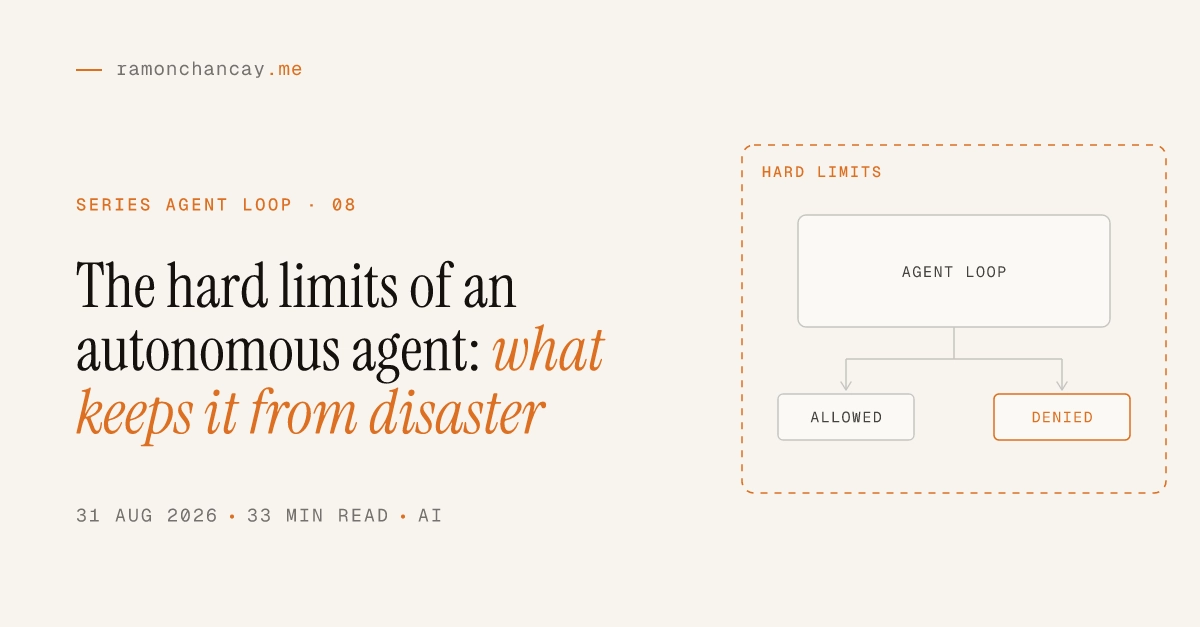
A hard limit is a restriction the program enforces, not the model: it is checked in the code that executes the action, after the model has decided, and it doesn't depend on the agent having understood the instructions correctly. The previous post left the system complete—a ticket goes in, a PR comes out, with nobody pressing a button—and that's where the question that decides whether this stays an experiment or stays running shows up: what happens when something goes wrong at three in the morning and nobody is watching. This post is that layer: iteration and token caps treated as a real budget, command and path allowlists, a kill switch that works from outside, idempotent effects, and a log that lets you know what happened. And at the end, the uncomfortable part: none of this is the hard bit.
TL;DR
A limit asked for in the prompt is a preference; a hard limit is code that runs after the model has decided. Everything that matters—what commands it runs, where it writes, how much it spends, when it stops—goes in the program, not in the instructions.
The four that aren't optional: a per-run budget (iterations, tokens and time), a command allowlist with no shell, a path allowlist resolved with realpath, and a kill switch someone else can flip without deploying anything.