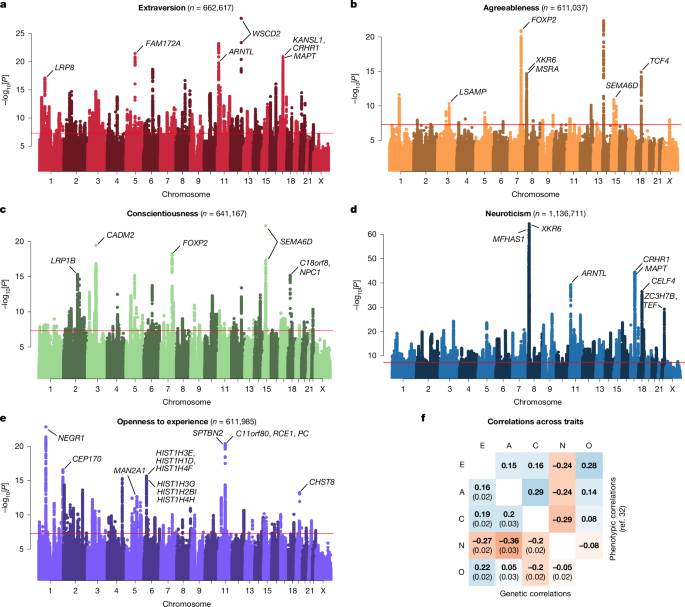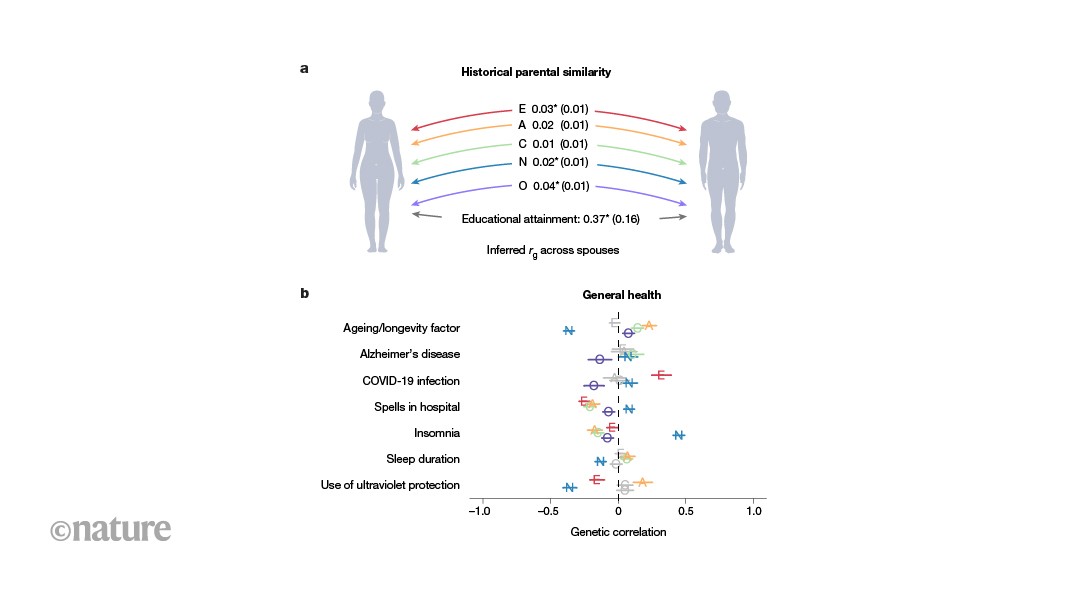
Why is one person naturally outgoing while another prefers solitude? Why do some people seem highly organised and disciplined, while others are more spontaneous? And why are some individuals more prone to worry or emotional ups and downs?For decades, psychologists have debated how much of our personality comes from genes and how much is shaped by our environment and life experiences.Now, one of the largest studies of personality genetics to date has provided some of the clearest evidence yet that our DNA does play a role — although it is far from the whole story.Researchers analysed genetic and personality data from more than 1 million people across 46 research cohorts and identified 1,260 genetic variants associated with the five major personality traits, commonly known as the Big Five. Of those variants, 824 had not previously been linked to personality.The findings, published in Nature, offer new clues about why people differ in the way they think, behave and respond to the world.Your DNA may influence personality — but it doesn't define youThe study examined the five broad dimensions psychologists commonly use to describe personality:Extraversion — sociability, energy and assertivenessAgreeableness — compassion, cooperation and trustConscientiousness — organisation, responsibility and self-disciplineNeuroticism — tendency toward anxiety and emotional instabilityOpenness to experience — curiosity, imagination and interest in new experiencesResearchers found that common genetic variants accounted for roughly 4.8% to 9.3% of the variation in the measured traits in population-level analyses. Depending on the measurement used, the estimates reached around 13% or higher.That may sound modest, but the significance lies in the scale and consistency of the genetic associations.The study suggests that personality is influenced by a large number of genetic differences, with each individual variant generally having an extremely small effect.In other words, there is no single piece of DNA responsible for making someone extroverted, anxious, conscientious or adventurous.Scientists have been looking for these clues for yearsThe connection between personality and genetics is not a new idea.Previous research, including studies of twins and families, has suggested that personality has a substantial heritable component. But scientists struggled to identify the specific genetic variants involved.One reason was the sheer complexity of personality.Instead of being controlled by one or two powerful genes, personality appears to involve hundreds or potentially thousands of genetic differences, each contributing a tiny amount.Earlier genetic studies were often too small to reliably detect these subtle effects.The new research addressed that problem by combining data from 46 cohorts, producing a dataset that included between roughly 611,000 and 1.14 million participants for individual Big Five traits.The much larger sample allowed researchers to detect associations that would have been almost impossible to identify in smaller studies.There is no single “personality gene”Perhaps the most important takeaway is what the study does not show.Finding genetic variants associated with personality does not mean scientists can look at someone's DNA and determine whether they are going to be outgoing, anxious or highly organised.Individual variants have remarkably small effects.The researchers found that the genetic architecture of personality is spread across the genome rather than concentrated in a handful of genes. Many more variants are likely to be involved than those identified in the current study.This makes personality fundamentally different from traits controlled largely by a single genetic mutation.Your DNA may nudge certain tendencies in one direction, but it does not write a fixed script for your life.Your upbringing still mattersThe findings reinforce an important point in the long-running nature versus nurture debate: personality is shaped by both biology and experience.The researchers conducted additional analyses involving more than 50,000 related participants, including family members, to investigate whether the genetic associations might actually be reflecting shared family environments.Those analyses found relatively little evidence that the personality associations were being substantially driven by common family environments.That does not mean upbringing is unimportant.The study's authors stress that personality develops through the combined influence of genetics, family and social environments, experiences and individual choices.Genes may influence tendencies, while the environment helps shape how those tendencies are expressed.The genetic patterns were surprisingly consistentThe researchers also found that the genetic associations were broadly consistent across different countries, age groups and ways of measuring personality.That matters because personality questionnaires can vary, and people can describe themselves differently from the way friends or relatives describe them.Despite these differences, the underlying genetic associations remained relatively robust.The researchers also found little evidence that people systematically choose partners with similar personalities, another factor that can complicate genetic studies of human behaviour.Personality may be connected to health and everyday behaviourThe findings could have implications beyond understanding why people behave differently.Personality traits have previously been associated with a wide range of health and behavioural outcomes. The new study found genetic correlations between personality and factors including substance use, physical activity, body mass index, hospitalisation and healthy ageing.Conscientiousness, for example, showed genetic links with behaviours such as more frequent exercise and lower substance use.Researchers also found genetic associations between personality traits and psychiatric conditions.However, these relationships should not be interpreted as proof that a particular personality trait directly causes a specific health condition. The study identifies genetic correlations and uses several analytical approaches to explore possible relationships; it does not mean that a person's DNA can determine their future health.Could a DNA test tell you what kind of person you are?Not yet — and researchers involved in the study are clear about that.Although scientists were able to use genetic information to predict personality traits statistically across groups, the predictive power is not strong enough to accurately determine an individual's personality from their genome.For someone who wants to understand their own personality, a properly validated psychological assessment remains far more useful than a genetic test.The reason is simple: the genetic contribution is only one part of an extraordinarily complicated process.The bigger question is how genes and experiences interactThe new study does not settle the nature-versus-nurture debate. Instead, it gives researchers a much stronger foundation for asking more precise questions.Scientists can now investigate how genetic differences influence biological processes in the brain, how those processes interact with childhood and adult experiences, and how personality may influence the environments people choose for themselves.The research also raises the possibility that personality could eventually become useful in understanding why people respond differently to health risks or treatments.But that remains an area for future research.For now, the clearest message from this enormous genetic study is also the most human one: you are neither simply born with your personality nor completely shaped by your surroundings.Your genes may provide some of the starting conditions, but the person you become emerges from a much larger interaction between biology, environment, experiences and choices.And after decades of searching for a “personality gene,” scientists now have stronger evidence that there was never going to be just one.
Are you born with your personality? Scientists have uncovered genetic clues to the traits that may shape who you become
New research reveals genetic variants influence personality traits like extraversion and conscientiousness. These genetic associations are spread across the genome and have small individual effects. Personality develops through a combination of genetics, family, and life experiences. The study found genetic links between personality and health outcomes like substance use. Understanding personality requires considering both biology and environmental influences.
1,119 words~5 min read