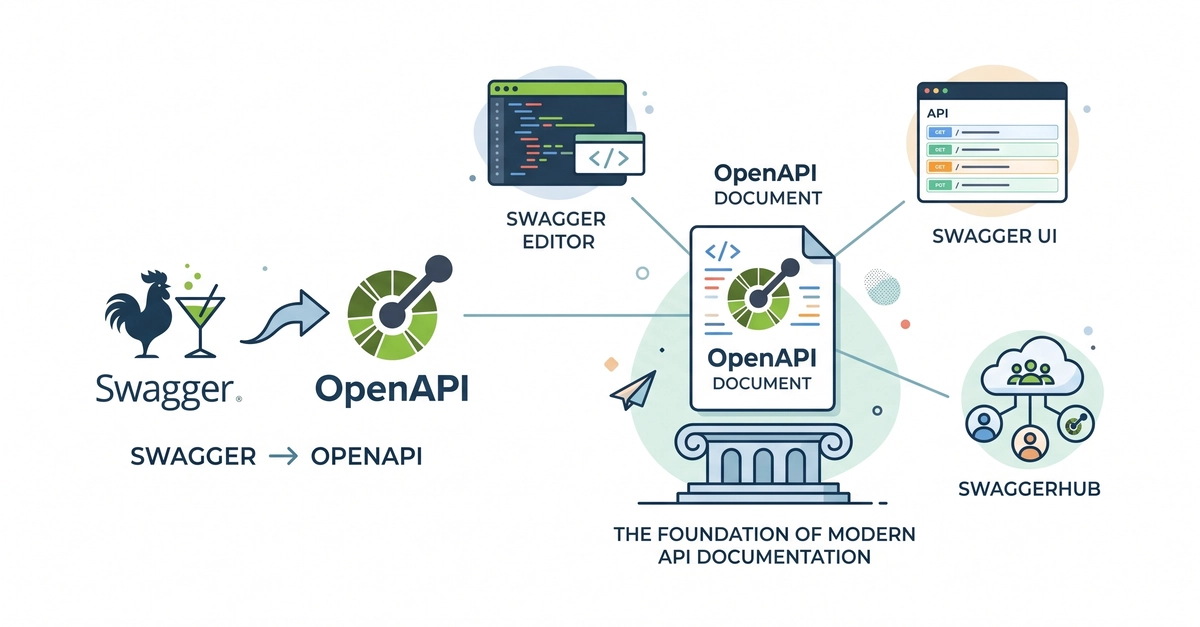
"Swagger" and "OpenAPI" get used interchangeably, and untangling that is actually the first useful thing to do here, one is a specification, the other is a tool that renders it. This post uses the Product API from an earlier CRUD post as the running example throughout, since the goal is showing exactly how documentation gets generated from code you've already written, not introducing a new domain to learn alongside a new concept.
What Swagger and OpenAPI Actually Are
OpenAPI is a specification, a structured JSON or YAML document that precisely describes an API: every endpoint, every parameter, every request body shape, every possible response. Swagger UI is one specific tool that takes that OpenAPI document and renders it as an interactive, browsable webpage, letting someone read the docs and actually try a request right from the browser. Swagger existed before OpenAPI became the open, vendor-neutral standard name for the specification format, which is exactly why people still say "Swagger" when they technically mean "OpenAPI."
Think of a restaurant's recipe card versus its printed menu. The recipe card in the kitchen is the precise, structured truth, exact ingredients, exact quantities, exact steps. The printed menu a customer reads is a different, friendlier presentation of that same underlying information, letting the customer browse and choose without ever seeing the recipe card itself. OpenAPI is the recipe card. Swagger UI is the printed menu.