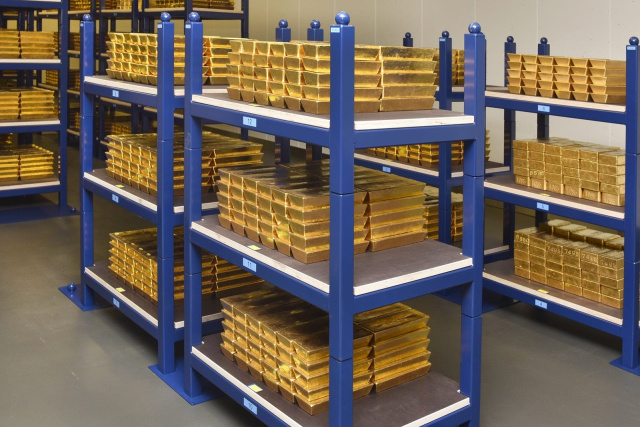
For six months between March and August, the Dutch central bank quietly shifted 86 tons of gold out of New York and Ottawa to London, saying the move made it “better prepared for serious crises.” Confirming the action yesterday, De Nederlandsche Bank (DNB) stated that the decision had been made “due to the increasing geopolitical unrest” and therefore wanted to improve the “tradability” of Dutch gold.“Gold stored in London at the Bank of England … is considered the most easily tradable gold in the world,” wrote DNB. “This makes it the fastest way for DNB to deploy in a crisis situation. The part of the gold stock located in New York and Ottawa is less directly deployable.”
DNB hasn’t reallocated all of its North American gold reserves—of the 612 tons it holds in total, 18.5% remains in New York and Ottawa.
But the situation wasn’t lost on economists in the current climate, in which a series of actions by the U.S. Treasury has—intentionally or not—drawn attention to the increasing risk premiums in the Treasury market.
As UBS’s Paul Donovan remarked this morning: “One reason U.S. Treasury Secretary Scott Bessent was reported to have intervened in the support of the yen in the past was the desire to prevent Japanese investors rushing for the exit of the U.S. Treasury bond market. While this was going on, the central bank of the Netherlands was apparently rushing to the exit of the New York Federal Reserve with as much gold as it could carry stuffed into its pockets.”