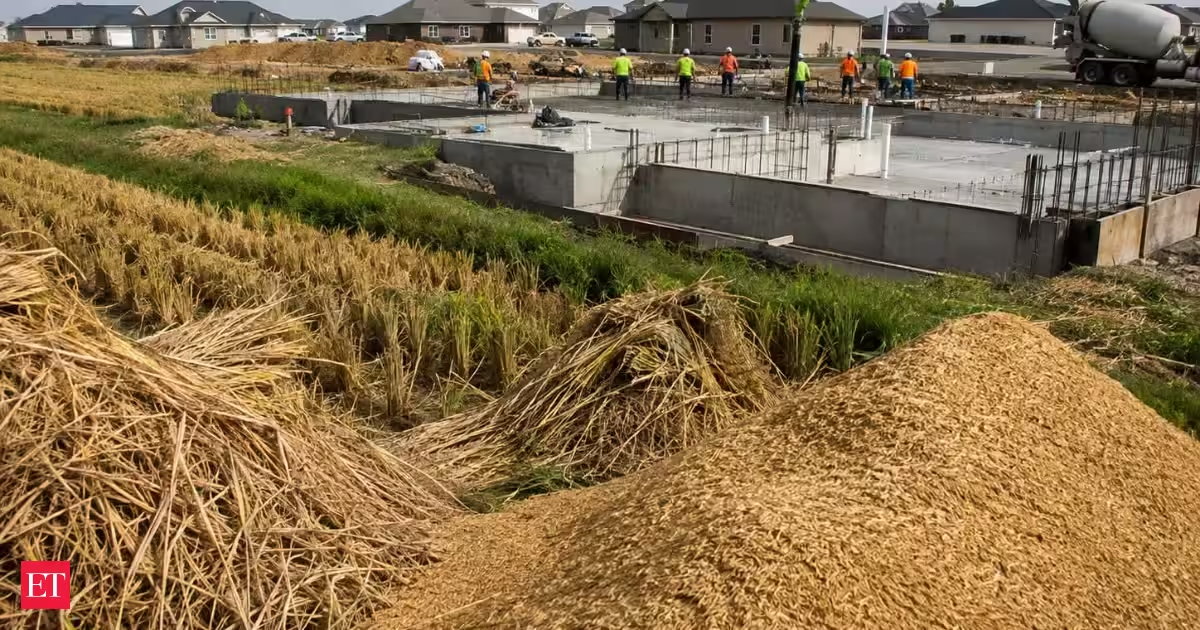
There's a problem with concrete. We can't live without it, but we have to pay a pretty high price for it in the form of environmental impacts. Researchers have increasingly examined whether industrial and agricultural byproducts can offset part of that cost, and sugarcane offers one such candidate. When sugarcane is juiced, a fibrous residue called bagasse is left behind. This bagasse is typically burned as fuel in the sugar mill's own boilers to generate process heat and electricity, and that combustion produces sugarcane bagasse ash as a byproduct. It may contain enough silica to make it a potential ingredient in Portland cement concrete.In their 2021 paper titled “Utilization of sugarcane bagasse ash as cement replacement for the production of sustainable concrete – A review,” published in the journal Construction and Building Materials, Khalil, Aslam, and Ahmad combined 20 years of experiments to find that when processed properly, sugarcane bagasse ash (SCBA) contains high amounts of reactive silica and can chemically bind with cement, that can mirror, and in some tests, can enhance the strength-building properties of Portland cement. In other words, burned sugarcane waste may help replace part of the material used in concrete, though, as the more recent research below shows, the review's broadly favorable findings need to be read alongside a narrower, more specific 2022 study before drawing firm conclusions about optimal replacement levels.Sugar cane. Image credits: Wikimedia CommonsWhy this matters more than you thinkIts production requires the heating of limestone to extremely high temperatures, which causes the release of CO2 from the fuel used as well as from the chemical decomposition of the limestone. According to the International Energy Agency, the cement sector is responsible for about 7% of global CO2 emissions, and the World Economic Forum similarly estimates global cement manufacturing accounts for roughly 8% of worldwide CO2 emissions, several times the aviation sector's share of roughly 2 to 2.5% of global emissions. The World Economic Forum has noted that if the cement industry were a country, it would rank as the world's third- or fourth-largest emitter.What the research showsIt may be a bit messy, but interesting when you get to the extremely important part. Not all studies are in accord with the correct amount of SCBA to be replaced. Some of the individual studies summarized in the 2021 review reported favorable results at a 20% replacement level; for instance, a separate 2022 study published in Scientific Reports by Amin et al. found that a binary blend using 20% bagasse ash matched or exceeded the compressive strength of the unmodified control mix. Results at this replacement level have varied across studies, depending on how finely the ash was processed and how the mix was designed, so a single universal threshold isn't well established.Bagasse fibre after the extraction of the sugar-bearing juice from sugarcane, being loaded. Image credits: Wikimedia CommonsA paper titled “Mechanical Properties of Eco-friendly Concrete Made with Sugarcane Bagasse Ash,” published in the Civil Engineering Journal in 2022 by Abdalla, Koteng, Shitote and Matallah, tested SCBA-and-silica-fume blends across a wider range, from 10% to 40% replacement by weight of cement. The study found that the 10% blend produced the highest mechanical strength of the mixes tested, while strength declined and workability worsened as the SCBA proportion increased toward 40%.Why isn't this already available in the market?Bagasse ash is not a magic material; it is not ready-to-use. How finely it is ground and the batch-to-batch consistency of the raw ash significantly affect its performance, which is more easily controlled in a laboratory than at a US ready-mix concrete plant. Unlike fly ash or slag, which builders in the U.S. already use as cement alternatives, there is no large-scale, common American supply chain to collect and process bagasse ash. In the United States, sugarcane is grown commercially only in Louisiana and Florida, with a small amount in Texas; research groups, including researchers at Louisiana State University studying SCBA for transportation infrastructure applications, have examined its use in concrete on a pilot basis in that region. Scaling up sugarcane beyond the pilot projects being conducted in a few states in the Gulf Coast is more of a logistical challenge than it is a chemical one, because sugarcane is not a common crop in the United States.The bottom lineSugarcane bagasse ash is not going to end the carbon footprint of American concrete on its own, and anybody who may say so is talking about oversimplification. The peer-reviewed research papers offer this nuance and skepticism. However, in an age of pressure on US cities to make buildings greener, and construction waste on the rise, along with the by-products of the sugar mills, this plain, fibrous by-product needs far more attention than a straw ban can ever provide.
In 2022, researchers studied sugarcane bagasse ash as a partial cement substitute; lower replacement levels showed better mechanical performance in concrete
Discover the potential of sugarcane bagasse ash as a sustainable alternative to Portland cement in concrete, mitigating environmental impacts of the construction industry.
788 words~4 min read