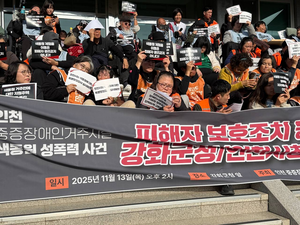
A South Korean court on Wednesday handed down a prison sentence to the head of a care facility for sexually assaulting multiple residents with disabilities.The Seoul court sentenced the director of the Saekdongwon facility in Ganghwa district of Incheon, identified by his surname Kim, to 15 years in prison for committing the offenses between 2012 and 2025. It found Kim guilty of sexually assaulting three residents and injuring one survivor who resisted by throwing a glass cup at his head. Kim, however, denied all allegations of sexual assault.As part of the sentencing, the court also prohibited Kim from working at any facility serving people with disabilities, children, or young people for 10 years, and ordered him placed on probation for three years after his release. The ruling is subject to appeal.The court acquitted Kim of one count of raping a resident under his care because the prosecutors could not establish violence or intimidation legally required for rape.“There is no doubt the act constituted sexual violence that caused sexual humiliation to a person with disabilities and therefore amounted to a violation of the Welfare of Persons with Disabilities Act,” the court said in its ruling, according to The Korea Herald. “For rape to be established, however, there must have been violence or intimidation sufficient to render the victim incapable of resisting, and it cannot be found that such violence or intimidation occurred.”The South Korean police began investigating the director after one of the survivors with severe intellectual disability made allegations of assault in February. Kim was arrested on 20 February following the investigation.The allegations prompted the government to launch inspections at 1,507 care facilities for disabled people across the country. "The Saekdongwon case is not simply a case of sexual crimes committed by an individual, but one in which abuse was concealed organizationally and structurally,” said Ko Eun Young, the lawyer for the survivors, said.“We hope today’s ruling offers at least some comfort to the victims and their families, and serves as a meaningful foundation for making the country’s residential facilities for people with disabilities more transparent and safer.”
South Korea care home director jailed for sexually assaulting disabled residents
Man found guilty of sexually assaulting three residents and injuring one who resisted
348 words~2 min read