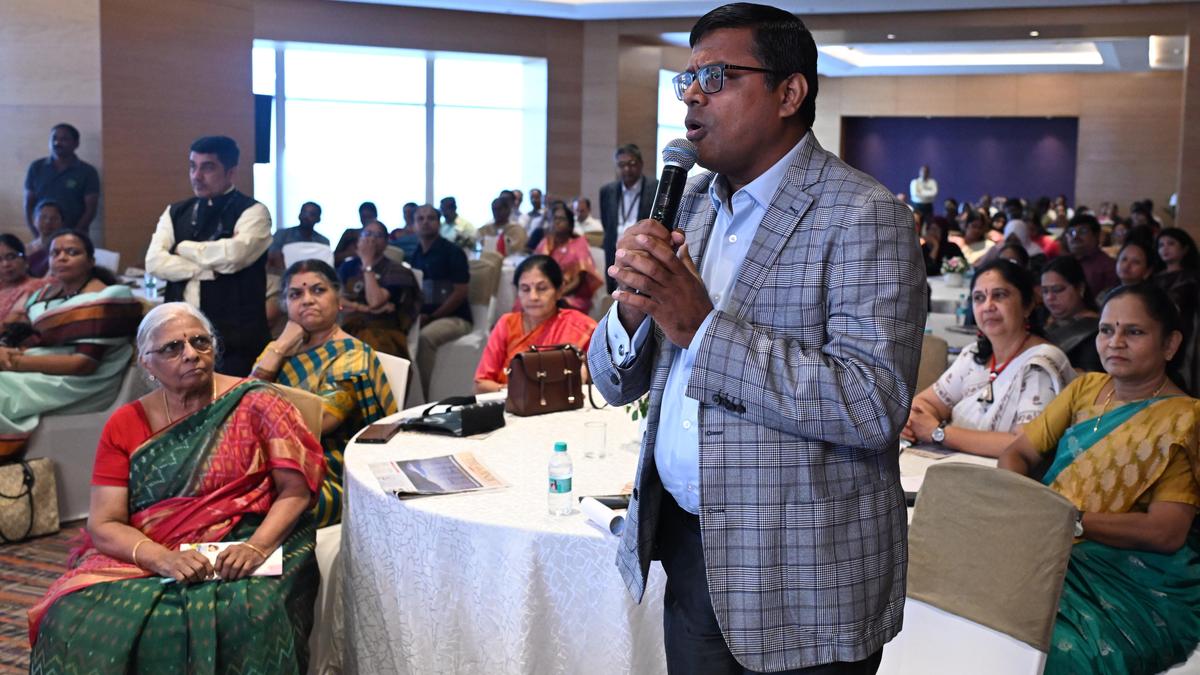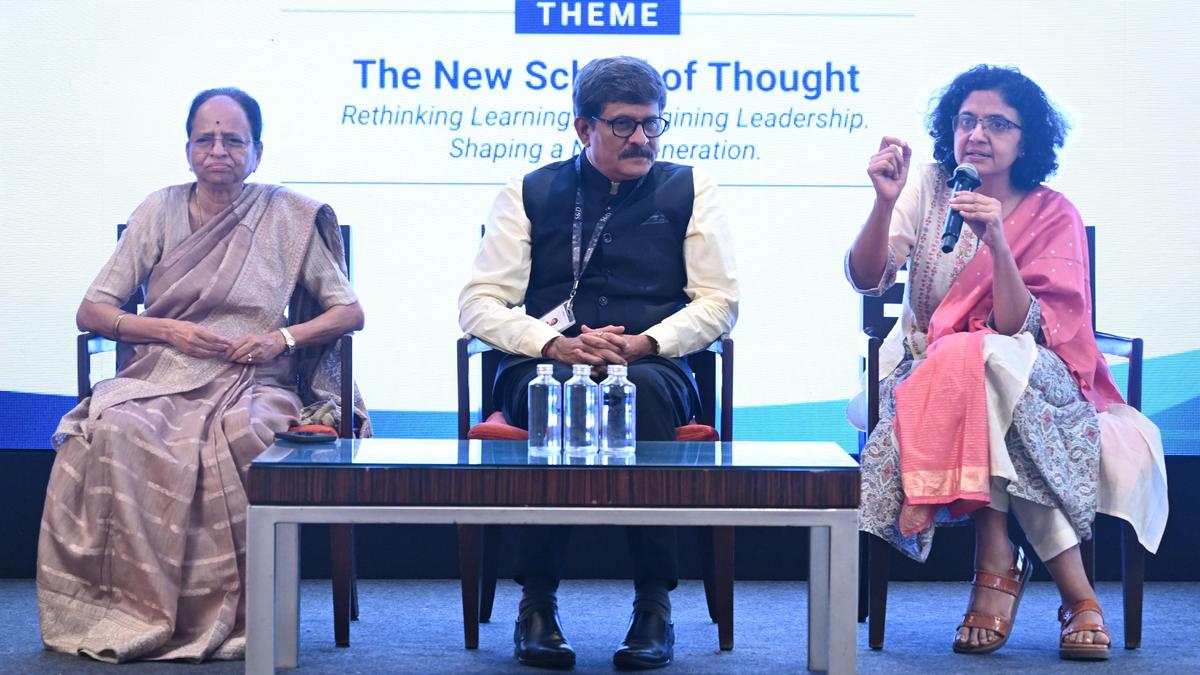
Lakshmi Vijayakumar, Founder of SNEHA, Sridhar Aranala, Chief Sales and Distribution Officer, The Hindu Group, and Ramya Venkataraman, Founder & CEO of the Centre for Teacher Accreditation, at The Hindu In School Educator’s Confluence in the city on Wednesday.
| Photo Credit: B. JOTHI RAMALINGAM
The Hindu In School Educator’s Confluence 2026 brought together educators and academic leaders across the city on Wednesday to discuss ideas on ‘The New School of Thought: Rethinking, Learning, Reimagining Leadership, Shaping a New Generation.’“The theme, New school of Thought, is about reimagining learning environments that balance technology and humanity, innovation with values, and academic excellence with holistic development,” said P. Subramaniam, Regional Head, The Hindu Group. R.A. Babu Vijay, Assistant Vice President, Sales & Distribution, The Hindu Group, said: “This is not another discussion on the challenges facing education but an invitation to collectively create environments and rediscover focus through purpose.”Constant digitisationThe first session, “The Digital Child: Are we losing attention, connection and curiosity?” saw Lakshmi Vijayakumar, Founder of SNEHA and Head of the Department of Psychiatry at VHS, discuss how constant digitisation is affecting children particularly those from lower-income countries, where children may have only a few avenues for recreation. “Digitisation has affected the brain in terms of the neurochemicals that process the information. When you have more than two hours of exposure to social media, your grey cells are affected,” she said, adding how the parents today introduce gadgets into children’s formative stages to keep them quiet, often during meals. This practice needs to change. She also touched upon behavioural addiction, deliberate emotionality, the side effects of social media including cyber bullying, and how many schools abroad are choosing to return to tools over tech after the constant digitisation.“We have found that when you use social media for more than two hours, for every one-hour increase in the use of social media, anxiety, depression and suicidal thoughts increase by 18% because it constantly makes you feel bad about yourself,” added Dr. Vijayakumar. She also asked the parents to set aside gadget-free time every day, and how children should be allowed to feel boredom to stimulate their creativity.In the session on “The Teacher of Tomorrow: Empowering Education in the Age of AI,” Ramya Venkataraman, Founder & CEO of the Centre for Teacher Accreditation, visualised the teachers of tomorrow as professionals who see their own growth alongside their students’.Teacher competenciesShe spoke about educators understanding where they stand as professionals, assessing teacher competencies, training and tools, and using technology to provide personalised support.“If teaching is being done badly in a particular classroom and in this classroom, we also put some technology, nothing much is going to change except the classroom is going to become fancier,” adds Ms. Venkataraman. “Therefore, it is important to first see the teacher as professional and then think about where technology including Artificial Intelligence can play a role,” she added. The session also included a discussion on the human capabilities such as problem solving, design thinking, communication, interpersonal skills, and judgment which will continue to matter for students as they grow up in a world dominated by AI.AI readiness for a school or teacher, she said, means the ability to build these human capabilities while using AI responsibly to improve learning and work.“The more use of AI does not correspond to higher readiness of AI. What matters is AI leverage along with digital safety and safeguards. AI readiness for teachers also includes understanding AI and its potential impact, adaptability and continuous learning, and building future ready human capabilities for students,” added Ms. Venkataraman. Published - September 03, 2026 05:00 am IST