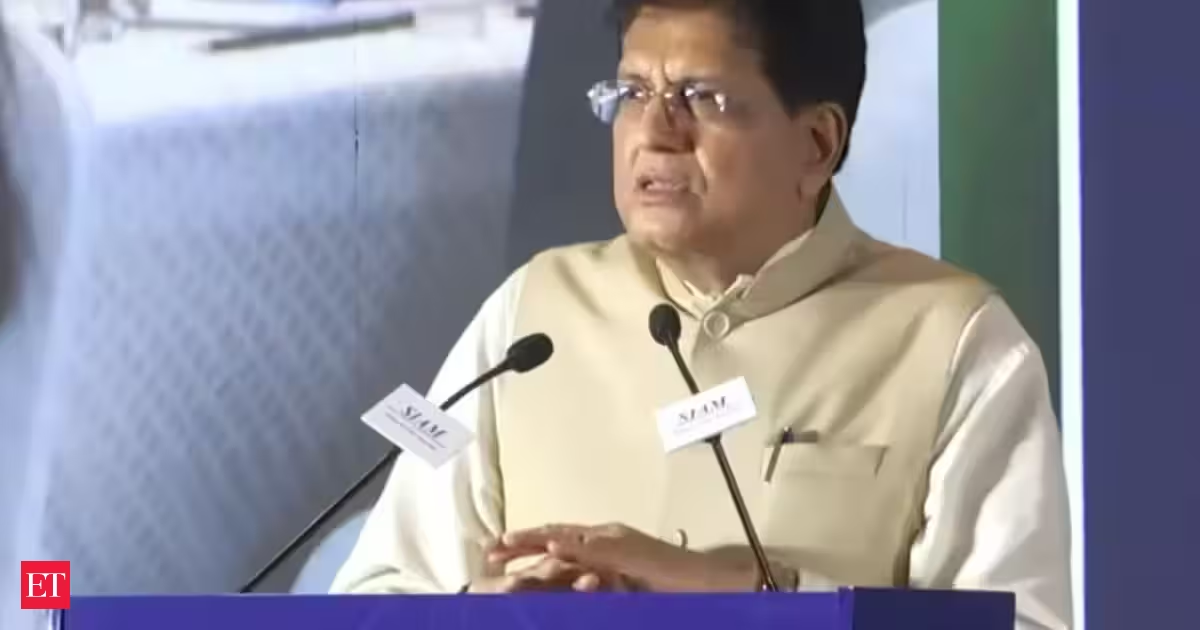
H D Kumaraswamy, Minister for Heavy Industries and Steel
| Photo Credit:
The government on Wednesday urged the automotive industry to focus more on design and domestic value addition (DVA) to drive India’s electric vehicle (EV) transition, saying the success of the country’s electric mobility cannot be measured only by the number of EVs sold.Speaking at the 66th annual convention of Automotive Component Manufacturers Association (ACMA) here, Minister for Heavy Industries and Steel, H D Kumaraswamy called on the component industry to invest more boldly in cleaner, more efficient, and emerging technologies - not only for the domestic market, but to make for the world too.“The Ministry of Heavy Industries will continue to work closely with ACMA, SIAM (Society of Indian Automobile Manufacturers), and industry stakeholders to improve scheme implementation, resolve operational issues, and create an enabling environment for investment and innovation,” he said.He said government schemes are supporting investment, DVA, advanced technology, manufacturing, and the transition to cleaner mobility, adding that India’s green mobility transition is gathering momentum.“However, our success cannot be measured only by the number of electric vehicles sold. It must also be measured by how much technology is designed in India, how much value is added domestically...how many MSMEs participate in the new supply chains, and how effectively Indian products compete in global markets,” Kumaraswamy noted.India should not merely participate in the global mobility transition; India should help lead it, he added.Auto PLI scheme shows encouraging resultsHe further said that the production-linked incentive (PLI) scheme for the automobile and auto component industry was showing encouraging results and as of June 30, 2026, approved applicants reported investment of ₹45,477 crore, resulting in over 67,000 employment opportunities.Speaking at the inaugural session, Shailesh Chandra, President, SIAM,, said that following GST 2.0 last year, the automobile industry witnessed a strong acceleration, with growth exceeding 15-20 per cent across all categories in the second half,, culminating in a record annual volume across all major categories.“The strong momentum has continued in FY27, with both domestic demand and exports remaining robust. This acceleration in growth was made possible by the commendable ambition, agility, and excellence demonstrated by the auto component industry,” he said.Chandra said the auto components industry rapidly scaled up capacity and capabilities to support rising demand among auto manufacturers. Today, this sector has also grown into a formidable force, with industry turnover of ₹7.60 lakh crore in FY26, including exports of around $24 billion, as per ACMA estimates.India eyes global automotive manufacturing leadership“These numbers demonstrate that India is becoming an important automotive manufacturing and technology base for the world. The opportunity before us is therefore much larger than just import substitution. Given our current scale and growth trajectory, our ambition should be to establish India as one of the world’s leading automotive manufacturing and mobility hub,” Chandra said, adding that ‘Made in India’ should become synonymous with quality technology, reliability and global competitiveness.Meanwhile, Hisashi Takeuchi, MD and CEO, Maruti Suzuki India, said the government’s initiatives, such as the PLI scheme and the India Semiconductor Mission, are already creating opportunities to build capabilities in critical areas and reduce strategic dependencies.Auto industry urged to strengthen cybersecurityBut as the industry embraces greater digitalisation, cybersecurity becomes equally important, he said, adding that it was encouraging to see organisations continuously strengthening their cybersecurity systems by investing in advanced technologies.“Having said that, even hackers are evolving their technology and becoming more sophisticated with each passing day. So, we have to ensure that we stay one step ahead of them. At the same time, we cannot rule out the chances of a cyber incident. In view of this, we must be prepared with a robust contingency plan that enables us to resume business operations within the shortest possible time and minimise any potential disruption,” Takeuchi added.Published on September 2, 2026