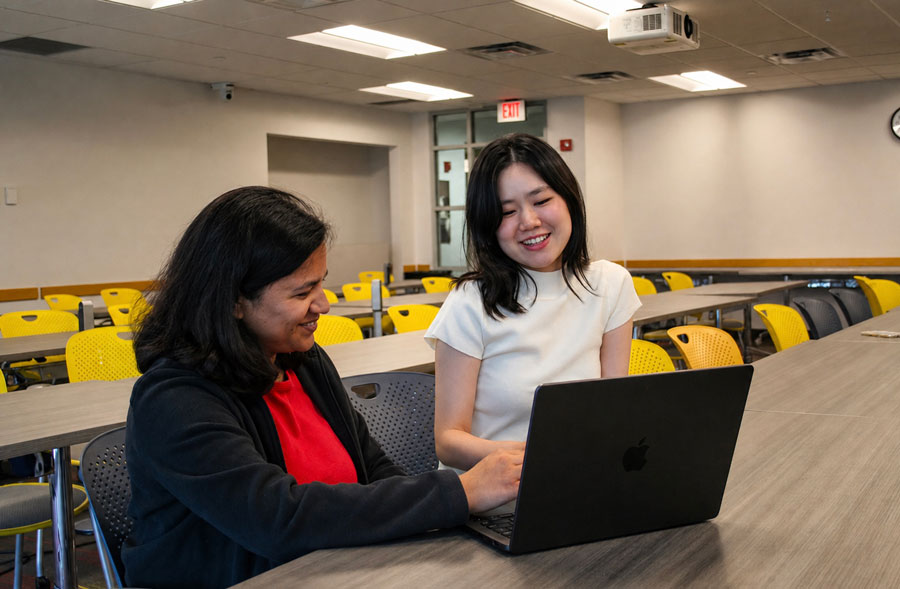
Research is central to life in Carnegie Mellon University's School of Computer Science. Faculty and graduate students continually define new questions, develop new approaches and expand the boundaries of their fields. But for undergraduates, knowing how to navigate that research community can be tricky. Students may be interested in AI research but not know where to find an opportunity or how to build relationships with researchers. Or they may not really understand what a research career looks like.Enter the CMU Paths to AI Research Program (PAIR), which helps undergraduates navigate the opportunities, questions and uncertainty that come with pursuing artificial intelligence research. PAIR connects undergrads with graduate student mentors from across SCS who provide perspective on their research questions and help students understand their choices.Graduate student mentors in PAIR help undergraduates navigate the opportunities, questions and uncertainty that come with pursuing artificial intelligence research. Above, mentors Leena Mathur (left) and Minjung Park (right) discuss new program deadlines and mentee numbers.For Leena Mathur, a Ph.D. student in the Language Technologies Institute who has served as a PAIR mentor and program leader since 2023, access to information is one of the program's most important contributions."There are many steps along the way to pursuing a research career. Information on how to identify research interests; find labs on campus; contact professors; and apply to internships, fellowships and graduate programs is not always clearly visible to undergrads," Mathur said. "One of my favorite parts of the program is helping democratize access to that information so students can make informed decisions about opportunities."PAIR makes that information accessible through mentorship, rather than by prescribing a particular path. Mentors help students find research opportunities, think through internships and fellowships, prepare for graduate school, and consider what type of research environment might suit them. In addition to providing mentorship, PAIR holds office hours, organizes panels and maintains resources for mentees.PAIR was founded in 2017 by Robotics Institute (RI) Associate Professor David Held and former students Benjamin Eysenbach, who earned his Ph.D. in machine learning in 2023, and Victoria Dean, who earned her Ph.D. in robotics in 2024."When you're an undergraduate, it can be difficult to know what research is really like, how to get started or even whether it's something you want to pursue," Held said. "We wanted to give students the chance to explore those questions with someone who has been through the process."Since its founding, PAIR has been led by successive generations of Ph.D. students from across SCS departments. Past leaders included computer science Ph.D. student Victor Akinwande and former RI Ph.D. graduate Alex LaGrassa. The current leadership includes Mathur, RI Ph.D. student Cecilia Morales and Human-Computer Interaction Institute Ph.D. student Minjung Park. PAIR has served close to 1,500 undergraduate mentees and recruited about 1,000 mentors from across CMU's AI research community.While PAIR matches mentors and mentees based on their interests and goals, computer science undergrad Elizabeth Terveen's decision to join the program and her eventual pairing with Mathur began somewhat unexpectedly.As she explored research opportunities through different labs, Terveen attended an RI seminar and found herself standing behind Mathur in line. They began talking about Mathur's research and internship experiences, and the conversation gave Terveen a glimpse of a path she was interested in pursuing. When Terveen later received an email about PAIR from Mathur, the connection felt like a natural fit.Terveen and Mathur's PAIR relationship spanned two semesters, during which Terveen sought advice about the day-to-day experience of undergraduate research, relationships with mentors and how to make the most of research opportunities. Mathur also helped her think through a scholarship application that required her to articulate her research interests and goals.Their conversations went beyond specific research topics to questions about what Terveen wanted research to feel like. What type of mentoring and advising style works for her? What environments does she enjoy? What kinds of problems does she want to solve?"I've refined where I want to end up, and I think that's a valuable goal," Terveen said. "Through talking with Leena, I have a much clearer sense of what environments I like working in and what types of problems I like to explore."Research itself rarely begins with a clear path. Researchers must determine which questions are worth pursuing, navigate uncertainty and refine their understanding as they go."To me, what researchers have in common is a disciplined relationship with uncertainty — being rigorous about what we know and do not know, choosing important challenges to work on and pushing the boundaries of knowledge," Mathur said.Terveen's experience in PAIR reflects an increasing ease with that uncertainty. "I'm more comfortable with not being an expert in something now," she said.The program is not designed to steer every student toward a research career. Instead, it gives them enough insight into research to decide whether it is right for them and, if so, how they might pursue it."Success for PAIR does not mean that every student chooses a research career," Mathur said. "The whole goal is to demystify potential career paths so students can decide for themselves what feels right."For more information about the program, visit the PAIR website.
PAIR Helps Students Find Their Place in AI Research
Research is central to life in Carnegie Mellon University's School of Computer Science. Faculty and graduate students continually define new questions, develop new approaches and expand the boundaries of their fields. But for undergraduates, knowing how to navigate that research community can be tricky. Students may be interested in AI research but not know where to find an opportunity or how to build relationships with researchers. Or they may not really understand what a research career looks like.Enter the CMU Paths to AI Research Program (PAIR), which helps undergraduates navigate the opportunities, questions and uncertainty that come with pursuing artificial intelligence research. PAIR connects undergrads with graduate student mentors from across SCS who provide perspective on their research questions and help students understand their choices.Graduate student mentors in PAIR help undergraduates navigate the opportunities, questions and uncertainty that come with pursuing artificial intelligence research. Above, mentors Leena Mathur (left) and Minjung Park (right) discuss new program deadlines and mentee numbers.For Leena Mathur, a Ph.D. student in the Language Technologies Institute who has served as a PAIR mentor and program leader since 2023, access to information is one of the program's most important contributions."There are many steps along the way to pursuing a research career. Information on how to identify research interests; find labs on campus; contact professors; and apply to internships, fellowships and graduate programs is not always clearly visible to undergrads," Mathur said. "One of my favorite parts of the program is helping democratize access to that information so students can make informed decisions about opportunities."PAIR makes that information accessible through mentorship, rather than by prescribing a particular path. Mentors help students find research opportunities, think through internships and fellowships, prepare for graduate school, and consider what type of research environment might suit them. In addition to providing mentorship, PAIR holds office hours, organizes panels and maintains resources for mentees.PAIR was founded in 2017 by Robotics Institute (RI) Associate Professor David Held and former students Benjamin Eysenbach, who earned his Ph.D. in machine learning in 2023, and Victoria Dean, who earned her Ph.D. in robotics in 2024."When you're an undergraduate, it can be difficult to know what research is really like, how to get started or even whether it's something you want to pursue," Held said. "We wanted to give students the chance to explore those questions with someone who has been through the process."Since its founding, PAIR has been led by successive generations of Ph.D. students from across SCS departments. Past leaders included computer science Ph.D. student Victor Akinwande and former RI Ph.D. graduate Alex LaGrassa. The current leadership includes Mathur, RI Ph.D. student Cecilia Morales and Human-Computer Interaction Institute Ph.D. student Minjung Park. PAIR has served close to 1,500 undergraduate mentees and recruited about 1,000 mentors from across CMU's AI research community.While PAIR matches mentors and mentees based on their interests and goals, computer science undergrad Elizabeth Terveen's decision to join the program and her eventual pairing with Mathur began somewhat unexpectedly.As she explored research opportunities through different labs, Terveen attended an RI seminar and found herself standing behind Mathur in line. They began talking about Mathur's research and internship experiences, and the conversation gave Terveen a glimpse of a path she was interested in pursuing. When Terveen later received an email about PAIR from Mathur, the connection felt like a natural fit.Terveen and Mathur's PAIR relationship spanned two semesters, during which Terveen sought advice about the day-to-day experience of undergraduate research, relationships with mentors and how to make the most of research opportunities. Mathur also helped her think through a scholarship application that required her to articulate her research interests and goals.Their conversations went beyond specific research topics to questions about what Terveen wanted research to feel like. What type of mentoring and advising style works for her? What environments does she enjoy? What kinds of problems does she want to solve?"I've refined where I want to end up, and I think that's a valuable goal," Terveen said. "Through talking with Leena, I have a much clearer sense of what environments I like working in and what types of problems I like to explore."Research itself rarely begins with a clear path. Researchers must determine which questions are worth pursuing, navigate uncertainty and refine their understanding as they go."To me, what researchers have in common is a disciplined relationship with uncertainty — being rigorous about what we know and do not know, choosing important challenges to work on and pushing the boundaries of knowledge," Mathur said.Terveen's experience in PAIR reflects an increasing ease with that uncertainty. "I'm more comfortable with not being an expert in something now," she said.The program is not designed to steer every student toward a research career. Instead, it gives them enough insight into research to decide whether it is right for them and, if so, how they might pursue it."Success for PAIR does not mean that every student chooses a research career," Mathur said. "The whole goal is to demystify potential career paths so students can decide for themselves what feels right."For more information about the program, visit the PAIR website.