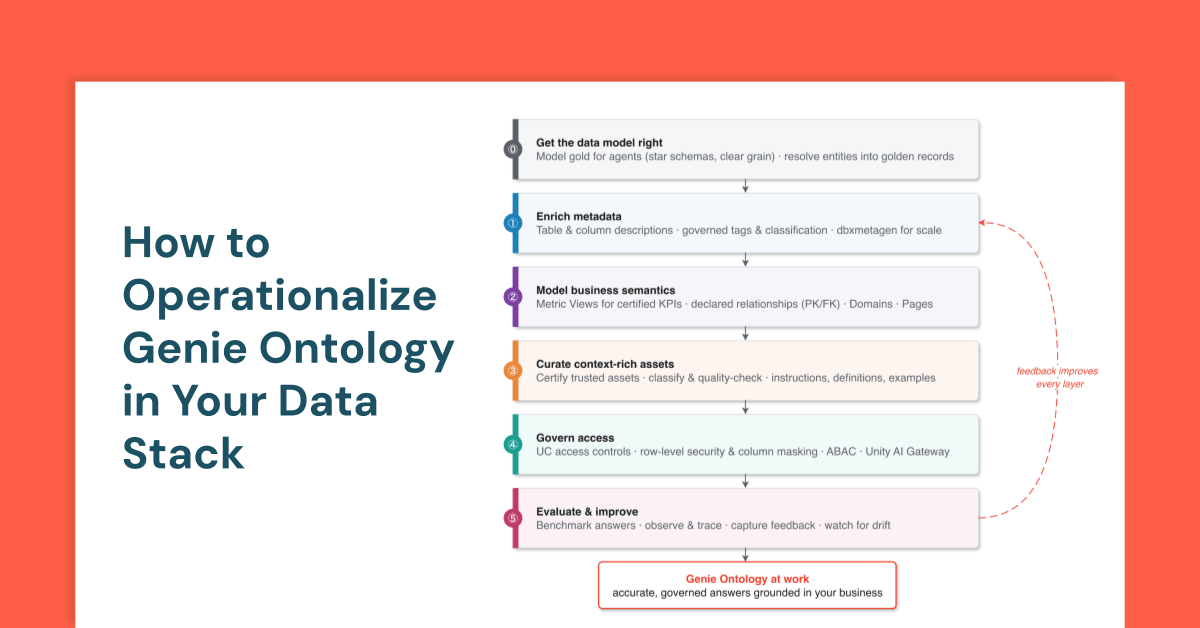
A practical guide to the data modeling, metadata, semantics, context, governance, and evaluation work that helps Genie Ontology return high-quality answers from your data.
by Srujan Alase and Richard Tomlinson
Large language models know how to reason, but they don't know your business. Giving enterprise AI the business context it needs means more than connecting it to data. Agents also need to understand your definitions, relationships, business rules, authoritative sources, and permissions. Genie Ontology closes that gap by combining modeled business semantics with context learned from the governed tables, queries, dashboards, notebooks, and other supported assets your teams already use. Genie ranks that context by authority and relevance, applies permissions, and delivers the most useful context to Genie at answer time. External agents can also access Genie’s intelligence through MCP.
A good semantic model provides an authoritative core. Semantic models capture the business concepts you deliberately define; an ontology extends that foundation with the broader relationships, knowledge, and context AI needs to understand how the business actually operates. In Databricks speak, Unity Catalog Semantics combine Metric Views, Pages, and Domains to establish your trusted business definitions. Genie Ontology then builds on that modeled core by incorporating inferred context from your existing assets, giving agents a much broader understanding of the business than a semantic model alone can provide.