One of our biggest goals on the WebAI team at Hugging Face is to make browser inference as fast and as user-friendly as possible. Getting there is a multi-layer effort: models need browser-friendly representations, runtimes need to build efficient execution plans, and the individual GPU operations at the bottom of the stack need to make the most of many different devices and browser implementations.
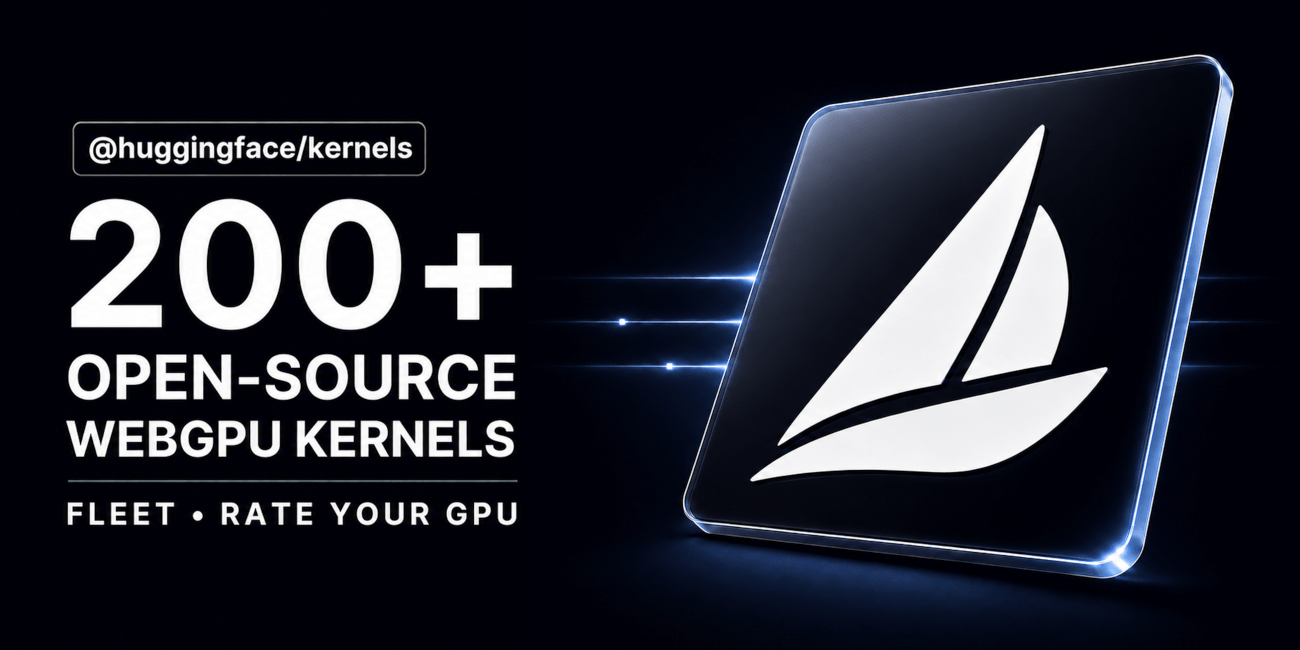
Today, we are releasing the first layer of that effort: @huggingface/kernels, a minimal library for loading and running optimized WebGPU kernels from the Hugging Face Hub, together with an initial collection of 207 kernels at huggingface.co/webgpu-kernels.
The collection covers operations used across a wide variety of machine learning architectures and workloads. More importantly, each kernel is published as a complete, versioned package: its interface, shader templates, correctness cases, benchmark cases, and usage instructions all live together on the Hub.
We are also launching Fleet, an in-browser GPU benchmarking and testing suite that runs and scores the kernels on your hardware. Beyond the results for your own machine, Fleet gives the community a way to contribute performance and correctness evidence from devices we could never cover in a conventional test lab. With your consent, every run adds private evidence that can help us find failures (incorrect results, pathologically slow cases, etc.), improve kernel variants, and make better optimization decisions across real-world hardware.