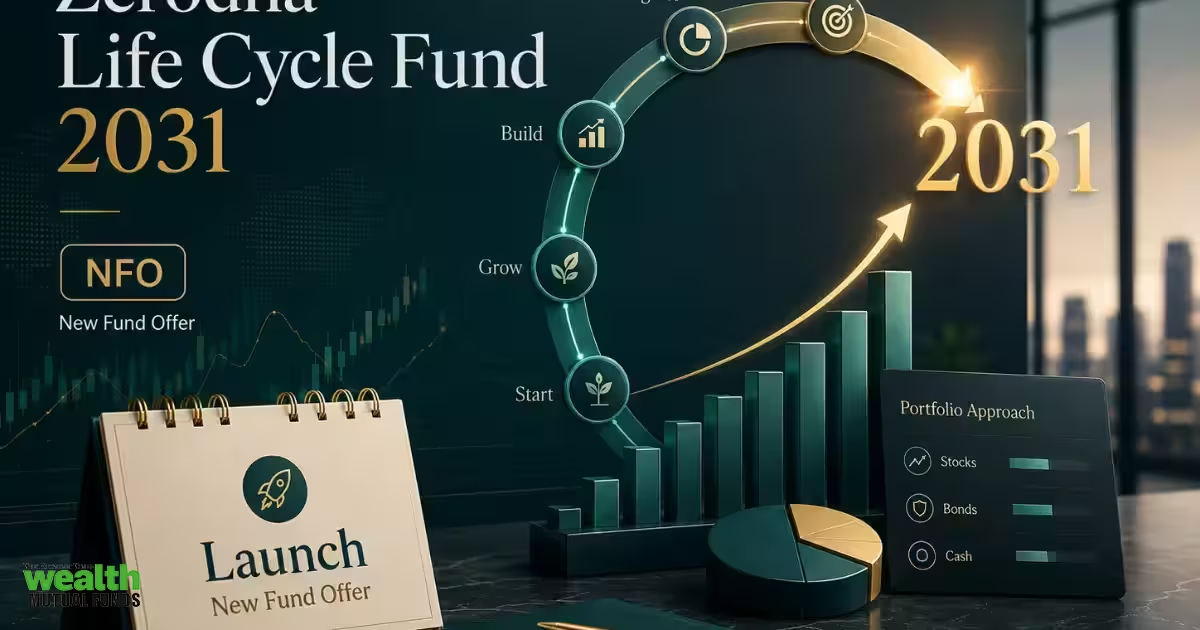
A Vinod Kumar, Founder, Perpetual Investments.Financial goals rarely arrive at the same time. A home purchase may be five years away. A child’s education may be a decade away. Retirement may be 15 years or more into the future. Life-cycle investing starts with the idea that the portfolio should reflect not only the goal, but also the time left to reach it. Life-cycle funds are open-ended mutual fund schemes built around a predefined maturity year. Investors can choose a fund whose timeline broadly matches their financial objective. This makes the investment horizon part of portfolio design from the beginning. The key feature is a glide path. When the target year is far away, the portfolio can hold a relatively higher allocation to equity to benefit from long-term growth potential. As the target date approaches, equity exposure is gradually reduced and debt which is a relatively stable asset, assumes a larger role. The above approach can be meaningful. One glide-path framework can hold 65-80 per cent in equity when 10-15 years remain. This can fall to 50-65 per cent with 5-10 years left and 35-50 per cent at 3-5 years. It can decline further to 20-35 per cent at 1-3 years and 5-20 per cent in the final year. The aim is to make the risk profile evolve with the time available. This also brings discipline to investing. Market movements can trigger loss aversion, herd behaviour and recency bias. A predefined allocation path reduces the need to make repeated asset-allocation decisions during volatile phases. It helps keep attention on the goal and the remaining investment horizon. Life-cycle investing are also multi-asset in nature. Along with equity and debt, such portfolios can invest in gold, silver and Infrastructure Investment Trusts, or InvITs. Each asset class can play a different role. Equity can drive long-term growth. Debt can add relative stability. Gold and silver can diversify the portfolio during periods of uncertainty. InvITs can provide another source of portfolio yield. Diversification matters because leadership changes across market cycles. No single asset class performs best all the time. A blended portfolio can therefore draw from different return drivers instead of depending on one market outcome. Flexibility can extend within equity as well. The share of India’s total market capitalisation represented by the top 50 stocks fell from 59.8 per cent in 2015 to 44.3 per cent by July 2026. Over the same period, the share of the mid-cap 150 stocks rose from 15.2 per cent to 20.7 per cent. Stocks beyond the top 250 increased from 11 per cent to 20.8 per cent. This highlights the value of being able to invest across market-cap segments as opportunities evolve. Professional management is another part of the framework. Equity selection can combine macroeconomic assessment with company fundamentals such as earnings visibility, competitive advantage, balance-sheet strength and valuations. Debt allocation can draw on views on interest rates, duration and accrual opportunities. There is also a practical benefit to internal rebalancing. When asset allocation changes within the fund, that shift does not by itself create a tax event for the investor. Life-cycle investing therefore brings several decisions under one framework: goal selection, time horizon, asset allocation, diversification and gradual de-risking. While choosing life-cycle funds, one should prefer the depth of an established fund house with decades of direct investment management experience, a deep research platform spanning multiple sectors and widest coverage of stocks. “This article is part of the sponsored content programme.”Published on September 1, 2026
Life Cycle Investing: A Portfolio Built Around Your Timeline
Life Cycle Investing: A Portfolio Built Around Your Timeline
578 words~3 min read