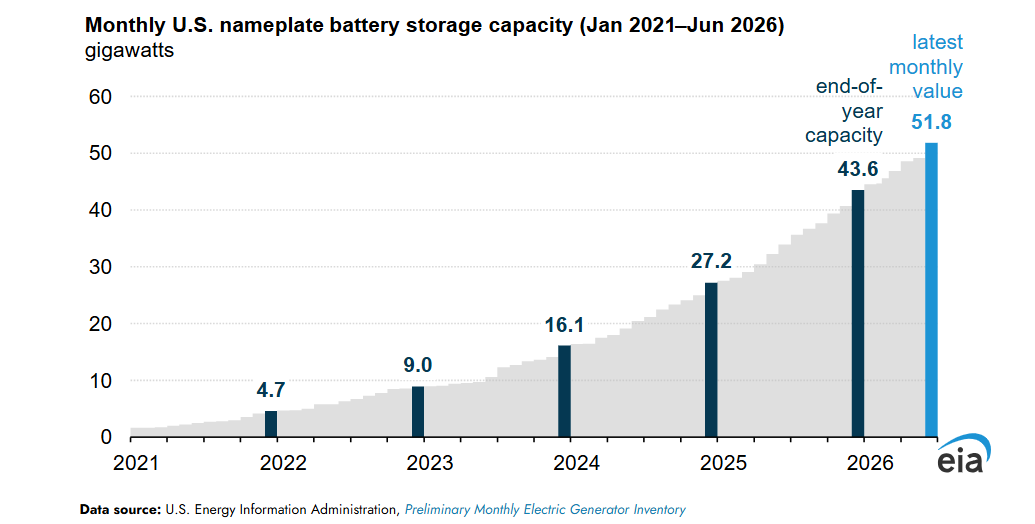
Total deployments marked a 104% jump from the previous quarter, when the Q2 2026 report tallied 9.7GWh of new capacity added, including 7.8GWh of utility-scale BESS. At the distributed end, there was 657MWh of new residential capacity added and 1.8GWh of commercial and industrial (C&I) projects brought online in the quarter.
Adding up the first half of the year’s numbers, nearly 10.3GW/31GWh entered operation at all scales, up 23% in GWh from H1 2025 and again, utility-scale comprised the bulk, with 8.1GW/26GWh of deployments.
Residential energy storage has fundamental underlying drivers for its adoption as homeowners seek to control rising electricity costs, offset the falling value of net metering and protect themselves from blackouts. There may also be market drivers toward increased virtual power plant (VPP) enrolment, according to the report.
Although annual residential installs have roughly doubled since 2023, there has been a sharp year-on-year drop following the Trump administration’s elimination of the 25D residential clean energy credit.
The C&I segment is conversely enjoying growing demand driven by the rapid expansion of data centres and the prominence of battery storage in securing onsite power without increasing grid connection.