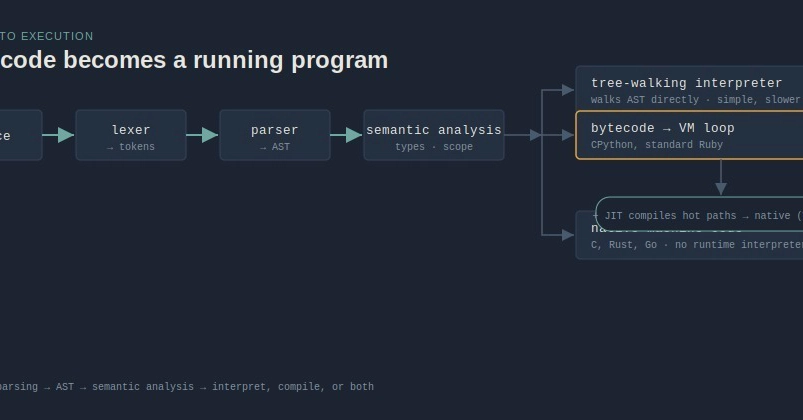
Every developer writes code that "just works" thousands of times without thinking about what happens between hitting save and seeing output on screen. This article pulls back that curtain. We're going to walk through, in real depth, how source code — plain text you typed — becomes a running program, covering lexing, parsing, abstract syntax trees, semantic analysis, and the actual difference between interpretation and compilation (including why that difference is far blurrier than most explanations make it sound).
This is one of those topics where understanding the fundamentals pays off across your entire career — it changes how you read error messages, how you reason about performance, and how you evaluate new languages and tools.
1. The Big Picture: Two Broad Strategies
At the highest level, there are two strategies for running code:
Compilation — translate the entire source program into another form (often machine code, but not always) before running it. The translation and the execution are separate steps.